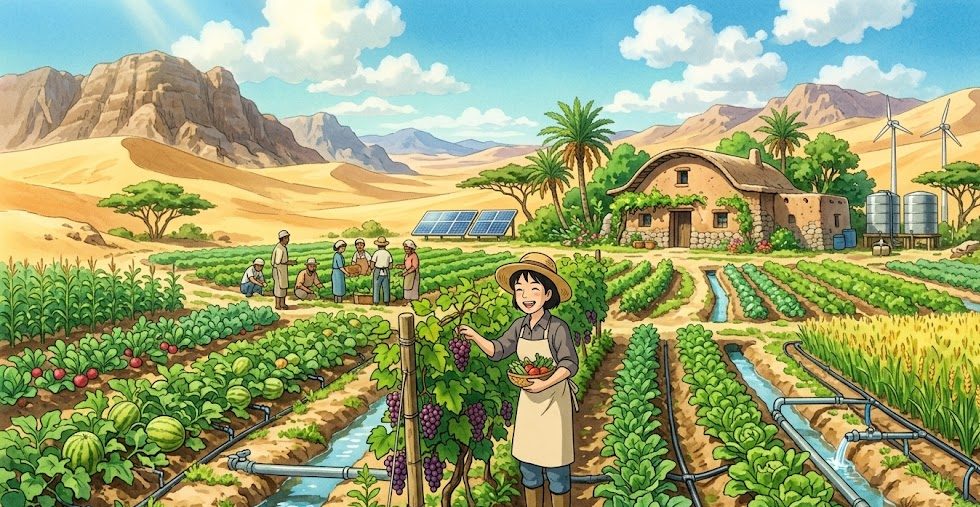
For centuries, the desert was viewed as an inhospitable barrier to agriculture—a place where water was scarce, soils were saline, and the sun was an unrelenting enemy. But in 2026, this narrative has shifted dramatically. With the convergence of precision technology, smart water management, and adaptive crop science, the desert is no longer a barrier; it is one of the most exciting frontiers for high-yield, high-value farming.
For the modern farmer, the desert offers a unique advantage: an abundance of solar energy and the ability to control the growing environment with unprecedented precision. If you are looking to unlock the potential of arid land, you need to stop thinking about “farming in the desert” and start thinking about “managing a controlled production ecosystem.”
Here is your guide to revolutionizing desert agriculture.
1. Water: From Scarcity to Circularity
Water management is the backbone of profitable desert farming. In arid climates, every drop must be treated as a capital asset.
- The Smart Drip Revolution: Forget traditional sprinkler systems that lose 50% of their water to evaporation. Modern drip irrigation systems, integrated with soil moisture sensors and IoT weather stations, deliver precisely what the plant needs, exactly at the root zone. This can reduce water usage by up to 60% while simultaneously increasing yields by 20-30%.
- Water Harvesting and Reuse: Profitable desert farms are becoming circular. Techniques like atmospheric water harvesting can generate fresh water from humidity, while advanced wastewater reclamation allows farmers to treat and reuse greywater for irrigation. By treating your farm as a closed-loop system, you insulate yourself from regional water shortages.
2. Soil-less Systems: The Precision Alternative
When the native soil is saline, depleted, or physically unsuitable for high-value crops, the best strategy is often to bypass it entirely.
- Hydroponics and Aeroponics: These systems represent a disruptive shift in desert agriculture. By growing plants in a neutral medium (like coconut coir) or suspended in mist-fed chambers, you remove the barriers of poor soil health. These systems are highly scalable and can be housed in controlled-environment greenhouses, protecting delicate high-value crops like strawberries, tomatoes, and leafy greens from the harsh desert winds and heat.
- The ROI: Because these are enclosed systems, they require significantly fewer chemical inputs. You are essentially creating a perfect, pesticide-free micro-climate that allows for year-round production.
3. Crop Selection: The “Climate-Resilient” Portfolio
The key to profitability is matching the right genetics to the right environment. You need crops that can handle heat and limited moisture, but that also fetch a premium price in the market.
- The Drought-Tolerant Staples: Crops like Sorghum, Quinoa, and Millet have deep root systems and are highly efficient at nutrient uptake. They are the “workhorses” of the desert, providing stable yields where other crops fail.
- The High-Value Performers:
- Medicinal Plants: Crops like Aloe Vera and Ashwagandha thrive in semi-arid conditions and are in high demand for cosmetics, herbal medicines, and health drinks. They are low-maintenance and highly drought-resistant.
- Specialty Herbs & Greens: Through CEA (Controlled Environment Agriculture), farmers are successfully producing premium herbs like basil, mint, and cilantro, which command high prices at local urban markets.
- Cacti and Succulents: Varieties like Prickly Pear are not just resilient; they are nutritional powerhouses. Their fruits and pads are increasingly popular for their antioxidant profile and fiber content, making them a “set-it-and-forget-it” crop for arid regions.
4. Soil Transformation: Beyond the Sand
If you choose to farm in the ground, you can transform “barren” sand into a productive growing medium through targeted intervention.
- Soil Amendments: Adding organic matter—well-aged compost and manure—is critical. It doesn’t just add nutrients; it builds a “sponge” structure that retains moisture in the root zone.
- Liquid Natural Clay (LNC): An innovative technique where clay is applied to sandy soil to create a stable, nutrient-retaining structure, often reducing water consumption by 50-80%.
- Mulching Strategies: Covering the soil with organic or synthetic materials is mandatory. It reduces evaporation, keeps the ground temperature cooler, and provides vital soil protection against the harsh sun.
5. Leveraging Controlled Environment Agriculture (CEA)
Among the most ambitious techniques in modern desert farming is the use of climate-controlled greenhouses.
- Automated Climate Controls: With AI-driven sensors that dynamically adjust temperatures, humidity, and lighting, you can maximize growth rates and minimize wastage.
- Agrivoltaics: This is a game-changer for arid regions. By growing crops beneath a canopy of solar panels, you generate clean energy while simultaneously creating a shaded micro-climate that reduces water loss for the plants underneath. It’s a dual-use approach that turns a harsh desert into a high-efficiency energy and food production zone.
The Business of Desert Farming
To be profitable in the desert, you must be a specialist. Traditional farmers rely on predictable weather; desert farmers rely on technology and data.
- Market Positioning: Because your produce is often locally grown in an otherwise “barren” environment, you can command a premium. Customers value the freshness, sustainability, and “water-wise” story of desert-grown food.
- Continuous Learning: The desert is a harsh teacher. The most successful desert farmers are those who track every variable—from transpiration rates to nutrient conductivity—and iterate their strategy based on the data.
The Path Forward
Desert agriculture is not a desperate attempt to survive; it is a calculated effort to innovate. As global populations rise and water security becomes the defining challenge of the 21st century, those who learn to harness the potential of the desert will be the true leaders in food security.
Whether you start with a single high-tech greenhouse or scale to a large-scale integrated farm, the principles remain the same: conserve every drop, protect the soil, and leverage technology to optimize growth. The revolution in the desert isn’t coming; it’s already happening, one sensor and one resilient crop at a time.