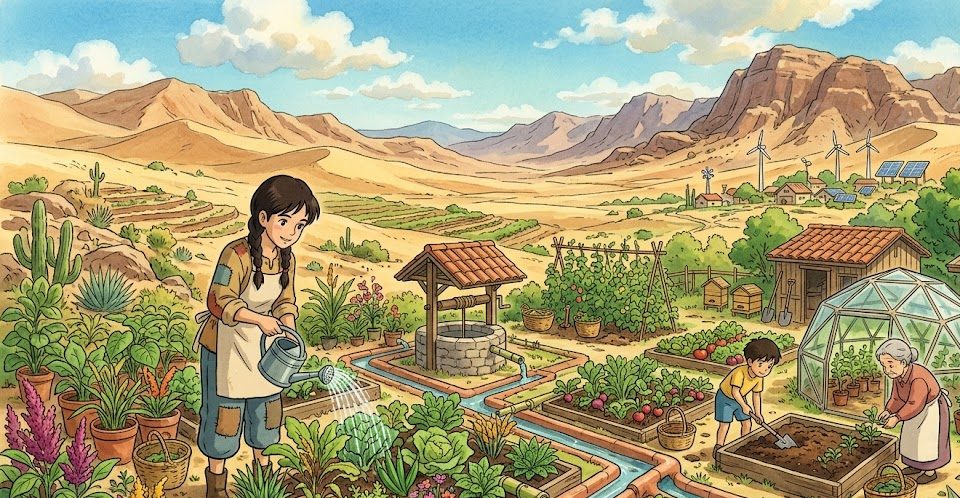
The global food system is under pressure. As fertile land diminishes and water scarcity becomes a reality for millions, the agricultural industry must look toward the fringes for solutions. To build a truly resilient future, we must master the environments we once thought were impossible to cultivate. This masterclass explores the intersection of Desert Farming, the revival of Forgotten Crops, and the efficiency of Micro-Scale Systems.
By understanding these three pillars, we can create a food system that is not only productive but also “Nature-Focused” and adaptable to any climate reality.
1. Desert Farming: Cultivating the Arid Frontier
Desert farming is the ultimate test of agricultural resilience. It requires a shift from “controlling” the environment to “collaborating” with it. In arid regions, every drop of water and every inch of shade is a strategic asset.
Water-Wise Innovation
The heart of desert farming lies in precision water management. Technologies like Subsurface Drip Irrigation deliver water directly to the root zone, reducing evaporation losses to nearly zero. Furthermore, utilizing “Climate Intelligence” allows farmers to schedule irrigation based on real-time atmospheric data, ensuring that plants receive moisture exactly when they need it most.
Soil Restoration in Arid Lands
Desert soil is often depleted or saline. Mastering this environment involves “Healing the Soil Naturally” through the use of biochar, organic compost, and deep-rooted cover crops that can break through compacted layers. These amendments increase the soil’s water-holding capacity, turning barren sand into a functional growing medium over time.
2. Forgotten Crops: The Hidden Keys to Food Security
In our quest for high-yielding monocultures, we have “forgotten” thousands of crop varieties that were once staples of the human diet. These heirloom and ancient crops are the secret weapons of resilient agriculture.
Genetic Resilience
“Forgotten Crops” like millets, amaranth, and certain varieties of pulses have evolved over centuries to thrive in harsh, low-input environments. Unlike modern “High-Yield” seeds that require perfect conditions and heavy chemicals, these crops are naturally resistant to local pests and drought.
Nutritional Diversification
Reviving these crops is not just about survival; it is about health. Many forgotten crops are nutrient powerhouses, offering higher levels of protein, fiber, and essential minerals than common grains. Integrating these into a “Diversified Farming Guide” allows farmers to tap into premium health-conscious markets while building a more stable ecological foundation.
3. Micro-Scale Systems: Efficiency Over Acreage
The Future of Cultivation is not necessarily bigger; it is smarter. Micro-Scale Systems prove that high productivity can be achieved on small footprints through intensive management and smart technology.
Intensive Micro-Farming
Micro-farming focuses on “Bio-Intensive” methods—planting crops in high densities and using vertical space. By focusing on “High-Value Cash Crops” like exotic vegetables or medicinal herbs, a micro-scale operation can often generate more revenue per square foot than a traditional large-scale farm.
The Role of Smart Technology
In a micro-scale system, there is no room for error. Using a Farming Innovation Hub to monitor every variable—from soil pH to light intensity—ensures that the small environment is perfectly optimized. This data-driven approach allows for “Year-Round Agricultural Excellence,” enabling multiple harvests within a single calendar year.
4. Integrating the Masterclass: A Holistic Blueprint
The true power of resilience comes when you integrate these three concepts into a single, cohesive strategy.
- Desert Micro-Farming: Imagine a micro-scale greenhouse in an arid region, using subsurface irrigation to grow drought-resistant forgotten crops. This is the pinnacle of “Smart Crop Farming”.
- Integrated Systems: Combining micro-scale crop production with small livestock or poultry creates a “Circular Economy.” The livestock provide organic fertilizer to heal the desert soil, while the “Forgotten Crops” provide hardy, low-cost feed.
- Healing the Land: By using nature-focused techniques across all three areas, we move beyond just “farming” and toward “restoration.” We are not just taking from the earth; we are building its resilience for the future.
5. The Economic Reality: Turning Resilience into Profit
Agricultural resilience is a powerful business model.
- Lower Input Costs: By using hardy, forgotten crops and precision water tech, you drastically reduce your spending on fertilizers, pesticides, and water.
- Niche Market Advantage: Being a “Livestock Specialist” or an “Exotic Vegetable” expert in a harsh environment allows you to command premium prices due to the unique nature of your produce.
- Sustainable Branding: Today’s consumers are looking for “Farm-to-Fork” transparency. A farm that can prove it is healing the soil and using smart technology to save water has a massive competitive edge.
Conclusion: Mastering the New Agricultural Era
Resilience in Agriculture is not a luxury; it is a necessity. By mastering Desert Farming, reviving Forgotten Crops, and embracing Micro-Scale Systems, we are preparing ourselves for the challenges of the digital frontier and a changing climate.
The journey from a traditional grower to a resilient master cultivator requires curiosity, technology, and a deep respect for natural cycles. Whether you are healing a small patch of soil or managing a high-tech innovation hub, the goal remains the same: to grow with intelligence, to produce with purpose, and to thrive against all odds.
SEO Meta Details:
- Focus Keyword: Resilience in Agriculture
- Secondary Keywords: Desert Farming, Forgotten Crops, Micro-Scale Farming, Sustainable Agriculture, Smart Crop Management.
- Meta Description: Master the pillars of agricultural resilience. Explore expert strategies for desert farming, reviving forgotten crops, and optimizing micro-scale systems for a sustainable future.