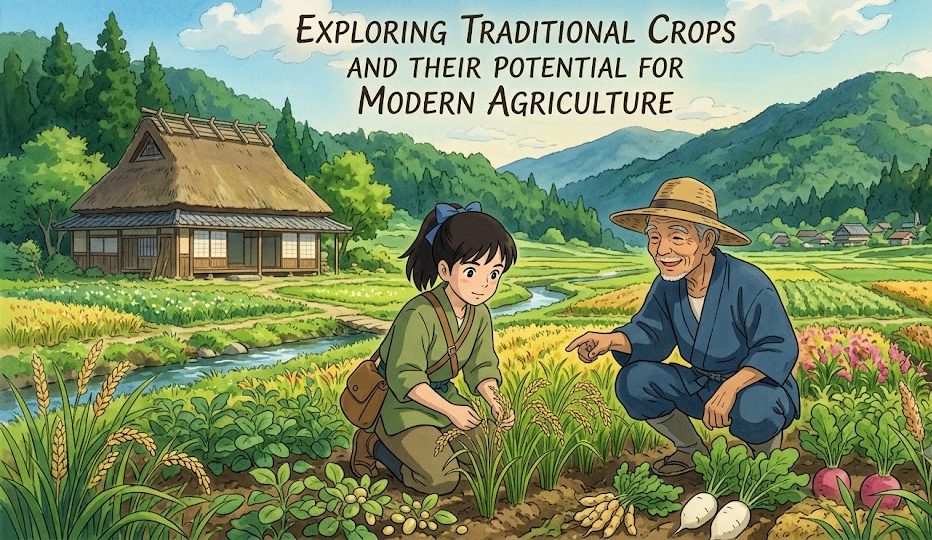
For thousands of years, farmers have grown crops adapted to their local climate, soils, water availability, and food traditions. Many of these crops were once important parts of regional agriculture but gradually became less common as farming systems became more focused on a smaller number of widely traded crops.
Today, some of these lesser-grown or traditional crops are receiving renewed attention. Farmers, researchers, food producers, and consumers are exploring whether these crops can contribute to more diverse and resilient agricultural systems.
These crops are sometimes described as forgotten crops, heritage crops, traditional crops, minor crops, or underutilized crops. The exact definition varies, but the basic idea is similar: they are plants that have historically been cultivated and used but are now less widely grown than major commodity crops.
Their revival is not simply about returning to old farming methods. Modern agriculture can combine traditional crop knowledge with improved varieties, irrigation systems, soil testing, storage technology, food processing, and modern markets.
What Are Forgotten Crops?
There is no single universal list of forgotten crops.
A crop may be considered underutilized because it is grown only in a particular region, has been replaced by more commercial varieties, is mainly consumed locally, or has received relatively little investment in large-scale agricultural research.
Examples can include different types of:
- Millets
- Sorghum
- Buckwheat
- Amaranth
- Teff
- Fonio
- Cowpeas
- Pigeon peas
- Bambara groundnut
- Traditional beans
- Heritage grains
- Regional leafy vegetables
- Indigenous fruit crops
Some of these crops are still widely cultivated in certain parts of the world. Calling them “forgotten” therefore depends heavily on geography.
A crop that is uncommon in one country may be an important agricultural product somewhere else.
Why Did Traditional Crops Decline?
Several factors contributed to the decline of many traditional crops.
Modern agricultural systems often favored crops with established supply chains, predictable markets, mechanized production systems, standardized varieties, and strong demand from food processors.
As a result, farmers sometimes replaced diverse local crops with a smaller number of commercially dominant crops.
Other factors included:
Changing diets: Consumers increasingly adopted foods that were widely available through modern supply chains.
Mechanization: Some traditional crops were not well suited to large-scale mechanical harvesting.
Market access: Farmers were more likely to grow crops with reliable buyers.
Agricultural policy: Research and investment often focused on major commodity crops.
Processing infrastructure: A crop may be difficult to sell if local milling, storage, or processing facilities are unavailable.
Urbanization: Traditional food knowledge can decline when people move away from rural communities.
This does not mean traditional crops disappeared completely. Many survived in small farms, household gardens, local markets, and cultural food traditions.
Why Are Forgotten Crops Becoming Interesting Again?
Interest in traditional crops has increased for several reasons.
One is agricultural diversity.
Growing several types of crops can provide farmers with alternatives when weather conditions, pests, diseases, or market prices affect one crop.
Another reason is climate adaptation.
Some traditional crops evolved or were selected under challenging local conditions. Certain varieties can tolerate heat, poor soils, short growing seasons, or irregular rainfall better than crops introduced from wetter environments.
However, not every traditional crop is automatically drought-tolerant or climate-resilient. Performance still depends on the specific variety and growing environment.
Millets and Other Hardy Grains
Millets are a useful example of crops that have received renewed attention.
Different millet species have been cultivated in Africa and Asia for centuries. They can be valuable in regions where farmers need crops adapted to relatively challenging growing conditions.
Examples include:
- Pearl millet
- Finger millet
- Foxtail millet
- Proso millet
- Little millet
- Barnyard millet
Different species have different characteristics, so farmers should select varieties according to local climate, soil, growing period, and market demand.
Modern interest in millet products has also created opportunities for flour, breakfast foods, baked products, snacks, and other processed foods.
Sorghum: An Old Crop With Modern Uses
Sorghum is another crop with a long agricultural history.
It is cultivated in many dry and semi-arid regions and can be used for food, animal feed, and other applications.
Food-grade sorghum can be processed into flour or incorporated into various traditional and modern foods.
Its ability to perform in relatively warm and dry environments makes it relevant to agricultural systems where water availability is limited.
However, farmers still need to consider rainfall patterns, soil conditions, pests, market demand, and suitable varieties.
Buckwheat and Short-Season Agriculture
Buckwheat is not a true cereal grain, although it is commonly used in similar ways.
It has a relatively short growing period and can be useful in some crop rotations.
Its seeds can be milled into flour and used in various foods.
Farmers considering buckwheat should evaluate local temperatures and frost conditions because suitability varies significantly by region.
Its role in agriculture can extend beyond food production. In some systems, flowering buckwheat can also provide resources for pollinating insects.
Amaranth: Grain and Leafy Vegetable
Amaranth includes species grown both for edible leaves and grain.
Certain varieties have long histories of cultivation in different regions, including parts of the Americas, Africa, and Asia.
Young leaves can be used as vegetables, while some species produce small seeds that can be processed into food.
This flexibility makes amaranth interesting for diversified farms.
However, farmers should distinguish between different amaranth species and varieties because their characteristics and uses can vary considerably.
Legumes With Agricultural Potential
Several traditional legumes deserve attention because legumes can play multiple roles in farming systems.
Examples include:
- Cowpeas
- Pigeon peas
- Bambara groundnuts
- Traditional beans
- Lentil varieties
- Chickpea varieties
Legumes can provide food while also contributing to crop diversification.
Many legumes form relationships with soil bacteria that help convert atmospheric nitrogen into forms plants can use. The effectiveness of this process depends on the crop, bacterial associations, soil conditions, and management.
Adding legumes to a crop rotation can therefore provide both production and soil-management benefits in appropriate systems.
Traditional Crops and Biodiversity
Agricultural biodiversity refers to the variety of crops, varieties, livestock, and other organisms associated with farming systems.
A farm that grows only one crop may be highly dependent on that crop’s performance.
A diversified farm may have several sources of food or income.
For example, a farmer could potentially combine:
Grain crops + legumes + vegetables + fruit trees
The exact combination depends on climate, available land, labor, markets, and farm objectives.
Crop diversity does not eliminate agricultural risk, but it can provide additional options when conditions change.
Traditional Knowledge Has Value
One of the most important aspects of forgotten crops is the knowledge surrounding them.
Farmers may know:
- When to plant particular varieties
- How to select seeds
- Which soils work best
- How to store harvested grain
- Which parts of the plant are edible
- How crops respond to local weather
- Which traditional foods can be prepared from them
This knowledge can be passed between generations.
When a crop disappears from cultivation, knowledge about its production and use can disappear with it.
Modern agricultural research can complement this traditional knowledge by testing varieties, documenting characteristics, improving cultivation techniques, and identifying new markets.
Seed Preservation and Local Varieties
Traditional crop varieties can be important genetic resources.
Farmers and seed organizations may maintain local varieties because they contain characteristics that could become valuable under changing environmental or market conditions.
Seed preservation can involve:
- Community seed banks
- Agricultural research collections
- Proper on-farm seed selection
- Regional conservation programs
- Documenting traditional varieties
Farmers should also follow applicable seed regulations and use reliable sources when obtaining planting material.
Preserving a variety does not necessarily mean it will become a major commercial crop. It means keeping potentially useful agricultural diversity available for future generations.
The Commercial Challenge
Growing an unusual crop is not automatically profitable.
A farmer may successfully produce a traditional crop but struggle to find buyers.
This is one of the biggest challenges facing crop diversification.
Before planting commercially, farmers should investigate:
- Local demand
- Wholesale buyers
- Retail opportunities
- Processing facilities
- Transportation costs
- Storage requirements
- Expected market price
- Seed availability
- Harvesting requirements
A crop with strong consumer interest but no nearby processing or distribution infrastructure may still be difficult to commercialize.
Creating Value Beyond the Raw Crop
One way to improve the commercial potential of traditional crops is through value-added products.
Instead of selling raw grain, a producer or food business might develop:
- Flour
- Breakfast products
- Baked goods
- Snack foods
- Ready-to-cook mixes
- Specialty ingredients
- Packaged traditional foods
Value-added processing can create additional revenue opportunities, but it also introduces new costs and regulatory requirements.
Food businesses must consider labeling, food safety, packaging, shelf life, processing equipment, and local regulations.
Forgotten Crops and Modern Food Trends
Consumer interest can influence agricultural demand.
Modern shoppers increasingly encounter products positioned around traditional ingredients, regional foods, diverse grains, and alternative ingredients.
Restaurants and specialty food producers can also create new markets for crops that were previously sold mainly through local channels.
This does not mean every traditional crop will become a major commercial product.
Instead, the opportunity may lie in smaller specialty markets where customers value distinctive ingredients and cultural food traditions.
How Farmers Can Experiment Safely
Farmers interested in forgotten crops do not necessarily need to convert their entire farm immediately.
A small trial plot can provide valuable information.
A practical trial might compare:
- Two or three varieties
- Different planting dates
- Irrigation levels
- Soil conditions
- Yield
- Pest pressure
- Labor requirements
- Harvest timing
Farmers can record the results and compare them with established crops.
This reduces the risk of making a large investment based only on theoretical potential.
Combining Traditional Crops With Modern Technology
Traditional crops do not require traditional farming methods exclusively.
Modern technology can help improve their production.
For example:
Soil testing can identify nutrient and pH conditions.
Weather monitoring can improve planting decisions.
Drip irrigation can improve water delivery where irrigation is appropriate.
Precision equipment can help manage inputs.
Crop monitoring tools can identify areas of poor growth.
Digital marketplaces can connect specialty producers with customers.
This combination of traditional crop diversity and modern management can create new possibilities for farmers.
Challenges Farmers Should Consider
Before adopting a forgotten crop, several questions deserve attention.
Is the climate suitable?
Historical performance in another region does not guarantee success locally.
Is quality seed available?
Reliable planting material is essential for consistent production.
Can the crop be harvested efficiently?
A crop requiring expensive manual harvesting may be difficult to scale.
Is there a market?
Production should be connected to realistic demand.
Does the crop fit existing equipment?
Specialized equipment may increase costs.
Can the crop be stored?
Storage requirements can affect profitability and food quality.
Are buyers available?
A good harvest has limited value if it cannot reach a suitable market.
A Practical Model for Crop Revival
Reviving a traditional crop can be approached as a gradual process:
Discover: Identify traditional crops historically grown in the region.
Document: Record local knowledge, varieties, growing conditions, and traditional uses.
Test: Grow small quantities under controlled farm conditions.
Measure: Compare yield, water requirements, labor, and production costs.
Develop: Identify food products and potential buyers.
Market: Tell consumers what makes the crop distinctive and useful.
Scale: Expand production only after demand and farm performance have been demonstrated.
This process can help avoid turning an interesting agricultural idea into an expensive experiment without a market.
The Future of Forgotten Crops
The future of traditional crops is unlikely to involve simply replacing major crops with older varieties.
Instead, their greatest potential may come from diversification.
A modern farm could continue producing major commercial crops while also experimenting with selected traditional varieties that offer different characteristics.
Researchers may also use traditional crop genetics to develop improved varieties better suited to future growing conditions.
Food companies can explore new products, while farmers can test specialty markets.
Consumers ultimately influence which crops remain economically viable.
Final Thoughts
Forgotten and underutilized crops represent more than agricultural history. They can provide opportunities for crop diversification, local food production, genetic conservation, specialty markets, and potentially more resilient farming systems.
Their revival should be approached carefully. A traditional crop is not automatically easier to grow, more profitable, or better suited to modern agriculture.
The most useful approach is to combine the knowledge developed by farmers over generations with modern soil testing, crop research, irrigation technology, processing, market analysis, and farm management.
For farmers, the opportunity may begin with a small trial rather than a complete change in production. For food businesses, it may involve turning a traditional ingredient into a useful modern product. For consumers, it can mean discovering foods and agricultural traditions that might otherwise disappear.
The real potential of forgotten crops lies not simply in bringing old crops back, but in finding thoughtful ways to give them a practical role in the agriculture of the future.