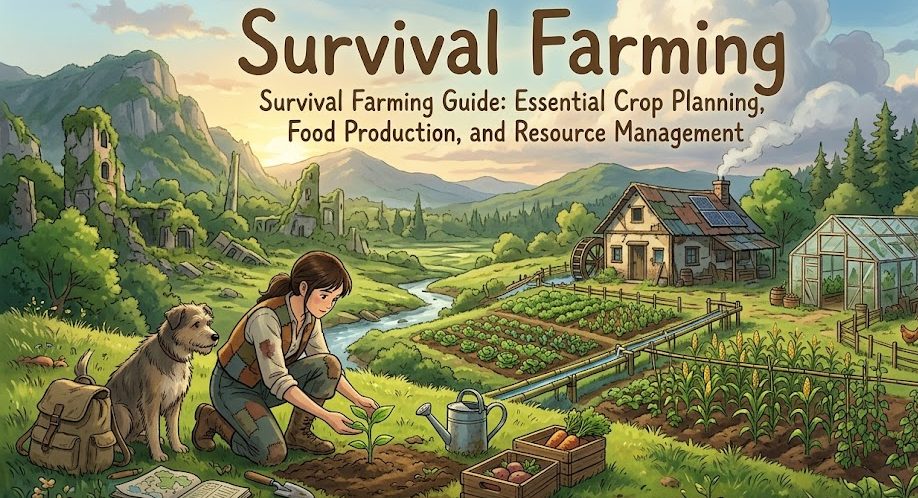
Survival farming is the practice of growing food and managing basic agricultural resources with a strong focus on self-reliance, resilience, and long-term food production. Unlike conventional farming, where the main objective may be commercial sales, survival farming is primarily concerned with maintaining a dependable source of food and useful resources.
A survival farm does not have to be large. A backyard, small rural property, homestead, or larger farm can all use survival-farming principles.
The key is planning around the resources that are actually available.
A successful system considers what crops can grow locally, how much water is available, how food can be stored, how soil fertility will be maintained, and how much labor the household can realistically provide.
Survival farming is not about growing every possible crop. It is about creating a practical food-production system that continues to function when weather, supply chains, prices, or other outside conditions become less predictable.
Start With the Food You Actually Eat
The first step in survival farming should be surprisingly simple: make a list of the foods your household regularly consumes.
Instead of selecting crops based on popularity, begin with your own meals.
A household might regularly use:
- Potatoes
- Beans
- Tomatoes
- Onions
- Carrots
- Squash
- Leafy greens
- Peppers
- Corn
- Herbs
- Fruits
The exact list will vary from one household to another.
This approach prevents a common problem: growing a large amount of food that nobody actually wants to eat.
Once the preferred foods are identified, divide them into categories based on how they are grown and stored.
Think in Terms of a Food System
A survival farm is more than a vegetable garden.
A complete food system can include:
Growing → Harvesting → Preserving → Storing → Using → Saving seed → Replanting
Each part supports the next.
For example, growing vegetables provides fresh food. Preserving excess harvest extends its usefulness. Saving suitable seeds can support future production. Composting plant residues can return organic material to the soil.
The goal is to reduce dependence on outside inputs while maintaining a productive cycle.
Evaluate the Land First
Before planting, understand the property.
Identify areas with:
- Full sunlight
- Partial shade
- Poor drainage
- Good drainage
- Strong wind exposure
- Easy water access
- Existing trees
- Fertile soil
- Compacted soil
- Slopes
- Potential growing areas
A simple property map can make planning much easier.
Do not assume that every available area should become a garden.
Paths, storage, composting, water collection, tool areas, and food-processing spaces are also part of the farm.
Test the Soil
Healthy soil is one of the most important long-term resources on a survival farm.
A soil test can provide information about pH and nutrient levels while helping identify potential problems.
Farmers should also observe physical soil characteristics.
Is the soil:
- Sandy?
- Clay-heavy?
- Compacted?
- Well-drained?
- Low in organic matter?
- Prone to erosion?
Different crops tolerate different soil conditions, but most productive gardens benefit from good structure, adequate nutrients, and sufficient biological activity.
Improving soil is a long-term project rather than a one-time task.
Plan the Water Supply Before Planting
Water is often the limiting resource in food production.
A survival farm should have a clear understanding of its reliable water sources.
Potential sources may include:
- Wells
- Stored water
- Rainwater where legally and practically appropriate
- Surface water
- Municipal supply
- Irrigation systems
Water planning should include both normal conditions and periods when rainfall is lower than expected.
Efficient irrigation can reduce waste.
Drip irrigation, soaker systems, mulching, and careful watering schedules can help direct water toward plant roots.
Water storage may also provide additional resilience, depending on local conditions and regulations.
Choose Crops for Reliability
A survival garden should prioritize dependable food production.
That does not necessarily mean choosing only the fastest-growing crops.
Consider:
- Climate tolerance
- Growing season
- Water requirements
- Storage life
- Ease of cultivation
- Seed availability
- Harvest reliability
- Household usefulness
Some crops are valuable because they provide calories or store well.
Others are valuable because they provide fresh produce throughout the growing season.
A balanced crop plan should include both.
Grow a Mix of Fresh and Storage Crops
Fresh vegetables are important, but many crops have relatively short storage lives.
Survival farming benefits from combining crops that can be eaten immediately with crops that can be stored for longer periods.
Storage-friendly crops may include suitable varieties of:
- Potatoes
- Sweet potatoes
- Winter squash
- Dry beans
- Onions
- Garlic
- Carrots
- Certain grains
Storage requirements vary by crop.
Temperature, humidity, ventilation, darkness, and physical handling can affect how long food remains usable.
Use Succession Planting
Succession planting helps spread production across the season.
Instead of planting an entire crop at one time, farmers can make multiple plantings when local conditions allow.
This can provide a more continuous supply of:
- Lettuce
- Radishes
- Greens
- Beans
- Herbs
- Certain vegetables
Succession planting also reduces the risk of losing the entire crop at one time.
If one planting experiences poor weather, another planting may still produce later.
Include Multiple Planting Seasons
A strong survival-farming system should not depend entirely on one planting window.
Where the climate allows, farmers can divide the growing year into several periods.
A simplified system might include:
Early season → Main growing season → Late season → Winter production or storage
Cool-season crops and warm-season crops have different environmental requirements.
Understanding local frost dates and seasonal temperature patterns helps determine when different crops should be planted.
Save Seeds When Practical
Seed saving can reduce dependence on outside suppliers.
However, not every crop is equally easy to save seed from.
Farmers should learn which crops:
- Produce useful seed in the same growing season
- Cross-pollinate easily
- Require isolation
- Need specific harvesting methods
- Maintain variety characteristics reliably
Seeds should be properly dried, labeled, and stored.
A basic seed record should include the crop name, variety, year harvested, and any observations about plant performance.
Build Soil Fertility Without Constantly Buying Inputs
Long-term survival farming requires a plan for soil fertility.
If nutrients are repeatedly removed through harvest, they eventually need to be replaced.
Organic materials can help maintain soil health.
Possible resources include:
- Compost
- Crop residues
- Leaves
- Grass clippings when appropriate
- Animal manure that has been properly managed
- Cover crops
Composting can turn many suitable organic materials into a useful soil amendment.
Farmers should avoid using contaminated materials or poorly managed manure on food-growing areas.
Use Crop Rotation
Growing the same crop repeatedly in the same location can increase certain pest and disease problems and place repeated demands on the soil.
Crop rotation changes the sequence of plants grown in each area.
For example:
Legume → Leafy crop → Root crop → Fruit crop → Cover crop
The exact rotation should be adapted to local crops and growing conditions.
Rotation also gives farmers an opportunity to manage soil structure and nutrient demands over time.
Grow Some Crops for Seed and Some for Food
If self-reliance is a major goal, a portion of the garden can be dedicated to seed production.
This is different from harvesting every plant as food.
Seed plants need to remain in the ground long enough to produce mature seed.
Farmers should select healthy plants with desirable characteristics and keep accurate records.
Over time, this can create a locally adapted seed supply.
Consider Perennial Food Crops
Annual vegetables need to be replanted every year.
Perennial crops can continue producing for multiple years once established.
Depending on the climate, a survival farm might include:
- Fruit trees
- Berry plants
- Asparagus
- Perennial herbs
- Nut trees
- Other locally suitable perennial food plants
Perennials require more initial planning because they occupy space for a long period.
Their placement should therefore be considered carefully.
Keep a Protected Growing Area
A small greenhouse, high tunnel, cold frame, or other suitable protected structure can extend the growing season.
Protected growing areas may be useful for:
- Starting seedlings
- Protecting plants from frost
- Growing sensitive crops
- Producing greens during colder periods
- Maintaining a nursery area
A protected space does not need to be large to be useful.
The most important consideration is whether it solves a real production problem.
Maintain a Food Preservation System
Producing food is only half of the equation.
If a garden produces more than the household can eat immediately, the excess needs to be handled properly.
Common preservation methods include:
- Freezing
- Drying
- Dehydrating
- Fermentation
- Root-cellar-style storage
- Canning using safe, tested procedures
Food preservation should always follow appropriate safety practices.
Improperly preserved food can become unsafe even when it looks normal.
A survival-farming plan should therefore include preservation skills alongside growing skills.
Build a Practical Pantry
A pantry provides another layer of resilience.
Shelf-stable foods can complement fresh garden production.
Depending on household preferences, a pantry might contain:
- Dried beans
- Rice
- Grains
- Pasta
- Flour
- Salt
- Cooking oils
- Shelf-stable ingredients
- Properly stored preserved foods
The goal is not to eliminate all outside purchasing.
Instead, the pantry and garden can work together to reduce dependence on constant fresh-food purchases.
Consider Livestock Carefully
Animals can become part of a survival farm, but they require significantly more resources than many people expect.
Possible livestock systems include:
- Chickens
- Ducks
- Goats
- Sheep
- Rabbits
- Other locally appropriate animals
Before keeping animals, consider:
- Feed requirements
- Water
- Housing
- Fencing
- Veterinary care
- Predator protection
- Waste management
- Daily labor
Animals should be added only when the household has the capacity to care for them consistently.
Use Farm Waste as a Resource
A self-reliant farm should look for ways to reuse suitable materials.
Crop residues can become compost or mulch.
Leaves can contribute to compost.
Certain animal manures can be properly composted and returned to the soil.
Damaged but safe plant material may be used in appropriate composting systems rather than discarded.
Resource cycling reduces waste and can reduce dependence on purchased inputs.
Build a Simple Tool System
Survival farming does not require every piece of modern agricultural machinery.
A basic collection of reliable tools can handle many small-scale tasks.
Useful equipment may include:
- Hand pruners
- Shovels
- Hoes
- Rakes
- Garden forks
- Wheelbarrows
- Harvest containers
- Hoses
- Irrigation equipment
- Seed-starting supplies
Tools should be maintained and stored properly.
A broken tool during an important planting or harvesting period can create unnecessary delays.
Keep Backup Plans for Important Crops
Agriculture is inherently uncertain.
A crop may fail because of:
- Drought
- Excess rainfall
- Frost
- Heat
- Pests
- Disease
- Poor germination
- Animal damage
For important food crops, consider having more than one strategy.
This could mean planting different varieties, using multiple growing locations, or maintaining a second planting window where the climate allows.
Diversification can reduce the consequences of a single crop failure.
Protect the Garden From Animals
Wildlife can cause significant damage to food gardens.
Depending on the area, protection may be needed against:
- Deer
- Rabbits
- Birds
- Rodents
- Insects
- Other animals
Fencing and physical barriers are often among the most dependable protection methods.
The correct approach depends heavily on the animals present in the region.
Regular inspection is important because a small opening in a fence can quickly become a major problem.
Learn to Observe Plants
A survival farmer needs to become comfortable reading the garden.
Plants communicate problems through visible changes.
Look for:
- Yellowing leaves
- Wilting
- Stunted growth
- Leaf damage
- Unusual spots
- Poor flowering
- Weak stems
- Root problems
Early observation can prevent small problems from becoming large losses.
Walking through the growing area regularly is one of the simplest and most valuable farm-management habits.
Track Food Production
Records make a survival farm more reliable over time.
Record:
- Planting dates
- Varieties
- Harvest quantities
- Crop failures
- Seed performance
- Water usage
- Weather conditions
- Preservation quantities
- Storage performance
At the end of each season, review the records.
Ask:
What produced enough food?
What required too much work?
What failed?
What should be planted more heavily next year?
This turns each season into a learning cycle.
Create a Balanced Garden
A survival garden should not consist entirely of one crop type.
A balanced system can include several categories:
Calorie Crops
Crops that provide substantial food energy and may store well.
Fresh Vegetables
Crops that provide fresh produce during the growing season.
Protein-Oriented Crops
Beans, peas, and other suitable crops can contribute useful plant protein.
Flavor Crops
Herbs, onions, garlic, and other ingredients can make basic foods more useful.
Fruits
Perennial and annual fruit crops can add variety.
Storage Crops
Crops selected specifically for longer storage can extend food availability beyond harvest season.
Plan Around Your Household’s Capacity
Survival farming can become overwhelming if the system is larger than the available labor.
A garden that requires several hours of work every day may not be sustainable for a household with full-time jobs or other responsibilities.
Start with a manageable area.
Improve the system.
Then expand gradually.
Efficiency often comes from better design rather than simply working harder.
A Practical Survival Farming Framework
A simple framework can help organize the entire operation:
1. Feed
Identify the foods your household actually needs.
2. Grow
Choose reliable crops suited to local conditions.
3. Protect
Manage water, pests, weather, and animals.
4. Preserve
Store or preserve excess production safely.
5. Reuse
Return suitable organic resources to the farm.
6. Save
Maintain seeds, tools, food, and useful records.
7. Improve
Use each season’s experience to make the next one better.
This framework keeps survival farming focused on practical resilience rather than unnecessary complexity.
Common Survival Farming Mistakes
One common mistake is trying to become completely self-sufficient immediately.
A more realistic approach is gradual improvement.
Another mistake is growing too many crops.
A large crop list can make seed management, watering, harvesting, and preservation difficult.
Ignoring food storage is another problem.
A large harvest is not very useful if it cannot be safely stored or preserved.
Farmers may also underestimate water needs, animal-care requirements, or the labor required to maintain a large garden.
The best system is one that the household can consistently operate.
Final Thoughts
Survival farming is fundamentally about resilience.
It combines crop production, soil management, water conservation, food preservation, seed saving, storage, and resource planning into one connected system.
The goal does not have to be complete independence from the outside world. Even producing a meaningful portion of a household’s food can provide valuable flexibility and practical knowledge.
The strongest survival farms are built gradually.
Start by understanding the land. Identify the foods that matter most. Grow reliable crops. Improve the soil. Develop efficient water management. Learn preservation techniques. Save useful seeds. Keep records. Then expand as experience and resources allow.
Over time, the farm becomes more than a garden. It becomes a food-production system designed around the household, the local environment, and the resources available.