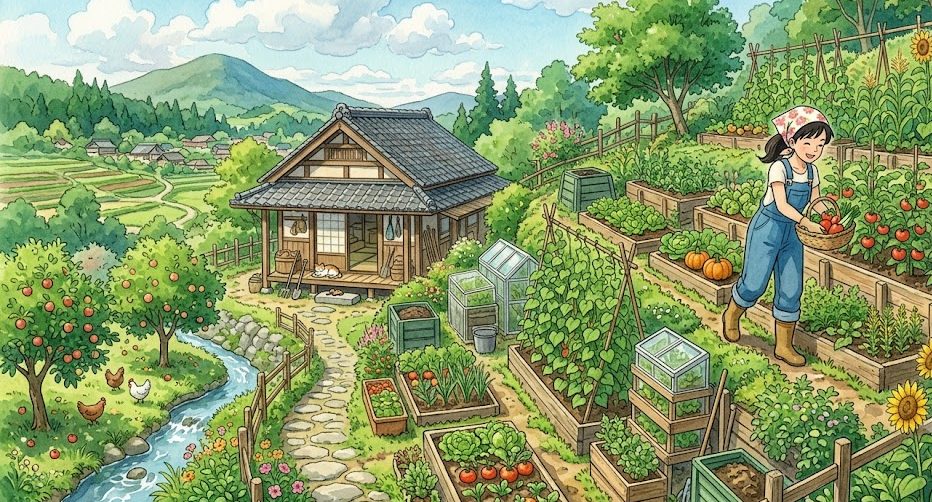
Micro farming is a practical approach to growing crops, herbs, vegetables, and other useful plants on a relatively small piece of land. Instead of depending on large fields, micro farms focus on making efficient use of limited space through careful crop selection, organized planting, intensive growing methods, and efficient resource management.
A micro farm can operate in a backyard, small urban plot, community garden, rooftop where structurally appropriate, greenhouse, or other suitable growing space. The scale may be small, but thoughtful planning can make these spaces surprisingly productive.
Micro farming can also be useful for people who want to learn agriculture without making a large investment. A small growing area allows beginners to experiment with crops, irrigation, soil improvement, and harvesting before expanding.
What Is Micro Farming?
Micro farming generally refers to small-scale agricultural production designed to make productive use of limited land and resources.
There is no universal land-size limit that defines a micro farm. The important characteristic is the scale and management approach.
A micro farm may focus on:
- Fresh vegetables
- Culinary herbs
- Salad greens
- Seedlings
- Flowers
- Specialty crops
- Mushrooms
- Container-grown plants
- Small fruit crops
- Eggs or other farm products where local regulations permit
Some micro farms grow food primarily for household use, while others operate as small businesses.
The objective is usually not to produce enormous quantities. Instead, the goal is to make a limited area productive and manageable.
Why Small-Space Farming Is Becoming More Popular
Land availability is a major challenge for many new growers.
Large agricultural properties can require substantial capital, while small plots may be more accessible.
Micro farming offers several potential advantages:
Lower starting scale: A person can begin with a relatively small growing area.
Practical learning: Beginners can gain hands-on experience without managing hundreds of acres.
Fresh production: Crops can be harvested close to where they are consumed.
Flexible crop selection: Small farms can focus on specialty crops rather than commodity production.
Efficient space use: Vertical growing, succession planting, containers, and raised beds can increase productivity per unit of land.
However, small-scale farming is still real farming. Labor, water, pests, weather, soil fertility, marketing, and operating costs all matter.
Start With a Site Assessment
Before buying seeds or equipment, examine the available space.
Look at:
- Total growing area
- Sunlight exposure
- Water access
- Drainage
- Soil condition
- Wind exposure
- Accessibility
- Storage space
- Local regulations
- Existing structures
Sunlight is particularly important.
Many vegetables require several hours of direct sunlight to grow well, although exact requirements vary by crop.
Observe the site throughout the day rather than assuming that an area is sunny simply because it looks bright.
A simple sketch of the property can help identify the best locations for beds, containers, paths, irrigation lines, and storage.
Decide What You Want the Farm to Produce
A common mistake is trying to grow too many crops at once.
A small farm benefits from a clear purpose.
For example, one micro farm might focus on salad greens, while another specializes in culinary herbs.
Possible categories include:
Fast-Growing Vegetables
These may include lettuce, radishes, certain Asian greens, and other crops suited to short production cycles.
Herbs
Basil, parsley, cilantro, mint, rosemary, thyme, and other herbs can work well in appropriate climates.
Specialty Crops
Some small farms focus on unusual vegetables, edible flowers, specialty peppers, or heritage varieties.
Seedlings
Producing healthy transplants for gardeners can be another small-scale business opportunity.
The right crop depends on local climate, customer demand, growing space, and available labor.
Use Raised Beds to Organize Space
Raised beds can make small farms easier to organize.
Instead of planting randomly across an entire garden, growers can divide the space into manageable production units.
A simple layout might include:
Bed 1: Leafy greens
Bed 2: Root crops
Bed 3: Herbs
Bed 4: Seasonal vegetables
Paths between beds provide access for planting, harvesting, watering, and maintenance.
The exact dimensions should allow the grower to reach the center of each bed without stepping onto the growing soil.
This protects soil structure and makes routine work easier.
Container Farming
Containers can turn otherwise unused spaces into productive growing areas.
Suitable containers may include purpose-designed planters, large pots, grow bags, and other food-safe options appropriate for growing.
Containers can be useful when:
- Ground soil is poor
- Space is limited
- A rental property cannot be permanently modified
- Different crops require different soil mixes
- Mobility is important
The main challenge is moisture management.
Containers generally dry out faster than larger areas of ground soil, particularly during hot weather.
They therefore need appropriate drainage and careful irrigation.
Vertical Farming for Small Spaces
When horizontal space is limited, growers can make use of vertical structures.
Vertical growing can involve:
- Trellises
- Stacked planters
- Wall-mounted systems
- Shelving
- Climbing supports
- Hanging containers
Climbing crops such as beans, peas, cucumbers, and some squash varieties can be trained vertically where suitable.
This can improve the use of available space, although the structure must be strong enough to support mature plants and withstand wind.
Vertical growing should also preserve access for harvesting and maintenance.
Succession Planting
One of the most useful techniques for small farms is succession planting.
Instead of planting an entire bed once and waiting for the crop to finish, a grower can stagger planting dates.
For example:
Week 1: Plant the first section.
Week 3: Plant another section.
Week 5: Plant another section.
This can create a more continuous harvest.
Succession planting is particularly useful for crops with relatively short growing periods.
It can also reduce the problem of having an entire crop mature simultaneously.
Intercropping and Companion Planting
Intercropping means growing different crops together rather than dedicating every area to a single crop.
For example, a grower might combine a taller crop with a shorter crop if their growth patterns are compatible.
Companion planting is another popular gardening concept, although claims about specific plant combinations should be treated carefully and based on reliable agricultural information.
The practical objective should be simple: use space efficiently without creating excessive competition for light, water, and nutrients.
Soil Management Is Critical
Small farms cannot afford to ignore soil health.
Healthy soil supports root development, water management, nutrient availability, and biological activity.
Before adding fertilizers or amendments, consider testing the soil.
A soil test can provide useful information about:
- pH
- Nutrient levels
- Organic matter
- Salinity in some testing systems
Possible soil-management practices include adding suitable organic matter, reducing unnecessary disturbance, maintaining plant residues where appropriate, and rotating crops.
Avoid adding large amounts of fertilizer simply because a crop is expected to grow quickly. Excess nutrients can damage plants and contribute to environmental problems.
Efficient Watering
Water management becomes particularly important when many plants are concentrated into a small area.
Hand watering can work for very small operations, but drip irrigation or other efficient systems may make larger micro farms easier to manage.
A good irrigation system should deliver water where plants need it while minimizing unnecessary losses.
Useful practices include:
- Watering according to crop needs
- Checking soil moisture
- Mulching where appropriate
- Repairing leaks quickly
- Irrigating during suitable times of day
- Separating crops with different water requirements
Automated irrigation can save time, but it should not replace observation. Sensors and timers can fail, and crop requirements change throughout the season.
Crop Rotation in a Small Farm
Even a tiny growing area can benefit from crop rotation.
Growing the same plant family repeatedly in the same soil can increase the risk of certain pests and diseases.
A simple rotation might divide crops into broad groups such as:
Leafy crops → legumes → fruiting crops → root crops
The exact sequence should be adapted to the crops being grown.
For container systems, replacing or properly managing growing media may be necessary when disease or nutrient problems occur.
Pest Management Without Losing the Entire Crop
Small farms should monitor plants regularly.
Look under leaves, inspect stems, check new growth, and look for signs of insect activity or disease.
Early detection is easier to manage than a major infestation.
Integrated pest management can combine:
- Crop monitoring
- Physical removal
- Barriers
- Sanitation
- Crop rotation
- Beneficial organisms
- Appropriate biological controls
- Properly selected pesticides when necessary
Pesticides should always be used according to their labels and applicable local requirements.
The goal is not to eliminate every insect. Many insects are harmless or beneficial.
Greenhouses and Protected Growing
A small greenhouse or high tunnel can extend the growing season and provide protection from weather.
Protected growing can help with:
- Temperature management
- Wind protection
- Heavy rain
- Certain pests
- Season extension
However, protected structures also require ventilation and temperature management.
A greenhouse can become excessively hot if it is poorly designed or operated.
For a micro farm, the additional cost should be compared with the expected value of longer growing seasons or higher-quality production.
Choosing Crops for Profit
If the goal is to create a micro-farming business, crop selection should be based on more than what grows well.
Consider the relationship between:
Selling price + yield + growing time + labor + input costs + market demand
A crop that sells for a high price may still be unprofitable if it requires excessive labor.
Conversely, a relatively inexpensive crop may be attractive if it grows quickly and can be harvested repeatedly.
Small farms can sometimes compete by offering products that are difficult for large farms to produce efficiently, such as highly perishable specialty greens, herbs, unusual varieties, or locally requested products.
Find Customers Before Scaling
A small farm should understand its market before expanding production.
Potential customers can include:
- Local households
- Restaurants
- Farmers’ markets
- Independent grocery stores
- Food cooperatives
- Community groups
- Specialty food businesses
Ask potential customers what they actually buy.
Questions might include:
- Which products do you currently purchase?
- How often do you need them?
- What quantities do you use?
- What quality characteristics matter?
- Would local delivery be useful?
- What seasonal products are difficult to source?
Market research can prevent the common mistake of producing a large quantity of a crop that nobody nearby wants.
Keep Production Records
A micro farm can become much easier to manage when basic records are maintained.
Record:
- Planting date
- Variety
- Growing area
- Seed cost
- Fertilizer or soil inputs
- Water use where measurable
- Harvest quantity
- Labor time
- Selling price
- Waste
- Customer feedback
After several growing cycles, these records can reveal which crops are actually worth growing.
For example, a crop might appear profitable until labor is included in the calculation.
A Simple Micro-Farm Layout
A small operation could be organized into several zones:
Production beds: Main vegetable and herb growing areas.
Propagation area: Space for starting seedlings.
Compost or soil-management area: Properly managed organic materials.
Tool storage: Basic hand tools and irrigation equipment.
Washing and packing area: A clean location for preparing harvested products where applicable.
Access paths: Enough space to move equipment and harvest containers.
Good organization saves time.
On a small farm, walking back and forth unnecessarily can consume a surprising amount of labor.
Can Micro Farming Become a Business?
Yes, but profitability depends heavily on local conditions and management.
Micro farms can generate income through several approaches:
- Fresh produce sales
- Herb sales
- Seedlings
- Specialty crops
- Flowers
- Direct-to-consumer sales
- Farm boxes
- Local restaurant supply
- Educational workshops where appropriate
- Value-added products where legally permitted
However, revenue should not be confused with profit.
A business owner should subtract seeds, soil amendments, water, electricity, packaging, transportation, equipment, market fees, labor, maintenance, and other costs.
Small scale does not automatically mean high profit.
Common Micro-Farming Mistakes
Growing Too Many Crops
A large crop list can make planting and harvesting difficult to manage.
Ignoring the Market
Growing something successfully does not guarantee that customers will buy it.
Poor Space Planning
Crowded paths and poorly positioned beds increase labor.
Overwatering
More water does not automatically produce healthier crops.
Underestimating Labor
Harvesting, washing, sorting, packing, and delivery can require substantial time.
Expanding Too Quickly
It is usually easier to improve a small successful system than to fix a large inefficient one.
A Practical Starting Plan
Someone starting a micro farm can follow a simple progression.
Step 1 — Measure the space.
Record the dimensions and identify sunlight patterns.
Step 2 — Check the soil and water.
Test where appropriate and identify potential limitations.
Step 3 — Choose a small crop list.
Start with a few crops rather than dozens.
Step 4 — Build the basic infrastructure.
Prepare beds, containers, irrigation, paths, and storage.
Step 5 — Plant a trial area.
Do not use the entire space immediately.
Step 6 — Track results.
Record growth, harvest, problems, labor, and costs.
Step 7 — Adjust.
Remove crops that perform poorly and expand successful ones.
Step 8 — Consider selling.
Once production is reliable, explore local customers and suitable sales channels.
Final Thoughts
Micro farming demonstrates that productive agriculture does not always require large amounts of land. With thoughtful planning, even a small growing area can support vegetables, herbs, specialty crops, seedlings, and other forms of agricultural production.
The most important principles are simple: understand the site, choose suitable crops, organize the space efficiently, protect soil health, manage water carefully, monitor pests, and keep accurate records.
For people interested in starting a small agricultural business, the best strategy is usually to begin with a manageable area and learn from actual results. A successful micro farm is not created simply by squeezing as many plants as possible into a small space.
It is created by making every square foot, every litre of water, every hour of labor, and every crop choice count.