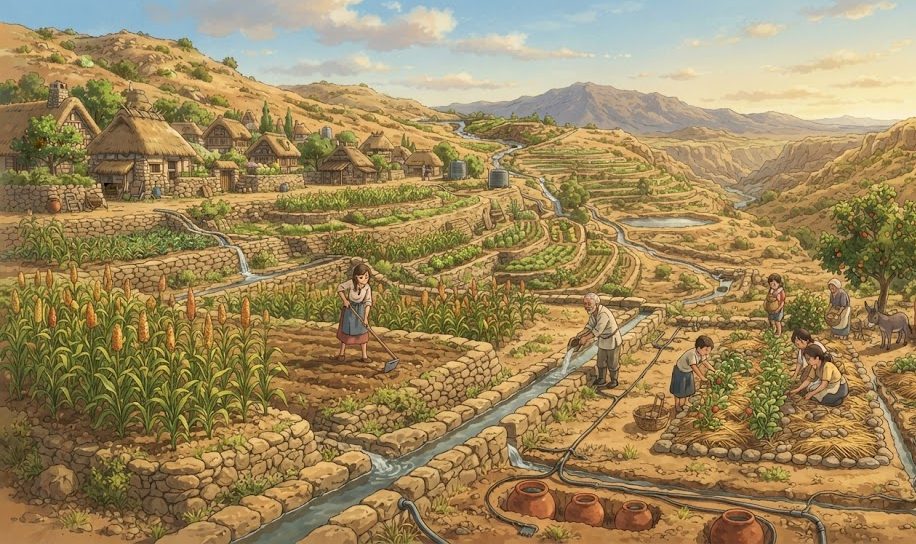
Farming in a desert or extremely dry region presents challenges that are very different from those found in areas with regular rainfall. Limited water, intense sunlight, high temperatures, poor soil structure, strong winds, and rapid evaporation can all make crop production difficult.
However, dryland agriculture is possible when farmers select suitable crops and design their farming systems around water conservation. Instead of trying to recreate the conditions of a wetter climate, successful desert farming generally focuses on working with the local environment.
Modern irrigation systems, improved soil management, protective structures, drought-tolerant crops, weather monitoring, and careful scheduling can all help farmers make better use of limited water resources.
Understanding the Desert Farming Environment
Before selecting crops, it is important to understand the conditions of the growing site.
Desert and semi-arid regions can vary considerably. Some receive very little annual rainfall, while others have seasonal rain but long periods of drought. Temperatures can also vary widely between daytime and nighttime.
Several factors should be evaluated:
- Annual and seasonal rainfall
- Average and extreme temperatures
- Soil texture and drainage
- Water availability and quality
- Wind exposure
- Salinity levels
- Length of the growing season
- Local pest and disease pressure
- Availability of irrigation infrastructure
A farming plan that works in one dry region may not work in another.
For example, a farm in the southwestern United States may face different conditions from one in a semi-arid part of the Mediterranean or another dry agricultural region.
Start With a Water Assessment
Water is usually the most important resource in desert agriculture.
Before planting a crop, farmers should understand exactly how much water is available and when it can be used.
Possible water sources may include wells, reservoirs, rainwater collection systems, surface water, or regulated irrigation supplies, depending on local conditions and regulations.
Water quality is also important. Irrigation water containing excessive salts can gradually increase soil salinity and reduce the ability of many crops to grow successfully.
A basic water assessment should consider:
Available volume: How much water can reliably be supplied?
Timing: When is the water available?
Quality: Does it contain salts or other substances that could affect soil or crops?
Delivery system: How efficiently can water reach the plants?
Understanding these factors before planting can prevent expensive problems later.
Choose Crops Carefully
Crop selection is one of the most important decisions in dry-region farming.
A crop that requires frequent irrigation may be difficult to manage where water is scarce. Farmers should consider species and varieties that can tolerate local heat and periods of limited water.
Depending on the climate, suitable crops may include certain varieties of:
- Sorghum
- Millet
- Chickpeas
- Lentils
- Beans
- Certain grains
- Dates
- Olives
- Grapes
- Melons
- Some herbs
- Selected vegetables
The exact choice should always be based on the local climate, soil, water availability, and market demand.
Drought tolerance does not mean a crop requires no water. Even drought-adapted plants need adequate moisture during important stages of establishment and development.
Improve Soil Before Planting
Desert soils can present several challenges.
Some may contain very little organic matter, while others may be compacted, sandy, alkaline, or affected by salt accumulation.
Improving soil structure can help increase its ability to hold and distribute water.
Organic matter can be particularly useful because it may improve soil structure and support biological activity.
Possible sources include:
- Well-managed compost
- Properly processed manure
- Crop residues
- Plant-based organic materials
- Suitable cover-crop residues
Materials should be properly managed before being incorporated into agricultural soil.
Adding large quantities of unsuitable material can create new problems, so soil testing is valuable before making major amendments.
Use Mulching to Reduce Evaporation
Bare soil can lose significant amounts of moisture through evaporation, especially under hot and windy conditions.
Mulching creates a protective layer over the soil surface.
Depending on the farming system, suitable mulch materials may include:
- Straw
- Shredded plant material
- Compost
- Wood-based materials
- Crop residues
Mulch can help moderate soil temperature, reduce evaporation, and limit weed growth.
However, mulch should be selected and managed according to the crop and local conditions. Poorly managed organic material can attract pests or create other problems.
Drip Irrigation for Efficient Water Delivery
Traditional irrigation methods can sometimes result in water being distributed over areas where it is not needed.
Drip irrigation delivers water close to the plant’s root zone through a network of pipes or emitters.
This allows farmers to control the amount and timing of irrigation more precisely.
A well-designed drip system can also make it easier to:
- Reduce unnecessary evaporation
- Deliver water directly to crops
- Automate irrigation schedules
- Apply water according to crop requirements
- Monitor irrigation more accurately
The system still needs regular maintenance. Clogged emitters, damaged pipes, leaks, and pressure problems can reduce performance.
Irrigate According to Crop Needs
More irrigation does not necessarily mean healthier crops.
Overwatering can waste scarce water, increase disease risks in some conditions, and contribute to nutrient losses or soil salinity.
Instead, irrigation should be adjusted according to factors such as:
- Crop growth stage
- Soil moisture
- Weather conditions
- Temperature
- Wind
- Root depth
- Expected evaporation
Young plants may need careful attention during establishment, while mature plants may have different water requirements.
Farmers can use soil-moisture sensors or other monitoring methods to improve irrigation decisions rather than relying entirely on fixed schedules.
Rainwater Harvesting
Even regions described as deserts may receive occasional heavy rainfall.
Capturing part of this water can provide an additional resource where appropriate.
Rainwater harvesting systems can direct runoff toward:
- Storage tanks
- Farm ponds
- Groundwater recharge areas
- Contour structures
- Carefully designed planting zones
The design should account for local rainfall patterns and soil conditions.
A small amount of water collected during occasional storms can be particularly useful when it is directed toward areas where plants can actually use it.
Use Shade Strategically
Intense sunlight and extreme temperatures can place stress on crops.
Shade structures can help reduce heat exposure for selected crops, particularly during the hottest periods.
Possible systems include:
- Shade cloth
- Greenhouses
- Shade houses
- Temporary protective structures
- Tree-based systems
Shade should be used carefully because excessive shading can reduce the light available for photosynthesis.
The goal is not to eliminate sunlight but to reduce harmful heat and radiation during stressful periods.
Wind Protection Matters
Strong winds can increase evaporation and damage young plants.
Wind can also move loose soil and create erosion problems.
Windbreaks made from suitable trees, shrubs, fences, or other structures can reduce wind speed around agricultural areas.
Vegetation-based windbreaks require water and management, so species should be selected carefully.
A well-designed windbreak can provide additional benefits such as habitat for beneficial organisms and improved microclimatic conditions.
Consider Raised Beds and Planting Design
Planting arrangement can affect how efficiently water reaches crops.
Raised beds, basins, furrows, contour planting, or other structures may be appropriate depending on soil type, slope, rainfall, and irrigation method.
In some dry farming systems, planting basins can help concentrate limited rainfall around crop roots.
The important principle is to design the field so that available water remains in the useful root zone for as long as possible.
Manage Salinity Carefully
Salinity is a major concern in irrigated dry regions.
When water evaporates, dissolved salts can remain behind in the soil. Over time, salt accumulation can affect plant growth.
Warning signs may include:
- White deposits on soil surfaces
- Poor plant growth
- Uneven crop development
- Reduced germination
- Leaf damage in sensitive crops
Soil and irrigation-water testing can help identify salinity problems.
Where appropriate, proper drainage and carefully managed irrigation may help move salts away from the root zone. The exact approach depends on soil conditions, water quality, and local environmental requirements.
Weed Management in Water-Limited Farming
Weeds compete with crops for moisture, nutrients, light, and space.
In water-limited environments, controlling weeds early can be particularly important because every unwanted plant may consume part of the available soil moisture.
Useful approaches include:
- Mulching
- Timely cultivation
- Mechanical removal
- Careful crop spacing
- Cover crops where appropriate
- Integrated weed-management strategies
Chemical herbicides may also be used in some farming systems, but they should always be applied according to the product label and applicable regulations.
Use Greenhouses and Protected Growing Systems
Protected agriculture can provide greater control over the growing environment.
Greenhouses and shade houses can help farmers manage:
- Temperature
- Humidity
- Wind
- Irrigation
- Crop protection
- Growing seasons
In desert regions, however, cooling a greenhouse can require substantial energy and water.
For this reason, passive cooling, ventilation, shading, evaporative systems where suitable, and climate-appropriate greenhouse designs can be important.
The best structure depends on the crop and local climate.
Consider Hydroponic Systems
Hydroponic farming can be useful in certain water-limited environments because plants are grown without traditional field soil and nutrients are delivered through a managed water system.
Some hydroponic systems recirculate water, reducing the amount lost compared with certain conventional irrigation systems.
Potential crops include leafy greens, herbs, and selected vegetables.
However, hydroponics requires careful management of:
- Nutrient concentrations
- Water quality
- Temperature
- pH
- Equipment
- Electricity
- Sanitation
It is not automatically cheaper or simpler than soil-based farming.
Technology Can Improve Water Management
Modern technology can help farmers make more informed decisions.
Useful tools include:
Soil-moisture sensors: Help estimate how much moisture is available around crop roots.
Weather stations: Provide local information about temperature, humidity, wind, and rainfall.
Satellite imagery: Can help identify differences in crop development and field conditions.
Automated irrigation controllers: Can adjust watering schedules according to programmed conditions or sensor information.
Farm-management software: Helps organize irrigation records, crop schedules, field observations, and other information.
Technology is most useful when it supports practical decisions rather than simply adding complexity.
Use Crop Rotation and Diversification
Growing the same crop repeatedly can increase certain pest, disease, and soil-management challenges.
Crop rotation can help diversify production and may improve long-term soil management.
For example, a farmer may rotate crops with different nutrient requirements or root structures.
Legumes can be particularly useful in some rotation systems because of their relationship with nitrogen-fixing bacteria, although their suitability depends on local conditions.
Diversification can also reduce dependence on a single crop market.
Choose the Right Planting Time
In a desert environment, timing can be just as important as crop selection.
Planting during the hottest part of the year may increase water demand and heat stress.
Farmers should consider local temperature patterns, expected rainfall, frost risk, and the crop’s growing period.
Some crops may perform better when planted during cooler months, while others are adapted to summer heat.
Using local agricultural extension information and historical climate data can help improve planting decisions.
A Practical Desert Farm Water-Saving Checklist
Before planting, farmers can review the following:
- Test soil and irrigation water
- Identify reliable water sources
- Select climate-appropriate crops
- Inspect irrigation equipment
- Improve soil structure where necessary
- Plan wind protection
- Prepare mulch
- Check drainage
- Establish a weed-management strategy
- Decide when each crop should be planted
- Monitor soil moisture
- Keep irrigation records
- Watch for salinity
- Review crop performance after harvest
Keeping records from one season to the next can be extremely valuable. Farmers can compare water use, crop yields, planting dates, weather conditions, and input costs to improve future decisions.
Final Thoughts
Desert farming is challenging, but water scarcity does not automatically make agriculture impossible. The key is to design the entire farming system around the local environment.
Efficient irrigation, appropriate crop selection, soil improvement, mulching, wind protection, rainwater harvesting, salinity management, and careful planting schedules can all contribute to more efficient use of limited resources.
Technology can provide additional support through soil sensors, automated irrigation, weather monitoring, and protected growing systems, but good basic farm management remains essential.
The most sustainable approach is usually not to search for a single technique that solves every problem. Instead, combine several practical methods and continuously monitor what works under local conditions.
With careful planning, farmers in dry and water-limited regions can make better use of available resources while building agricultural systems that are more resilient to heat, drought, and changing growing conditions.