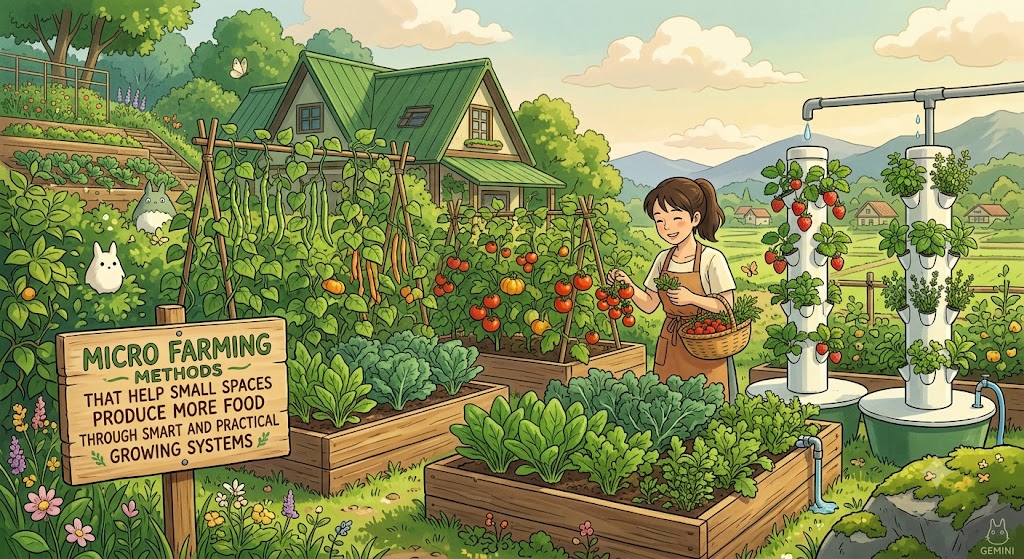
Micro farming is becoming an interesting option for people who want to grow food despite having limited land. Instead of depending on large fields, micro farms focus on making productive use of small plots, backyards, rooftops, community spaces, greenhouses, or other suitable areas.
The main idea is not simply to grow more plants in less space. Successful micro farming involves choosing appropriate crops, organizing growing areas efficiently, managing water and nutrients carefully, and selecting production methods that match local conditions.
For beginners, a small space can be a useful place to experiment, learn, and gradually develop a productive growing system.
Start by Understanding the Available Space
Before planting anything, farmers should evaluate the space carefully.
Important factors include sunlight, water access, drainage, soil quality, wind exposure, available working space, and proximity to customers.
Most vegetables require several hours of sunlight, although exact requirements vary by crop. Buildings, walls, trees, and other structures can create shaded areas that may be better suited to crops with lower light requirements.
Measuring the available area can also prevent overcrowding. A simple layout showing beds, paths, water lines, storage areas, and working space can make daily management much easier.
Choose High-Value Crops Carefully
Limited space means crop selection matters.
Micro farmers may focus on crops that provide good value from a relatively small growing area. Leafy greens, herbs, salad vegetables, microgreens, strawberries, specialty peppers, and certain compact vegetables can be considered depending on local demand and growing conditions.
However, the highest-priced crop is not automatically the best choice.
Farmers should consider seed costs, growing time, labor, water requirements, spoilage risk, customer preferences, and selling price before selecting crops.
A crop that can be harvested repeatedly may sometimes make better use of limited space than one that occupies the area for a long period.
Use Raised Beds
Raised beds can help organize small growing areas efficiently.
They provide clearly defined planting zones and can make soil preparation, irrigation, weeding, and harvesting easier.
The beds do not need to be extremely large. Narrow beds can be particularly convenient because farmers can reach the plants without stepping directly onto growing soil.
Paths should be wide enough for comfortable movement and routine maintenance.
Good drainage should also be considered, especially in areas that receive heavy rainfall.
Try Vertical Growing
Vertical farming methods can increase the effective growing area without expanding the ground footprint.
Trellises, supports, towers, hanging containers, and other structures can allow suitable crops to grow upward.
Climbing beans, peas, cucumbers, and some varieties of tomatoes can benefit from vertical support.
Vertical systems should be stable enough to handle the weight of mature plants and should not block sunlight from neighboring crops.
They also need regular pruning, tying, or training depending on the crop.
Use Containers in Small Areas
Containers can make farming possible where conventional soil beds are unavailable.
Buckets, grow bags, boxes, pots, and other suitable containers can be used for vegetables, herbs, and compact fruiting plants.
Containers should have adequate drainage and enough growing medium for the selected crop.
The growing medium should provide suitable structure, moisture retention, and drainage.
One advantage of containers is flexibility. They can be rearranged or moved when necessary, although large containers become heavy once filled with soil and water.
Consider Hydroponic Systems
Hydroponics allows plants to grow without traditional field soil by supplying water and nutrients through a controlled growing system.
This method can be useful where land is extremely limited.
Leafy greens and herbs are commonly suited to several hydroponic systems because they can have relatively short production cycles.
However, hydroponics requires careful management of water quality, nutrient concentration, pH, temperature, sanitation, and equipment.
Power interruptions or pump failures can also become important risks in systems that depend on continuous water circulation.
Beginners should start with a manageable setup before investing heavily in equipment.
Manage Water Efficiently
Water can become one of the most important resources in micro farming.
Drip irrigation, soaker systems, self-watering containers, and carefully designed hand-watering routines can help deliver moisture close to plant roots.
Farmers should avoid watering every plant according to the same schedule. Different crops and containers may dry out at different rates.
Checking soil moisture before irrigation can prevent unnecessary water use.
Mulching can also reduce evaporation from exposed soil and help maintain more consistent moisture.
Improve Soil Quality
Healthy soil can make a major difference in a small growing area.
Before planting, farmers should understand the condition of the existing soil. Soil testing can help identify pH and nutrient-related issues.
Compost and other suitable organic materials may improve soil structure and contribute nutrients when used appropriately.
Because micro farms often grow intensively, nutrients can be removed from the soil relatively quickly.
Crop rotation, composting, and responsible fertilizer use can help maintain productivity over time.
Practice Succession Planting
Succession planting is particularly useful when space is limited.
Instead of planting an entire crop at once, farmers can plant smaller quantities at regular intervals.
This can provide a more continuous harvest rather than producing a large quantity that becomes ready simultaneously.
For example, leafy greens or other short-duration crops can be planted in stages according to local growing conditions.
Succession planting can also make better use of beds as soon as one crop is harvested.
Combine Compatible Crops
Companion and mixed planting can help farmers use space more efficiently when crop combinations are suitable.
Tall crops can sometimes provide support or partial shade for shorter plants, while crops with different root depths may occupy different parts of the soil.
However, combinations should be selected based on actual compatibility rather than relying on unsupported claims about specific plant pairings.
Farmers should consider sunlight, water requirements, growth rate, root competition, and harvesting needs when designing mixed beds.
Use Small Greenhouses or Shade Structures
Protected growing structures can extend the useful growing season and provide additional control over environmental conditions.
Small greenhouses, tunnels, shade houses, and simple protective structures can help shield crops from excessive heat, heavy rain, wind, or certain pests.
The structure should match the local climate.
In hot regions, poor ventilation inside a greenhouse can create even higher temperatures than outdoors. Adequate airflow and suitable shading may therefore be essential.
Focus on Integrated Pest Management
Small farms can benefit from regular crop inspection.
Farmers should check leaves, stems, flowers, fruits, and growing media for signs of insects, disease, or other problems.
Removing damaged plant material, improving airflow, maintaining clean growing areas, using physical barriers, and encouraging beneficial organisms can all contribute to pest management.
Chemical treatments should not automatically be the first response. When crop-protection products are necessary, farmers should follow label instructions and applicable regulations.
Grow for a Specific Customer
One of the biggest advantages of micro farming is the ability to focus on specialized markets.
Instead of trying to compete directly with large farms on common commodities, small producers can explore local restaurants, farmers’ markets, specialty stores, direct customers, subscription boxes, or community-supported agriculture programs.
Before planting large quantities, farmers should talk to potential buyers and understand their preferred varieties, quantities, quality standards, packaging requirements, and delivery schedules.
Growing according to real demand can reduce waste.
Reduce Post-Harvest Losses
Small farms can lose a significant portion of their potential income after crops are harvested if products are not handled properly.
Harvesting at the appropriate stage, keeping produce clean, protecting it from excessive heat, and using suitable packaging can help maintain quality.
Farmers should understand the storage requirements of each crop because leafy greens, root vegetables, herbs, and fruits have different needs.
Selling harvests quickly through nearby customers can also reduce the need for long-term storage.
Track Costs and Production
Small space does not automatically mean low costs.
Seeds, containers, growing media, fertilizer, irrigation equipment, electricity, packaging, transportation, labor, and market fees can all affect profitability.
Farmers should maintain simple records of production and expenses.
Tracking how much each bed or growing system produces can help identify the most productive uses of available space.
Over time, these records can guide better decisions about which crops and systems deserve more attention.
Expand Only After Testing
Micro farming can become complicated when too many techniques are introduced at once.
Beginners may be better served by starting with a small number of crops and a simple growing system.
Once the process becomes manageable, they can experiment with vertical growing, hydroponics, protected structures, or additional crop varieties.
Testing before expansion reduces financial risk and provides practical experience.
Final Thoughts
Micro farming shows that productive agriculture does not always require large areas of land. Raised beds, containers, vertical systems, hydroponics, efficient irrigation, succession planting, protected structures, and careful crop selection can help small spaces produce meaningful quantities of food.
The best system depends on the available space, climate, water supply, budget, labor, and target market.
Rather than trying to maximize the number of plants immediately, successful micro farmers can focus on efficient use of space, consistent crop quality, and reliable demand. With careful planning, regular observation, and gradual improvements, even a modest growing area can become a practical and productive farming system.