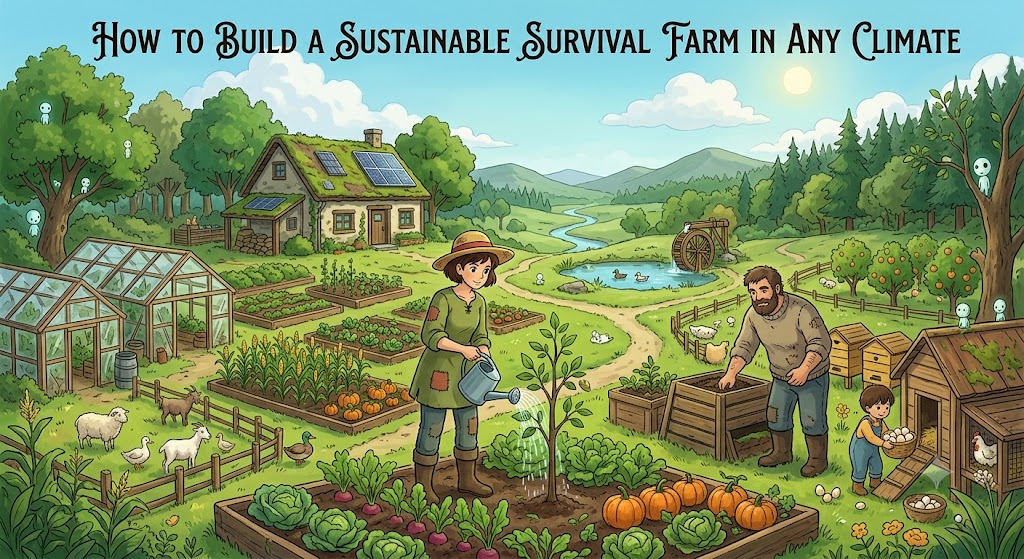
Creating a survival farm is no longer just an idea for remote homesteads or rural communities. Around the world, more people are choosing sustainable farming as a way to improve food security, reduce household expenses, and become less dependent on unpredictable food supply chains. Whether you live in a dry desert region, a tropical climate, a cold northern area, or a temperate countryside, it is possible to design a survival farm that works with your local environment rather than against it.
A sustainable survival farm is not about producing the maximum amount of food in one season. Instead, it focuses on creating a balanced system where healthy soil, efficient water management, diverse crops, and natural farming practices work together to provide reliable harvests year after year. By understanding your local climate and selecting suitable crops and techniques, even a small property can become a productive source of food and long-term resilience.
This guide explains how to build a survival farm that remains productive across different climates while protecting natural resources for future generations.
What Is a Sustainable Survival Farm?
A sustainable survival farm is a self-reliant farming system designed to produce food continuously while conserving soil, water, biodiversity, and other natural resources.
Unlike conventional farming that may rely heavily on external inputs, a sustainable survival farm emphasizes:
- Long-term food production
- Soil conservation
- Water efficiency
- Crop diversity
- Natural pest management
- Renewable resources
- Minimal waste
The objective is to create a farm that becomes stronger and more productive over time rather than exhausting the land.
Why Climate Matters in Farm Planning
Every farming region has unique environmental conditions.
These include:
- Temperature
- Rainfall
- Humidity
- Frost periods
- Wind exposure
- Soil type
- Water availability
Instead of trying to force unsuitable crops into difficult conditions, successful farmers adapt their farming systems to local climates.
Working with nature is often more productive than working against it.
Step 1: Understand Your Local Growing Conditions
Before planting your first crop, study your farm carefully.
Observe:
- Average rainfall
- Seasonal temperatures
- Sunlight patterns
- Wind direction
- Frost dates
- Drainage
- Natural vegetation
These observations help you make better decisions about crop selection and farm design.
Step 2: Build Healthy Soil First
Healthy soil remains the foundation of every sustainable farm.
Improve soil naturally by adding:
- Compost
- Well-rotted manure
- Mulch
- Cover crops
- Organic matter
- Crop residues
Healthy soil provides:
- Better nutrient availability
- Improved water retention
- Strong root development
- Greater microbial activity
Investing in soil improvement often produces long-term benefits that exceed short-term fertilizer use.
Step 3: Choose Climate-Appropriate Crops
Different climates support different crops.
Dry Regions
Suitable crops include:
- Millet
- Sorghum
- Cowpea
- Chickpeas
- Sesame
These crops generally tolerate drought better than many water-demanding species.
Temperate Regions
Popular options include:
- Potatoes
- Carrots
- Beans
- Apples
- Cabbage
- Peas
Tropical Areas
Good choices include:
- Sweet potatoes
- Bananas
- Cassava
- Moringa
- Papaya
- Okra
Cold Climates
Cold-tolerant crops include:
- Kale
- Spinach
- Garlic
- Onions
- Beets
- Turnips
Selecting crops suited to your environment increases productivity while reducing risk.
Step 4: Grow a Diverse Range of Crops
Crop diversity strengthens the entire farming system.
A balanced survival farm should include:
- Staple crops
- Protein-rich legumes
- Leafy vegetables
- Fruit trees
- Herbs
- Root vegetables
- Pollinator-friendly flowers
Diverse farms are generally more resilient against pests, diseases, and changing weather conditions.
Step 5: Design an Efficient Water System
Water conservation becomes increasingly important in every climate.
Practical strategies include:
- Rainwater harvesting
- Drip irrigation
- Mulching
- Swales on sloped land
- Water storage tanks
- Soil moisture monitoring
Efficient irrigation reduces waste while supporting healthy crop growth.
Step 6: Protect Your Farm with Windbreaks
Strong winds can damage crops, dry out soil, and reduce yields.
Natural windbreaks may include:
- Trees
- Shrubs
- Living hedges
- Bamboo (where appropriate)
Wind protection improves growing conditions while supporting wildlife.
Step 7: Practice Crop Rotation
Planting the same crops repeatedly in one location increases disease pressure and depletes soil nutrients.
Crop rotation helps:
- Improve fertility
- Reduce pests
- Minimize diseases
- Strengthen soil biology
Rotating crop families every season is one of the simplest methods for maintaining productive farmland.
Step 8: Encourage Natural Biodiversity
Healthy ecosystems naturally regulate many farming challenges.
Encourage biodiversity by growing:
- Native flowers
- Pollinator plants
- Companion crops
- Cover crops
- Mixed vegetable beds
Beneficial insects often reduce pest populations without heavy chemical use.
Step 9: Produce Your Own Compost
Composting transforms organic waste into valuable fertilizer.
Suitable compost materials include:
- Vegetable scraps
- Dry leaves
- Grass clippings
- Animal manure
- Crop residues
Compost improves soil fertility while reducing household waste.
Step 10: Save Seeds Every Season
Saving seeds increases self-sufficiency and preserves locally adapted crop varieties.
Benefits include:
- Lower production costs
- Greater independence
- Preservation of genetic diversity
- Better adaptation over time
Store seeds in cool, dry, airtight containers with clear labels.
Plan for Year-Round Food Production
Instead of producing food only during one season, design a continuous planting schedule.
Spring
- Peas
- Lettuce
- Spinach
Summer
- Tomatoes
- Beans
- Corn
- Cucumbers
Autumn
- Carrots
- Garlic
- Cabbage
Winter (Where Climate Allows)
- Kale
- Onions
- Cover crops
Continuous planting extends harvest periods throughout the year.
Include Perennial Crops
Perennial plants produce harvests for multiple years after establishment.
Examples include:
- Apple trees
- Berry bushes
- Asparagus
- Rhubarb
- Moringa
- Grapes
Perennials reduce annual planting work while providing long-term food production.
Raise Small Livestock (Optional)
Where space, regulations, and resources allow, integrating small livestock can improve farm sustainability.
Examples include:
- Chickens
- Ducks
- Rabbits
- Bees
Potential benefits include:
- Eggs
- Honey
- Natural fertilizer
- Pollination support
Integrating animals should match your available space and management capacity.
Reduce Waste Wherever Possible
Efficient farms recycle resources instead of discarding them.
Examples include:
- Composting kitchen waste
- Reusing rainwater
- Recycling crop residues
- Using natural mulch
- Saving seeds
Reducing waste lowers costs while improving sustainability.
Common Mistakes to Avoid
Many new survival farmers make avoidable errors.
Avoid:
Growing Unsuitable Crops
Always choose varieties adapted to your climate.
Ignoring Soil Health
Healthy soil supports every part of the farming system.
Relying on One Crop
Diversification reduces production risks.
Poor Water Management
Water conservation should remain a year-round priority.
Expanding Too Quickly
Grow gradually while learning from each season.
Example Sustainable Survival Farm Layout
| Farm Zone | Primary Purpose |
|---|---|
| Vegetable Beds | Daily food production |
| Root Crop Area | Long-term food storage |
| Fruit Orchard | Perennial harvests |
| Herb Garden | Culinary and medicinal use |
| Compost Station | Soil fertility |
| Rainwater Collection | Water security |
| Pollinator Garden | Biodiversity support |
A thoughtful layout improves efficiency while making future expansion easier.
Long-Term Habits for Farm Success
Sustainable farms improve through continuous care.
Develop habits such as:
- Monitoring soil quality
- Conserving water
- Recording harvest data
- Saving seeds
- Rotating crops
- Learning new techniques
- Observing weather patterns
Small improvements each season often lead to stronger long-term results.
Conclusion
A sustainable survival farm is built on balance rather than size. By understanding your local climate, improving soil naturally, conserving water, growing diverse crops, encouraging biodiversity, and reducing waste, you can create a farming system capable of producing reliable harvests year after year.
Whether you farm in a dry, tropical, temperate, or cold region, adapting your methods to local conditions is the key to long-term success. With thoughtful planning, patience, and consistent management, a survival farm can provide food security, environmental sustainability, and greater independence for generations to come.
Frequently Asked Questions (FAQs)
1. Can a survival farm succeed in any climate?
Yes. By selecting crops suited to local conditions, conserving water, improving soil, and adapting farming practices to the environment, survival farms can be productive in many different climates.
2. What is the most important part of a sustainable survival farm?
Healthy soil is often considered the foundation of sustainable farming because it supports plant growth, improves water retention, and enhances long-term productivity.
3. Why is crop diversity important?
Growing a variety of crops reduces the risk of total crop failure, improves nutrition, supports biodiversity, and helps manage pests and diseases naturally.
4. How can I conserve water on a survival farm?
Rainwater harvesting, drip irrigation, mulching, improving soil organic matter, and watering efficiently are effective ways to reduce water use.
5. Is a large property necessary to build a survival farm?
No. Careful planning, intensive growing methods, vertical gardening, and crop diversity can make even small properties productive and sustainable over the long term.