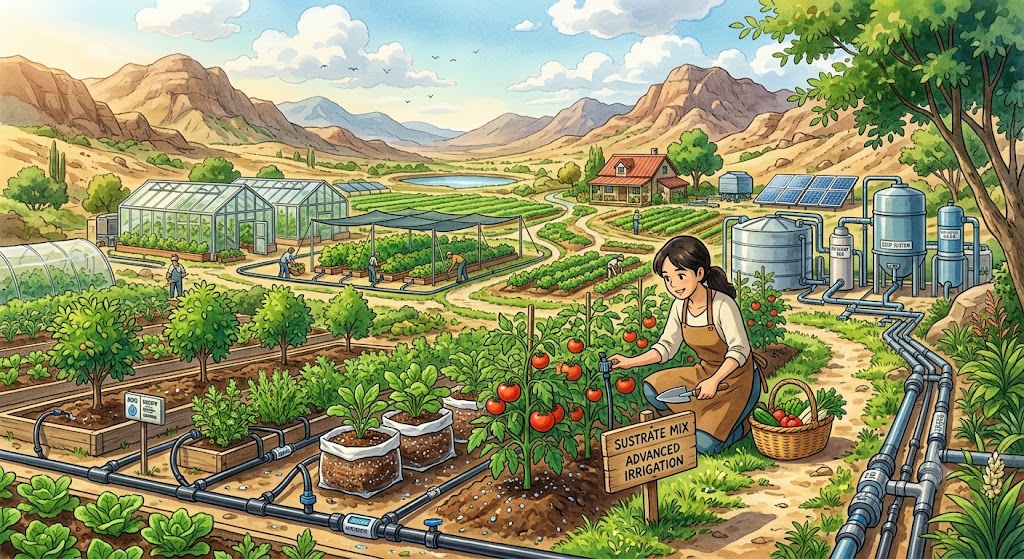
Desert regions are often associated with harsh temperatures, limited rainfall, and challenging growing conditions. However, advances in agricultural technology have transformed many arid landscapes into productive farming zones capable of producing vegetables, fruits, grains, and specialty crops at commercial scales. Countries and regions with desert climates are increasingly using innovative irrigation systems, advanced substrate management techniques, and precision agriculture technologies to overcome environmental limitations and achieve impressive agricultural productivity.
As global populations continue to grow and arable land becomes more limited, desert farming is gaining attention as a practical solution for expanding food production. By efficiently managing water resources and optimizing growing environments, farmers can successfully cultivate crops even in some of the world’s driest regions.
This guide explores the advanced irrigation technologies and substrate management strategies that are helping transform desert agriculture into a sustainable and profitable farming model.
Understanding the Challenges of Desert Farming
Desert agriculture faces several unique obstacles that can affect crop growth and productivity.
Common Challenges
- Low rainfall
- High evaporation rates
- Extreme temperatures
- Poor soil fertility
- Salinity issues
- Limited organic matter
- Water scarcity
Overcoming these challenges requires careful planning and the use of specialized agricultural technologies.
Why Desert Farming Is Becoming More Important
The demand for food continues to rise while agricultural land resources remain limited.
Desert farming offers several potential benefits:
Advantages
- Expansion of food production areas
- Improved food security
- Efficient resource utilization
- Economic development opportunities
- Reduced pressure on traditional farmland
Modern innovations are making it increasingly possible to farm successfully in arid environments.
The Critical Role of Water Management
Water is the most valuable resource in desert agriculture.
Efficient irrigation systems are essential for maximizing productivity while minimizing water loss.
Goals of Irrigation Management
- Deliver water precisely
- Reduce evaporation losses
- Improve water-use efficiency
- Support healthy crop growth
- Maintain long-term sustainability
Advanced irrigation technologies have become the foundation of successful desert farming operations.
Drip Irrigation Systems
Drip irrigation is one of the most widely used technologies in arid agriculture.
The system delivers water directly to the root zone through a network of pipes and emitters.
Benefits of Drip Irrigation
- Significant water savings
- Reduced evaporation
- Improved nutrient efficiency
- Better weed control
- Enhanced crop performance
Drip irrigation often uses considerably less water than traditional surface irrigation methods.
Subsurface Drip Irrigation
Subsurface drip irrigation places water delivery lines beneath the soil surface.
Advantages
- Further reduction in evaporation
- Improved root-zone moisture control
- Reduced weed growth
- Increased irrigation efficiency
This technology is particularly effective in extremely hot environments where surface water losses are high.
Smart Irrigation Systems
Modern irrigation systems increasingly use automation and digital technologies.
These systems may incorporate:
- Soil moisture sensors
- Weather stations
- Automated controllers
- Remote monitoring platforms
Benefits
- Real-time decision-making
- Improved water efficiency
- Reduced labor requirements
- Better crop management
Smart irrigation helps farmers apply water only when necessary.
Precision Irrigation Technologies
Precision irrigation combines sensors, mapping tools, and data analysis to optimize water application.
Key Components
- GPS technology
- Soil monitoring systems
- Satellite imagery
- Crop growth data
Advantages
- Reduced water waste
- Improved yield potential
- Better resource allocation
- Enhanced sustainability
Precision agriculture technologies continue to improve irrigation efficiency in desert environments.
Water Recycling and Reuse
Many commercial desert farms incorporate water recycling systems.
Examples
- Greenhouse water recovery
- Drainage water treatment
- Recirculating irrigation systems
Benefits
- Reduced freshwater demand
- Lower operating costs
- Improved sustainability
Water reuse strategies help maximize the value of limited water resources.
Desalination for Agricultural Water Supply
In some desert regions, desalination provides an alternative source of irrigation water.
Benefits
- Reliable water supply
- Reduced dependence on rainfall
- Increased agricultural potential
Although desalination can be expensive, technological improvements continue to increase its feasibility in certain areas.
Understanding Substrate Management
Substrate management is another key component of successful desert agriculture.
A substrate is the material that supports plant roots and helps regulate water, nutrients, and oxygen availability.
Why Substrate Management Matters
Effective substrates improve:
- Water retention
- Root development
- Nutrient availability
- Plant stability
Proper substrate selection can significantly improve crop performance in challenging environments.
Improving Desert Soil Conditions
Natural desert soils often have limitations that restrict plant growth.
Common problems include:
- Low organic matter
- Poor nutrient availability
- High salinity
- Weak water retention
Soil Improvement Strategies
- Compost application
- Organic matter incorporation
- Mulching
- Biochar use
- Soil conditioning materials
These practices help create a more productive growing environment.
Using Organic Matter to Enhance Soil
Organic matter plays a critical role in desert agriculture.
Sources include:
- Compost
- Animal manure
- Crop residues
- Green manure crops
Benefits
- Improved water-holding capacity
- Enhanced nutrient retention
- Better soil structure
- Increased microbial activity
Organic matter helps transform poor soils into productive agricultural resources.
Biochar Applications in Desert Farming
Biochar is a carbon-rich material produced from organic biomass.
Advantages of Biochar
- Increased water retention
- Improved nutrient storage
- Enhanced soil fertility
- Long-term soil improvement
Many researchers view biochar as a valuable tool for sustainable desert agriculture.
Hydroponics and Soilless Production Systems
Hydroponics allows crops to grow without traditional soil.
Instead, plants receive nutrients through water-based solutions.
Benefits for Desert Farming
- Reduced water use
- High productivity
- Controlled growing conditions
- Limited land requirements
Hydroponic systems are becoming increasingly common in commercial desert agriculture.
Greenhouse Desert Farming
Greenhouses provide protection from extreme weather conditions while improving environmental control.
Benefits
- Reduced water loss
- Temperature regulation
- Improved crop quality
- Year-round production
Greenhouse systems often combine advanced irrigation and substrate technologies for maximum efficiency.
Managing Salinity Challenges
Salinity is a common concern in arid environments.
Excess salts can reduce crop growth and productivity.
Salinity Management Strategies
- Efficient irrigation
- Proper drainage
- Salt-tolerant crop varieties
- Regular soil monitoring
Effective salinity control supports long-term agricultural sustainability.
Crop Selection for Desert Agriculture
Certain crops perform particularly well under arid conditions.
Examples include:
- Dates
- Pomegranates
- Olives
- Melons
- Tomatoes
- Cucumbers
- Peppers
Selecting suitable crops improves production efficiency and profitability.
Sustainability in Desert Farming
Modern desert agriculture emphasizes sustainable resource management.
Sustainability Goals
- Water conservation
- Soil improvement
- Renewable energy integration
- Efficient resource utilization
Sustainable practices help ensure long-term productivity and environmental protection.
Future Innovations in Desert Agriculture
Emerging technologies continue to improve desert farming capabilities.
Future developments may include:
- AI-driven irrigation systems
- Advanced climate-controlled greenhouses
- Improved desalination technologies
- Precision nutrient management
- Robotics and automation
These innovations are expected to further expand agricultural opportunities in arid regions.
Frequently Asked Questions
1. Can crops be grown successfully in desert environments?
Yes. Modern irrigation systems, soil improvement techniques, and controlled-environment agriculture make commercial desert farming possible.
2. What is the most efficient irrigation method for desert farming?
Drip irrigation and subsurface drip irrigation are among the most water-efficient systems used in arid agriculture.
3. Why is substrate management important?
Proper substrate management improves water retention, nutrient availability, root development, and overall crop productivity.
4. How does hydroponics help desert agriculture?
Hydroponics reduces water use, improves efficiency, and allows crop production without relying on traditional soil.
5. What crops grow well in desert conditions?
Dates, olives, pomegranates, melons, tomatoes, cucumbers, and peppers are commonly grown in arid regions.
Conclusion
Desert farming is no longer limited by traditional environmental constraints. Through advanced irrigation technologies, innovative substrate management practices, controlled-environment agriculture, and precision farming systems, modern growers are transforming arid landscapes into productive agricultural enterprises. Efficient water use, soil improvement, hydroponic production, and greenhouse cultivation have become essential tools for overcoming the challenges of desert agriculture.
As global food demand continues to increase and agricultural resources become more constrained, desert farming offers significant opportunities for sustainable expansion. By adopting advanced technologies and resource-efficient practices, farmers can successfully cultivate crops in some of the world’s most challenging environments while contributing to food security, economic development, and agricultural innovation.
Explore more helpful articles on our website for additional farming guides, agricultural technologies, and sustainable crop production strategies.