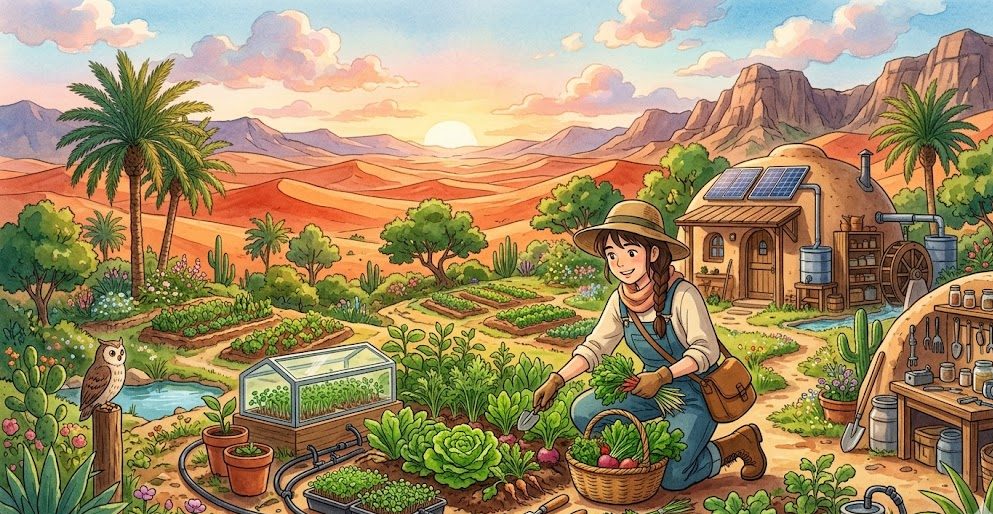
In an era of shifting climates and rising food costs, agricultural innovation is moving away from traditional broad-acre models toward specialized, high-efficiency systems. Mastering desert, micro, and survival farming allows you to transform challenging environments into productive, self-reliant ecosystems.
This guide outlines the strategies required to succeed in these specialized niches, combining traditional wisdom with cutting-edge technology.
1. Desert Farming: Engineering the Arid Frontier
Desert agriculture is no longer about fighting the environment; it is about working within its constraints through precision and circular resource management.
Key Strategies
- Water Efficiency via Tech: Relying on flood irrigation in arid regions leads to salinization and waste. Instead, utilize pressurized drip irrigation or micro-jets, which deliver water directly to the root zone with up to 90% efficiency (Girma & Jemal, 2015).
- Closed-Loop Agroponics: Integrate aquaculture and hydroponics to create a circular model. Fish waste provides nutrients for crops, while plants purify the water for the fish (Alnuaimi, 2025). This requires minimal soil and drastically reduces water consumption.
- Soil Amelioration: Combat salinization by incorporating organic matter like straw, which improves soil structure, increases water-holding capacity, and helps leach salts away from the root zone (Tarolli et al., 2024).
2. Micro Farming: Entrepreneurship on a Small Scale
Micro farming, often defined by small land holdings managed by family units, is an entrepreneurial model that relies on high-value crops and intensive production.
Principles of Success
- Value-Added Production: Successful micro-farmers do not just sell raw goods. They process products (e.g., turning cassava into starch or flour) to capture more profit per unit (Apata, 2015).
- Multiple Revenue Streams: Profitability in micro-farming is rarely tied to a single crop. Successful operators combine various ventures—such as poultry, vegetables, and agro-processing—to buffer against price volatility in any single market (Apata, 2015).
- Operational Efficiency: Small-scale success is built on “attention to detail.” Monitoring cash flow, staying educated through producer groups, and carefully managing risks are often more important than the scale of the operation itself (Cuykendall, n.d.).
3. Survival Farming: Building Resilient Self-Sufficiency
Survival farming focuses on food security and resilience. It uses low-input methods designed to withstand extreme conditions and instability.
Core Pillars
- Diversity of Species: Resilience is built through variety. During times of crisis, reliance on a single staple crop is dangerous. Incorporating wild-harvested edible plants and mushrooms can provide a critical safety net when primary crops fail (Skrzypczyński, n.d.).
- Cooperative Models: Drawing on the philosophy of decentralized, self-reliant village units, cooperative farming can help save labor and capital while ensuring all community members have access to basic food requirements (Pathak, 2022).
- Working with Nature: Survival farming prioritizes sustainable use of local natural resources, such as soil and water conservation, to ensure that the land remains productive for the long term without heavy reliance on external inputs (Pathak, 2022).
Comparative Strategic Matrix
| Farming Type | Primary Goal | Critical Resource | Success Factor |
| Desert | Productivity | Water / Technology | Precision irrigation & circularity |
| Micro | Profitability | Labor / Management | Market diversification & added value |
| Survival | Resilience | Knowledge / Biodiversity | Low-input methods & cooperation |
Conclusion
The future of agriculture lies in specialization. Whether you are aiming to turn a desert plot into a “green oasis” using AI-integrated agroponics, or building a resilient micro-farm to secure your family’s future, the principles of systems thinking remain the same:
- Monitor: Use data to track water usage, crop health, and market prices.
- Adapt: Be prepared to change your technology or your crop selection as environmental conditions shift.
- Integrate: Look for ways to recycle waste and energy within your farm to reduce costs and environmental impact.
By mastering these specialized approaches, you move from being a simple participant in the food industry to an innovative architect of your own sustainable future.