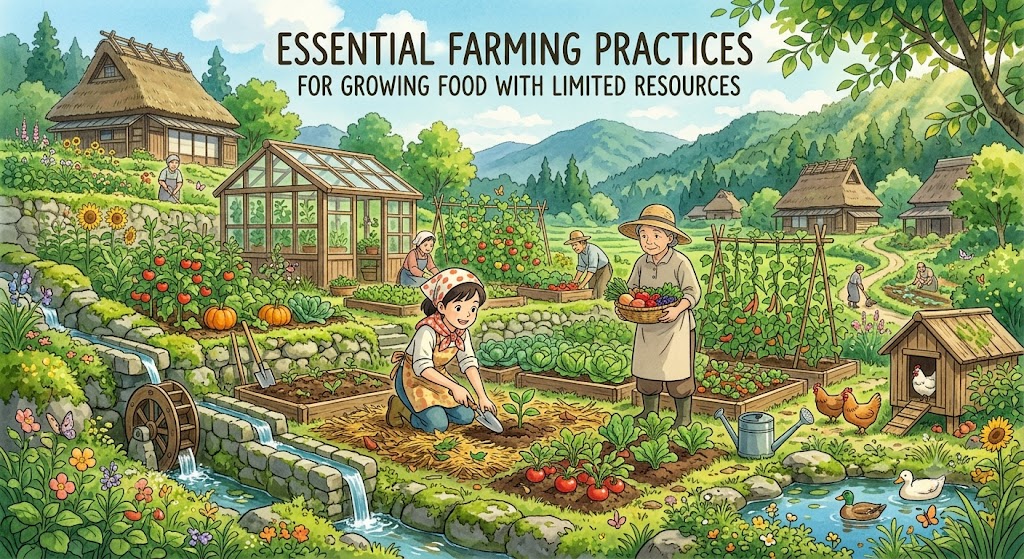
When resources are limited, growing food can become much more challenging—but it is still possible with careful planning, simple techniques, and a good understanding of the local environment. Survival farming focuses on producing useful food with limited access to water, equipment, land, fertiliser, electricity, or other agricultural inputs.
The goal is not necessarily to produce the largest possible harvest. Instead, survival farming prioritises reliability, efficient use of available resources, practical crops, soil protection, and the ability to keep producing food over time.
Whether someone is managing a small backyard plot, a rural homestead, an allotment, or a larger piece of land with limited resources, the same principles can help make food production more resilient.
What Is Survival Farming?
Survival farming is a small-scale or resource-conscious approach to food production where farmers work with limited inputs. Rather than depending heavily on machinery, expensive irrigation systems, synthetic fertilisers, or purchased supplies, the emphasis is on making the most of what is already available.
A survival farming system may rely on:
- Locally adapted seeds
- Rainwater and careful irrigation
- Compost and organic matter
- Hand tools
- Mulching
- Crop rotation
- Companion planting
- Natural pest management
- Small livestock where appropriate
- Food crops that provide useful calories and nutrients
The approach can be useful in many situations. A gardener trying to reduce expenses, a smallholder dealing with unreliable water, or someone developing a self-sufficient homestead may all use similar techniques.
Start With the Resources You Already Have
One of the biggest mistakes in low-resource farming is choosing crops before understanding the available conditions.
Before planting, make a simple inventory of what you already have.
Land
Measure the usable growing area and identify:
- Sunny sections
- Shaded areas
- Slopes
- Low-lying areas
- Areas prone to flooding
- Existing beds or planting spaces
Even a small area can produce useful food if it is organised efficiently.
Water
Determine where your water comes from and how reliable it is.
Possible sources may include rainfall, stored water, wells, household greywater where legally and safely appropriate, or carefully managed irrigation.
Do not design a crop plan that requires more water than you can realistically provide.
Tools
You may not need a large collection of equipment. Basic tools such as a spade, hoe, hand fork, rake, watering can, pruning tool, and buckets can handle many small-scale jobs.
Maintaining simple tools properly can be more valuable than purchasing specialised equipment.
Organic Materials
Look around the property for materials that can improve the soil.
Leaves, grass clippings, crop residues, aged manure, and kitchen plant waste can potentially become useful compost or mulch when handled correctly.
Choose Crops for Reliability, Not Just Popularity
A limited-resource farm should prioritise crops that fit the local climate and growing conditions.
Instead of selecting crops because they are popular, consider four questions:
- How much water does the crop require?
- How long does it take to produce food?
- How much space does it need?
- Can part of the harvest be stored or replanted?
Root crops, beans, leafy vegetables, squash, potatoes, sweet potatoes, and other locally suitable crops can be useful choices depending on climate and soil.
However, there is no universal list of “best” survival crops. Conditions differ substantially between regions.
For example, a crop that performs well in a cool UK growing season may require a very different approach in a hot, dry region of the United States.
The best crop is usually the one that matches the local growing season, soil, rainfall, and available care.
Grow a Mix of Crops
Depending on only one crop creates unnecessary risk.
Weather, insects, disease, poor germination, or unexpected temperature changes can damage a harvest. Growing several types of crops spreads that risk.
A small food garden might combine:
- A root crop
- A leafy vegetable
- A legume
- A fruiting vegetable
- A hardy herb
- A calorie-dense crop suitable for the region
Different crops also use soil resources differently, making crop diversity useful for long-term management.
Make Water Use a Priority
Water is often the most important resource in low-input farming.
A simple strategy is to focus on getting more value from every litre of water rather than simply increasing the amount of irrigation.
Mulch the Soil
A layer of suitable organic mulch can reduce direct evaporation from the soil surface and help moderate soil temperature.
Possible materials include:
- Straw
- Dry leaves
- Grass clippings that are suitable for the purpose
- Shredded plant material
- Well-aged organic materials
Keep mulch away from plant stems where excessive moisture or rot could become a problem.
Water at the Right Time
Watering during the cooler part of the day can reduce unnecessary evaporation.
Deep, appropriate watering is generally more useful than frequent shallow watering, although the correct schedule depends on the crop, soil type, weather, and growth stage.
Capture Rainwater
Where local regulations and building conditions allow, rainwater collection can provide an additional source for gardens.
Simple barrels or tanks can capture runoff from suitable roof areas.
Stored water should be managed safely, covered where appropriate, and used according to local guidance.
Improve Soil Without Relying on Expensive Inputs
Healthy soil is one of the most valuable resources on a low-input farm.
Instead of continuously purchasing fertiliser, farmers can focus on improving organic matter and reducing soil degradation.
Compost is one useful option. It can be produced from suitable plant materials and other compostable inputs.
Well-managed compost can improve soil structure and contribute nutrients, although it should not automatically be treated as a complete fertiliser for every crop.
Protect the Soil Surface
Bare soil can be vulnerable to erosion, evaporation, and temperature extremes.
Mulching, ground cover, crop residues, and carefully planned planting can help protect the soil.
Avoid Excessive Disturbance
Repeated unnecessary digging can damage soil structure and disturb organisms living within the soil.
Where practical, minimise soil disturbance while still preparing an appropriate seedbed for the crop being grown.
Save and Reuse Seeds Carefully
Seed saving can reduce future dependence on purchased seed, but it requires planning.
Not every commercial plant variety produces seed that reliably reproduces the same characteristics. Hybrid varieties, for example, may not produce offspring identical to the original plants.
For seed saving, farmers should learn which crops are suitable and allow healthy plants to mature fully before collecting seed.
Store seeds in a cool, dry, protected environment and label them with the crop and collection year.
Over time, a small collection of locally successful seeds can become a valuable resource.
Use Succession Planting
A single planting does not have to provide the entire harvest.
Succession planting means growing crops at different times so that one harvest is followed by another.
For example, a gardener might plant fast-growing vegetables first and later use the same space for another suitable crop.
This approach makes better use of limited land and can extend the period during which fresh food is available.
Make Better Use of Vertical Space
When land is scarce, growing upward can increase production without requiring additional ground area.
Trellises, stakes, frames, and other simple supports can be used for suitable climbing plants.
Beans, peas, cucumbers, and certain varieties of squash or other vining crops may benefit from vertical support, depending on the variety.
Vertical growing also has another advantage: it can make harvesting and plant management easier in some gardens.
However, supports must be strong enough to handle mature plants, wind, and the weight of the crop.
Practice Crop Rotation
Growing the same crop repeatedly in the same location can increase the risk of certain pest and disease problems and may contribute to nutrient imbalances.
Crop rotation involves changing what is planted in a particular area over successive growing seasons.
A simple rotation might move between:
- Legumes
- Leafy crops
- Root crops
- Fruiting crops
The exact rotation should depend on the crops and local conditions.
Even a basic rotation is often better than repeatedly planting the same crop in exactly the same location.
Use Natural Pest Management
Low-resource farming does not mean ignoring pests.
Instead, farmers can combine several preventive methods.
Regularly inspect plants for:
- Chewed leaves
- Discoloured foliage
- Wilting
- Insect activity
- Damaged stems
- Unusual spots
Removing severely affected plant material can sometimes prevent a small problem from spreading.
Encouraging beneficial insects, maintaining crop diversity, using physical barriers, and keeping the growing area clean can also contribute to integrated pest management.
Chemical treatments should never be used casually. If a pesticide is necessary, follow the product label and local regulations carefully.
Compost Kitchen and Garden Waste
A compost system can turn suitable organic waste into a useful soil amendment.
A simple compost pile generally needs a mixture of carbon-rich materials and nitrogen-rich materials, along with appropriate moisture and air.
Examples of carbon-rich materials include dry leaves and some forms of plant residue. Fresh green plant material can contribute nitrogen.
Avoid adding materials that are unsuitable for the chosen composting method, particularly anything that could introduce disease, attract pests, or create contamination problems.
Finished compost should have a relatively earthy smell and a crumbly appearance rather than resembling fresh waste.
Consider Small Livestock Carefully
In some farming situations, chickens, goats, sheep, rabbits, or other livestock may contribute to a broader food system.
Animals can provide food and, depending on the system, manure that can eventually contribute to soil fertility.
But livestock should not be added simply because they appear useful.
Animals require reliable food, water, shelter, health care, protection from predators, and appropriate space. They also create additional daily responsibilities.
For a small survival-oriented farm, starting with crops may be simpler than immediately adding livestock.
Preserve Food After Harvest
Producing food is only part of the challenge. Reducing post-harvest losses is equally important.
Depending on the crop and local conditions, preservation methods may include:
- Drying
- Freezing
- Refrigeration
- Root-cellar-style storage
- Fermentation
- Canning using tested, food-safe methods
- Storing suitable crops in cool, dry conditions
Different foods require different preservation methods.
For example, some root vegetables can be stored for extended periods under suitable conditions, while delicate leafy vegetables generally require faster consumption or preservation.
Food safety should always take priority over attempts to extend shelf life.
Keep Farming Records
A notebook can become one of the most valuable tools on a low-resource farm.
Record:
- Planting dates
- Seed varieties
- Weather conditions
- Watering schedules
- Harvest quantities
- Pest problems
- Successful crops
- Failed crops
- Seed sources
- Soil amendments used
After several growing seasons, these records can reveal which crops consistently perform well.
This information can help reduce waste and improve future decisions without requiring expensive technology.
A Simple Survival Farming Layout
A small growing area can be divided according to purpose.
| Area | Main Purpose |
|---|---|
| Main beds | Staple vegetables and calorie-producing crops |
| Quick-growth section | Fast-growing vegetables |
| Perennial section | Suitable long-term herbs or crops |
| Compost area | Recycling suitable organic materials |
| Seed area | Growing plants for future seed collection |
| Water area | Safe storage and efficient irrigation |
| Protected area | Crops requiring additional weather protection |
The layout does not need to be complicated. The objective is to reduce unnecessary movement and make daily maintenance easier.
Common Mistakes to Avoid
Low-resource farming becomes much easier when common mistakes are avoided.
Growing too many crops at once: A huge crop list can make watering, harvesting, and pest monitoring difficult.
Ignoring the local climate: A crop may look productive in another region but perform poorly under local conditions.
Using all available land immediately: Keeping some space available for succession planting and experimentation can be more useful.
Overwatering: More water does not always mean healthier plants.
Neglecting soil protection: Repeated cultivation without rebuilding soil quality can reduce long-term productivity.
Planting without a harvest plan: Decide how food will be eaten, stored, shared, or sold before producing large quantities.
Depending on one method: A resilient system normally uses several complementary techniques rather than relying on a single solution.
How to Start With Very Limited Resources
Someone starting from almost nothing does not need to build a complete farm immediately.
A practical progression could look like this:
Step 1: Choose a small growing area.
Start with manageable space that receives suitable sunlight.
Step 2: Test the soil if possible.
A basic soil test can provide useful information about pH and nutrients.
Step 3: Select a small number of suitable crops.
Choose crops that match the local climate and available water.
Step 4: Improve the soil.
Use suitable compost and organic matter rather than trying to solve every problem with purchased inputs.
Step 5: Add mulch.
Protect the soil surface and monitor moisture.
Step 6: Plant in stages.
Avoid putting all seeds in the ground on one day.
Step 7: Track results.
Record what grows well and what struggles.
Step 8: Expand gradually.
Use lessons from the first growing cycle before increasing the size of the operation.
The Real Goal of Survival Farming
Survival farming is not about creating a perfect farm without modern technology. It is about developing a food-growing system that can continue functioning when resources are limited.
The most valuable skills are often simple ones: understanding soil, recognising suitable crops, managing water, saving useful seeds, preventing waste, observing plants, and learning from each growing season.
A productive low-resource farm is built gradually. Instead of trying to purchase every tool or install every system at once, farmers can focus on improving one part of the operation at a time.
With careful crop selection, water conservation, soil management, biodiversity, food preservation, and good record keeping, even a modest growing area can become a reliable source of fresh food.
The strongest survival farming systems are not necessarily the most complicated. They are the ones that make efficient use of available resources, adapt to local conditions, and remain practical enough to maintain over the long term.