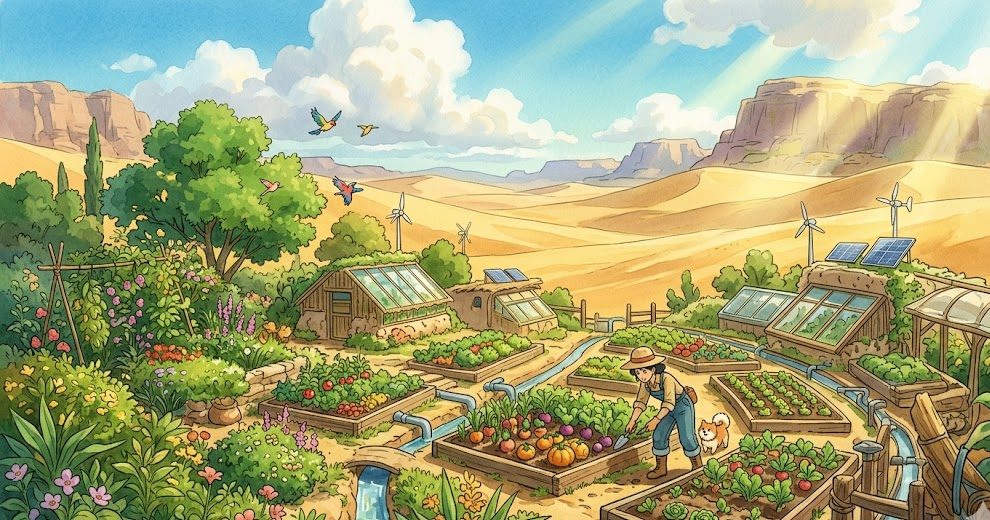
As the global climate shifts and food security becomes an increasingly urgent topic, the future of agriculture lies in innovation and adaptation. Moving beyond conventional farming methods, producers are now turning to specialized techniques that allow for food production in the most challenging environments. From the arid sands of desert landscapes to the high-density efficiency of micro-farming and the preservation of biological diversity through heirloom crops, specialized farming is proving to be both a survival strategy and a lucrative frontier.
In this guide, we explore the essential principles of mastering these niche agricultural systems and how they contribute to a more resilient food future.
1. Mastering Desert Agriculture: Turning Arid Land into Green Zones
Desert farming was once considered a near-impossible feat, but today, it is a testament to human ingenuity. The primary challenge in arid regions is, of course, water scarcity and extreme heat. However, with the right management, these regions can become highly productive.
Water Conservation and Precision Irrigation
The backbone of successful desert farming is water efficiency. Flood irrigation is largely obsolete in these environments. Instead, farmers must adopt drip irrigation systems that deliver water directly to the root zone, minimizing evaporation. Combining this with mulching—using organic or inorganic materials to cover the soil—helps retain moisture and protects the soil surface from the scorching sun.
Protected Cropping and Climate Control
To combat extreme solar radiation, many producers utilize shade netting. These structures reduce the intensity of sunlight while allowing enough light for photosynthesis, preventing crop heat stress. In more advanced setups, greenhouses equipped with cooling pads and circulation fans create a micro-climate where high-value crops like peppers, tomatoes, and certain melons can thrive even when the outside temperature is triple-digit.
2. The Micro-Farming Revolution: High Density, High Return
Micro-farming is the art of maximizing yield within a minimal footprint. Whether you are using a backyard, a vertical indoor setup, or a small urban plot, micro-farming prioritizes intensive land use and rapid turnover.
The “Intensive” Mindset
Micro-farmers focus on crops with short life cycles, such as leafy greens, herbs, and microgreens. By utilizing succession planting—where one crop is harvested and another is immediately sown in its place—a farmer can produce a continuous supply of produce throughout the year.
Soil Health and Nutrient Cycling
In a high-density environment, soil depletion is the greatest risk. Master micro-farmers rely heavily on composting and vermiculture. By recycling all organic farm waste into nutrient-rich humus, they maintain soil fertility without relying solely on synthetic inputs. This closed-loop system not only saves money but also builds the microbial life necessary for high-yield, nutrient-dense produce.
3. Heirloom Crop Mastery: Preserving Genetic Diversity
Heirloom crops—open-pollinated varieties that have been passed down through generations—are increasingly prized for their superior flavor, nutritional profile, and cultural significance. Unlike industrial hybrids, heirloom seeds can be saved and replanted, making them an essential tool for survival farming.
Why Heirloom Matters
Industrial agriculture has narrowed the genetic pool of our food supply to a few high-yielding but genetically uniform varieties. Heirloom varieties offer genetic resilience. Because these plants have adapted to specific local conditions over decades or centuries, they often possess natural resistance to local pests and diseases, and they are frequently more tolerant of regional climatic swings.
Seed Saving as a Skill
Mastering heirloom production is inseparable from the art of seed saving. A successful grower must learn to identify the most robust plants, ensure proper isolation to prevent cross-pollination, and master the techniques of cleaning and storing seeds. This knowledge empowers farmers to become self-reliant, reducing their dependence on external seed suppliers and preserving rare varieties that would otherwise be lost to time.
4. Integrating Systems for Maximum Resilience
The most successful specialized farmers do not view these methods in isolation. They integrate them to build a comprehensive survival system.
- Diversification: Never rely on a single crop or a single method. A farm that integrates heirloom vegetables for market, micro-greens for quick turnover, and desert-adapted drought-resistant varieties for security is inherently more stable.
- Data-Driven Decisions: Even in small-scale farming, monitoring soil moisture, local weather patterns, and market demand is critical. Keeping detailed records allows you to adjust your planting schedules and resource allocation based on what actually works for your unique climate.
- Value-Added Production: Specialized farming often yields premium products. Rather than selling raw produce at commodity prices, master the art of value-added processing. Drying herbs, creating heirloom seed packets, or providing “micro-farm” subscription boxes can significantly increase your profit margins.
5. Overcoming the Challenges of Niche Farming
While specialized farming is rewarding, it requires a higher level of technical knowledge than conventional row-crop farming.
- Pest Management: Smaller-scale, intensive systems can sometimes attract localized pest outbreaks. Integrated Pest Management (IPM), which uses beneficial insects and physical barriers rather than broad-spectrum pesticides, is essential to maintaining the delicate balance of your farm.
- The Learning Curve: Because these methods are specialized, the “trial and error” phase can be steep. Start small, document everything, and do not be afraid to experiment with new varieties that have been historically successful in your specific geographic micro-climate.
Conclusion
Survival and specialized farming are about more than just growing food; they are about mastering the environment. By adapting to the constraints of the desert, scaling down through micro-farming, and honoring the past through heirloom cultivation, you are building a system that is not only productive but also sustainable.
In a world of unpredictable climates and supply chains, the ability to grow high-quality food using specialized, resilient techniques is a profound advantage. Whether you are driven by the desire for self-sufficiency or the pursuit of a high-value niche market, the path to mastery begins with a commitment to soil health, genetic diversity, and smart, efficient management. Stay curious, stay observant, and continue to refine your craft in the field.