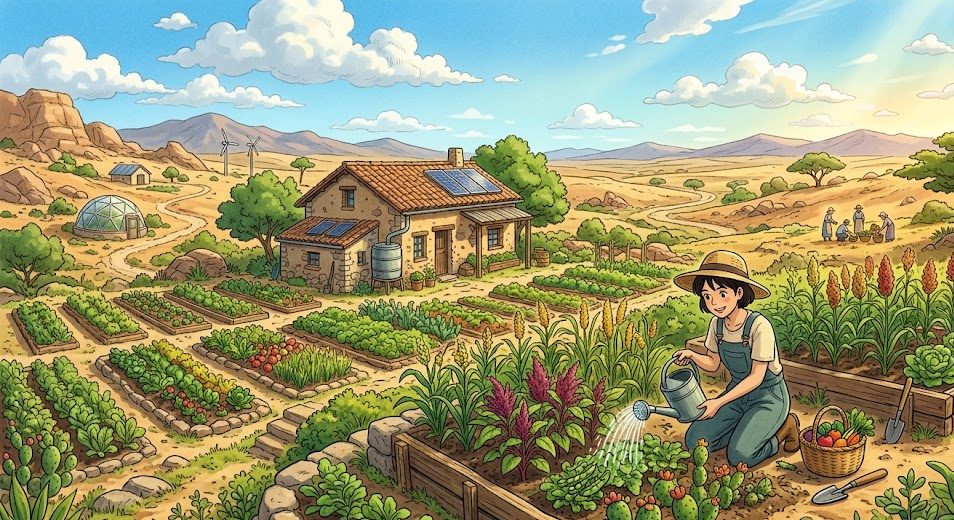
As the world grapples with shifting climates and expanding deserts, traditional large-scale monoculture is proving to be fragile. The future of resilient agriculture lies in Micro Farming—the practice of high-intensity, small-scale cultivation—combined with the revival of Forgotten Crops. These ancient, drought-tolerant species have sustained humanity for millennia in harsh environments and are now the keys to a sustainable, profitable future.
1. The Power of Micro Farming in Arid Environments
Micro farming focuses on maximizing the productivity of a small land area (often less than 5 acres). In arid lands, where water is “liquid gold,” this smaller footprint allows for much tighter resource management.
Key Micro-Farming Strategies:
- Precision Irrigation: Instead of flood irrigation, micro-farms utilize Drip Irrigation or Subsurface Drip systems. These deliver moisture directly to the root zone, reducing evaporation by up to 60%.
- Micro-Climates through Agroforestry: By planting drought-hardy trees (like Acacia or Neem) alongside crops, farmers create a “canopy effect.” This lowers ground temperatures, reduces wind erosion, and keeps the soil moist for longer.
- Soil Amending: In sandy, arid soils, organic matter is often non-existent. Micro farmers use Biochar and Vermicompost to turn “dirt” into a “sponge” that can hold water for weeks instead of minutes.
2. Reviving “Forgotten Crops”: The Guardians of Food Security
For decades, global agriculture has relied on a handful of crops like wheat, rice, and maize. However, these are often “water-thirsty” and struggle in heatwaves. Forgotten Crops (also known as Neglected and Underutilized Species or NUS) are naturally adapted to thrive where others fail. +1
Top Forgotten Crops for Arid Lands:
- Millet (Pearl and Finger Millet): Known as the “Miracle Grain,” millets require minimal water and can grow in poor, rocky soils. They are nutritionally superior to rice, containing high levels of iron and calcium.
- Sorghum: This ancient grain is remarkably heat-tolerant. It enters a state of “dormancy” during extreme droughts and resumes growth as soon as it rains.
- Bambara Groundnut: A “complete food” containing protein, carbs, and fats. It is a legume that fixes nitrogen back into the soil, making it a perfect partner for crop rotation.
- Pigeon Pea: A perennial legume that provides food, fodder for livestock, and fuel (from its woody stems) while improving soil structure with its deep taproots.
3. Techniques for Reviving Ancient Seeds
Reviving these crops isn’t just about planting them; it’s about restoring the biological and technical knowledge required to make them viable.
- Community Seed Banks: Setting up localized seed libraries ensures that climate-adapted varieties aren’t lost. These seeds have “genetic memory” of the local climate, making them more resilient than commercial hybrids.
- Ecological Seed Priming: Treating seeds with natural extracts or beneficial microbes before planting to give them a head start in dry conditions.
- In-Situ Conservation: Growing these crops in their natural habitats to allow them to continue evolving alongside changing weather patterns.
4. Innovative Water Harvesting for Arid Micro-Farms
In a micro-farming setup, every drop of rain must be captured.
- Zai Pits: A traditional African technique where small pits are dug and filled with organic matter. These pits act as “water traps” during the brief rainy season, concentrating moisture and nutrients exactly where the seed is planted.
- Contour Bunding: Small ridges built along the slopes of the land to slow down water runoff, giving the earth time to absorb the moisture.
- Dew and Fog Harvesting: In coastal arid regions, using mesh nets to capture moisture from the morning air can provide a consistent source of “free” water for high-value micro-crops.
5. The Economic Case: Why This Matters for 2026
From an entrepreneurial perspective, micro farming and forgotten crops represent an untapped “Blue Ocean” market.
- Lower Input Costs: These crops require significantly less chemical fertilizer and pesticide, drastically reducing your operational overhead.
- Climate-Resilience: While neighbors might lose their wheat crops to a heatwave, your Sorghum or Millet will likely survive, ensuring consistent revenue.
- Niche Premium Markets: There is a growing global demand for “Ancient Grains” and “Superfoods.” Selling these as premium, organic products can fetch 2-3x the price of standard commodities.
- Passive Income Integration: A micro-farm can be automated with IoT Soil Sensors and solar-powered pumps, allowing the system to run with minimal manual labor—perfect for the digital entrepreneur managing multiple assets.
6. Sustainable Integration: The Holistic Loop
To be truly sustainable, a micro-farm should be a closed loop:
- Livestock Integration: Use sheep or goats to graze on crop residues; their manure then fertilizes the next round of millets.
- Waste to Wealth: Turn stalks and husks into bio-fuel or compost.
- Beekeeping: Use hardy arid-land bees to pollinate your forgotten crops, adding honey as a secondary income stream.
7. Conclusion: The Future is Small and Diverse
The era of massive, resource-heavy farms is being challenged by a more intelligent, localized, and diverse model. By mastering Micro Farming and championing Forgotten Crops, we can turn arid lands from “barren” to “bountiful.”
This transition isn’t just an ecological necessity—it is a strategic business move for anyone looking to build a secure, sustainable, and profitable future in agriculture.
AdSense & SEO Strategy for Yagnik:
- Key Keywords: “Regenerative Agriculture Arid Lands,” “Drought Resistant Crops Guide,” “Micro Farming Profitability,” and “Ancient Grains Nutrition.”
- Engagement Tip: Add a “FAQ” section at the end of the post about where to buy ancient seeds to boost long-tail search traffic.
- Visual Direction: Maintain your Studio Ghibli-inspired watercolor style. Visualize a golden sun over a lush, green micro-farm in the middle of a desert, with small ponds and healthy, tall sorghum stalks. It should look like an oasis—clean, calm, and productive.
For a deeper look into the practical application of these methods in extreme environments, this video provides excellent context: Regenerating Arid Land with Micro-Farming
This video is highly relevant as it showcases real-world examples of how small-scale interventions and resilient crop choices can transform degraded, dry landscapes into productive ecosystems.

https://youtube.com/watch?v=L2G3T6P9Uyo%3Fhl%3Den-GB%26rel%3D0%26showinfo%3D0%26enablejsapi%3D1%26origin%3Dhttps%253A%252F%252Fgemini.google.com%26widgetid%3D3%26forigin%3Dhttps%253A%252F%252Fgemini.google.com%252Fapp%252F26a4a6d0abb22fe3%26aoriginsup%3D1%26vf%3D1