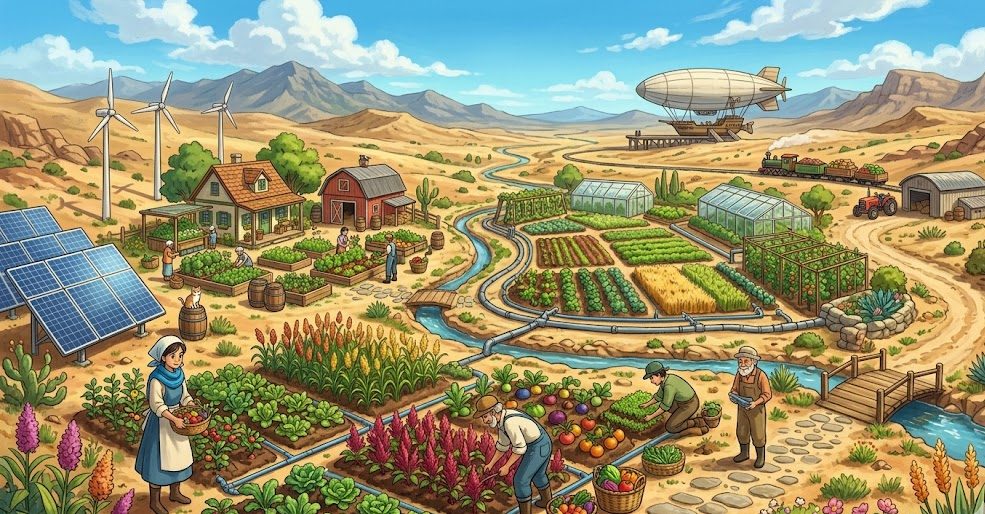
As we navigate a world of shifting climates and shrinking resources, the traditional agricultural model is being challenged. The “Green Revolution” of the past is being replaced by a “Digital and Biological Revolution.” To feed a global population in 2026, we are turning our eyes toward three unexpected frontiers: the heat of the desert, the precision of micro-spaces, and the genetic wealth of forgotten ancient crops.
1. Desert Farming: Turning Sand into Gold
For decades, deserts were seen as “wastelands” for agriculture. Today, through high-tech innovation, they are becoming the world’s most promising greenhouses.
A. Nano-Clay Technology (LNC)
One of the biggest hurdles in desert farming is that sand cannot hold water. Liquid Nano-Clay is an innovation that wraps every grain of sand in a thin layer of clay, transforming it into a “sponge” that retains water and nutrients. This allows crops like watermelons, citrus, and grains to flourish in the Sahara or the Middle East with 50% less water.
B. Seawater Greenhouses
Innovative greenhouses are now using the power of the sun and the ocean. Seawater is evaporated to cool and humidify the air inside the greenhouse, and the condensed salt-free water is then used to irrigate the crops. This creates a self-sustaining cycle that requires zero freshwater.
C. Solar-Agri Synergy
Desert farms are the perfect place for Agrivoltaics. By placing solar panels high above the crops, we achieve two things:
- Energy Generation: Powering the farm’s cooling and irrigation systems.
- Shade Protection: Reducing the heat stress on the plants below, which significantly lowers water evaporation.
2. Micro-Farming: Maximum Yield in Minimal Space
Micro-farming is the answer to rapid urbanization. It is the practice of intensive food production on small plots of land—often less than five acres—or even inside city buildings.
A. The Vertical Revolution
Micro-farming often goes vertical. By stacking crops in climate-controlled indoor environments, farmers can produce 30x more food per square foot than traditional field farming.
- Hydroponics & Aeroponics: These systems deliver nutrients directly to the roots via water or mist, completely removing the need for soil and reducing water usage by 95%.
B. High-Value “Niche” Production
Micro-farmers focus on quality over quantity. Instead of mass-producing wheat, they focus on:
- Microgreens: Nutrient-dense young greens harvested in 7–14 days.
- Gourmet Mushrooms: Using vertical racks to grow Lion’s Mane or Oyster mushrooms in dark, humid basements.
- Beekeeping: Integrating hives into small plots to provide honey and ensure local pollination.
C. The Tech Stack
Micro-farming is powered by IoT (Internet of Things). Small-scale farmers use sensors to monitor every variable—CO2, light spectrum, and nutrient pH—directly from their smartphones, making “precision agriculture” accessible to everyone.
3. Forgotten Crops: The Resurrection of Ancient Nutrition
In our pursuit of volume, the world has become dependent on just four crops: Wheat, Rice, Corn, and Soy. This lack of diversity is a threat to global food security. The future of agriculture lies in “Forgotten” or “Underutilized” crops.
A. Millets: The Climate-Smart Grains
Millets (like Ragi, Bajra, and Jowar) were the staples of our ancestors. They are “Super-Crops” because they:
- Are gluten-free and rich in minerals.
- Can grow in poor soil with almost no irrigation.
- Are naturally resistant to pests, removing the need for chemical sprays.
B. Breadfruit and Cassava
These resilient tropical crops are being rediscovered for their massive caloric yield and ability to grow in harsh conditions. Breadfruit, in particular, is being hailed as a “Tree of Life” because one tree can feed a family for decades.
C. Perennial Grains (Kernza)
Traditional grains die every year and must be replanted, which leads to soil erosion. Scientists are now domesticating Perennial Grains like Kernza. Once planted, they grow for years, developing deep roots that trap carbon in the soil and prevent drought damage.
4. The Integration: A Circular Ecosystem
The most successful “Future Farms” will integrate all three concepts. Imagine a desert innovation hub that uses solar power to run a vertical micro-farm, growing drought-resistant ancient millets alongside high-value hydroponic greens.
- Waste to Wealth: The waste from a mushroom micro-farm becomes compost for the desert’s nano-clay soil.
- Biodiversity: Reintroducing forgotten crops ensures that if a disease hits the global wheat supply, we have a “genetic backup” ready to feed the world.
5. Economic & Strategic Advantages
Why is this the future for Agri-Entrepreneurs?
- Market Demand: Modern consumers are looking for “Superfoods” (Forgotten Crops) and “Locally Grown” (Micro-Farming) produce.
- Resource Security: Reducing dependence on rain and fertile soil makes your business “Climate-Proof.”
- Scalability: You can start a micro-farm in a single shipping container and scale it into a global network of “Farm Hubs.”
6. Conclusion: The New Dawn of Farming
The future of agriculture is not about fighting nature, but about using technology to mirror its resilience. By embracing the Desert, we expand our boundaries. By mastering Micro-Farming, we optimize our efficiency. And by reviving Forgotten Crops, we reclaim our health and biodiversity.
In 2026, the most successful farmer is not the one with the most land, but the one with the most Innovation. Whether you are growing millet in the sand or kale in a skyscraper, you are part of a movement that is ensuring the thali (plate) of the future remains full, nutritious, and sustainable.
Key Takeaways for the Modern Farmer:
- Adaptability: Don’t fear harsh environments; use tech (like LNC or Drones) to conquer them.
- Diversity: Stop growing what everyone else is; look for the “Forgotten” high-value crops.
- Precision: Every drop of water and every square inch of space counts. Optimize through IoT.
The fields of the future are limited only by our imagination!