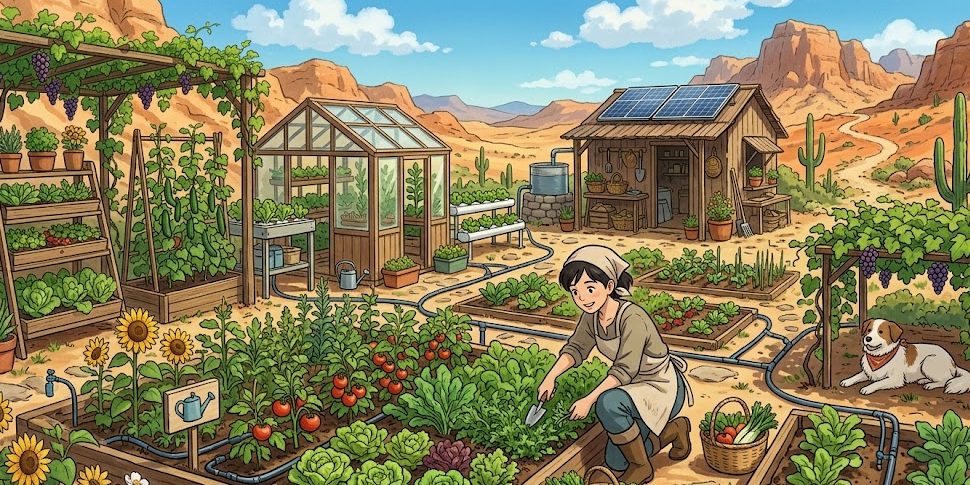
The global agricultural landscape is shifting. With urbanization rising and fertile land becoming a luxury, the future of food security lies in two seemingly impossible areas: Micro Farming and Desert Cultivation. Whether you are dealing with a tiny backyard in a crowded city or the sandy, arid soil of a dry region, technology and innovative techniques have made it possible to turn a “dead” space into a thriving green oasis.
This guide provides a deep dive into the strategies, tools, and mindsets required to master small-scale, high-yield farming and the secrets to making the desert bloom.
1. The Power of Micro Farming: Think Vertical, Not Horizontal
Micro farming is about maximizing the “yield per square inch.” When you don’t have acres of land, you must stop thinking about the ground and start thinking about the air.
A. Vertical Farming and Hydroponics
In a micro-farm, every wall is a potential garden.
- A-Frame Systems: Using A-shaped wooden or PVC structures allows you to stack layers of plants. The top layer gets the most sun, while the bottom layers house shade-loving greens.
- Hydroponic Towers: These vertical tubes use a “nutrient film” or “aeroponic mist” to feed plants. You can grow 30–50 plants in the space usually occupied by one, making it ideal for urban entrepreneurs.
B. High-Density Biointensive Planting
Unlike traditional rows with wide paths, biointensive farming uses hexagonal spacing. By planting crops close enough so that their leaves touch at maturity, you create a “living mulch.” This suppresses weeds and keeps the soil cool and moist—a critical factor in small-space success.
2. Desert Cultivation: Turning Sand into Gold
Farming in the desert or arid regions presents two massive hurdles: extreme heat and the lack of organic matter in the soil. However, civilizations have thrived in deserts for millennia, and modern tech has perfected their methods.
A. Liquid Nanoclay (LNC) and Soil Conditioning
Desert sand cannot hold water; it simply drains away.
- LNC Technology: This involves mixing thin layers of clay with water and applying it to sand. It coats each grain of sand, allowing it to hold onto water and nutrients just like high-quality loam.
- Biochar: Adding charcoal-like organic matter to desert soil creates “micro-pockets” that house beneficial bacteria and retain moisture for long periods.
B. Deep-Root Irrigation
Surface watering in the desert is a waste of time—the sun will evaporate it in minutes.
- Olla Irrigation: An ancient technique using unglazed clay pots buried in the ground. Water slowly seeps through the clay directly to the roots.
- Subsurface Drip: Placing drip lines 6–12 inches underground ensures that every drop of water goes exactly where it’s needed, reducing water usage by up to 80%.
3. Choosing the Right Crops for Stressful Environments
In micro-farming and desert setups, your crop choice determines your profit margin.
| Environment | Recommended Crops | Why? |
|---|---|---|
| Micro Farm (Urban) | Microgreens, Basil, Strawberries | High value, fast turnover, small footprint. |
| Desert (Arid) | Date Palms, Pomegranates, Figs | Naturally drought-tolerant and heat-loving. |
| Both | Cherry Tomatoes, Peppers | Adaptable to containers and vertical trellises. |
Export to Sheets
4. Smart Technology in Harsh Conditions
To succeed in small or dry spaces, you need to work smarter. This is where AgriTech comes in.
- IoT Moisture Sensors: In a desert, you can’t afford to guess. Sensors placed at different depths will tell your smartphone exactly when the water has reached the root zone.
- Automated Shade Systems: Using light sensors, motorized shade cloths can deploy during the 12:00 PM to 4:00 PM “danger zone” to prevent plant wilting, then retract to allow evening sun.
- Solar Desalination: For coastal desert regions, small-scale solar stills can turn brackish (salty) water into pure water for irrigation, making the farm entirely self-sufficient.
5. Managing Micro-Climates
A micro-farmer is a “Climate Architect.” You can create a mini-environment that differs from the harsh world outside your fence.
- Windbreaks: In deserts, hot winds can “cook” plants. Planting a perimeter of hardy shrubs or using mesh windbreaks can reduce wind speed and lower the transpiration rate of your crops.
- Thermal Mass: Using stones or water barrels inside a small greenhouse or micro-farm helps regulate temperature. They soak up heat during the day and release it slowly at night, preventing extreme temperature swings.
6. The Economics of Small-Scale Success
Can you really make money from a tiny plot or a sandy patch? Yes.
- Niche Marketing: Don’t compete with big farms on potatoes or onions. Focus on Exotic Vegetables or Medicinal Herbs that command high prices at boutique hotels and health food stores.
- Subscription Models: Use your micro-farm to provide “Freshness Boxes” to neighbors. Because your food travels only a few meters, the quality will always beat the supermarket.
- Waste-to-Wealth: Use a closed-loop system. Use kitchen waste for vermicomposting (worm farming) to create high-quality fertilizer that would otherwise cost a fortune in desert regions.
7. Step-by-Step Launch Plan
- Analyze Your Sunlight: Observe your space for 3 days. Where does the sun hit the hardest? Where is the shade?
- Start with the Soil: If it’s sand, add organic matter and clay. If it’s an urban balcony, use high-quality coco-peat and perlite.
- Install Smart Irrigation: Even a simple gravity-fed drip system is better than a hose.
- Go Vertical: Install your first trellis or wall planter.
- Monitor and Iterate: Use a simple log to track which plants survived the heat and which didn’t.
8. Conclusion: No Space is Too Small, No Land is Too Dry
The limitations of your land are only limited by your imagination. Micro farming proves that we don’t need vast acres to feed ourselves, and desert cultivation proves that even the harshest environments can be tamed with the right techniques.
By combining ancient wisdom—like Olla pots and biointensive spacing—with modern tech—like IoT sensors and LNC—you can turn a concrete balcony or a sandy backyard into a productive, profitable, and beautiful sanctuary.
The future of farming isn’t just in the fields; it’s in the small corners and the dry sands we once thought were useless. It’s time to start growing.