In the rapidly evolving economy of 2026, the traditional idea that you need hundreds of acres to be a successful farmer is officially obsolete. As land prices rise and urban centers expand, a new breed of “Agri-Entrepreneurs” is emerging. For professionals seeking Financial Freedom, Micro Farming has become a high-yield “Digital Goldmine.” By utilizing specialized “Smart Technology” and “Natural Farming” principles, it is now possible to turn a small backyard, a balcony, or even a spare room into a highly profitable venture.
This guide provides the ultimate “Practical Farming” blueprint for maximizing your harvest and your profits in a limited footprint.
1. The Philosophy of Micro Farming: Quality Over Quantity
The secret to Micro Farming isn’t growing more; it’s growing better. In 2026, profit margins are found in niche markets where “Exotic” and “Zero Chemical” produce command premium prices.
- High-Value Cash Crops: Focus on crops with short growth cycles and high market value per square foot, such as microgreens, gourmet mushrooms, or cherry tomatoes.
- Precision Yields: Every inch of space is a digital asset. By managing inputs with “Smart Technology,” you ensure that the “biological engine” of your farm is running at peak efficiency.
- The Closed-Loop Model: Micro Farming thrives when it is self-sustaining. Integrating small-scale composting or vermiculture ensures your soil is “recharged” without the cost of synthetic NPK.
2. Vertical Innovation: Thinking Up, Not Out
When you can’t expand horizontally, you must expand vertically. This is a mechanical necessity for any urban Farming Innovation Hub.
- Vertical Gardening: Use tiered shelving, wall-mounted planters, or tower systems to quintuple your growing area on the same footprint.
- Hydroponics and Aeroponics: These soilless “Smart Farming” innovations allow for 90% less water usage and 50% faster growth rates. They are perfect for “low-maintenance” indoor setups.
- Micro-Climates: Use small greenhouses or grow tents to create perfect summer conditions year-round, allowing for a continuous “Passive Income” stream regardless of the season.
3. Smart Technology for the Small-Scale Grower
In 2026, even the smallest farm can benefit from “AgriTech.” Technology acts as the “brain,” allowing the grower to focus on strategy rather than manual labor.
- IoT Soil & Moisture Sensors: These sensors provide real-time data to your phone, ensuring your “water-saving techniques” are precise and effective.
- Automated LED Lighting: In indoor Micro Farming, smart LEDs simulate the perfect spectrum of natural light, accelerating photosynthesis and increasing nutrient density.
- AI Predictive Analytics: Artificial Intelligence can analyze local market trends to tell you exactly which “Smart Crops” will be in highest demand next month, ensuring your harvest always finds a buyer.
4. Healing the Soil Naturally: The Organic Advantage
Even in small spaces, the health of your growing medium is paramount. “Healing the soil naturally” is the best way to ensure long-term resilience and Zero Chemical Costs.
- Living Soil: For container gardening, focus on creating a “living” medium rich in beneficial microbes and fungal networks (mycorrhizae).
- Organic Bio-Inputs: Utilize fermented organic matter and compost teas as liquid gold for your plants. These bio-inputs “recharge” the soil without the “burning” effect of chemical fertilizers.
- Natural Pest Management (NPM): In a small space, a single pest can be a disaster. Use biodiversity and biological barriers to manage threats naturally, keeping your produce clean and high-value.
5. Livestock Integration: The “Micro” Version
You don’t need a pasture to raise animals. Small-scale livestock can provide both a product and a resource for your “Closed-Loop” system.
- Quail and Poultry: Quails require very little space and produce high-value eggs that are prized in gourmet markets.
- Aquaponics: Combine fish farming with hydroponics. The fish provide the natural fertilizer for your plants, while the plants clean the water for the fish.
- The Manure Cycle: Small-scale livestock waste is the ultimate raw material for your bio-inputs, ensuring your Micro Farm remains a self-sustaining ecosystem.
6. Digital Branding and Market Access
In 2026, how you sell is as important as what you grow. Your Micro Farm is a brand.
- Traceability: Use digital logs to show your customers the “Zero Chemical” journey of their food. Transparency is a “digital goldmine” for modern consumers.
- Direct-to-Consumer: Bypass middlemen by using digital platforms to sell directly to health-conscious neighbors or high-end local cafes.
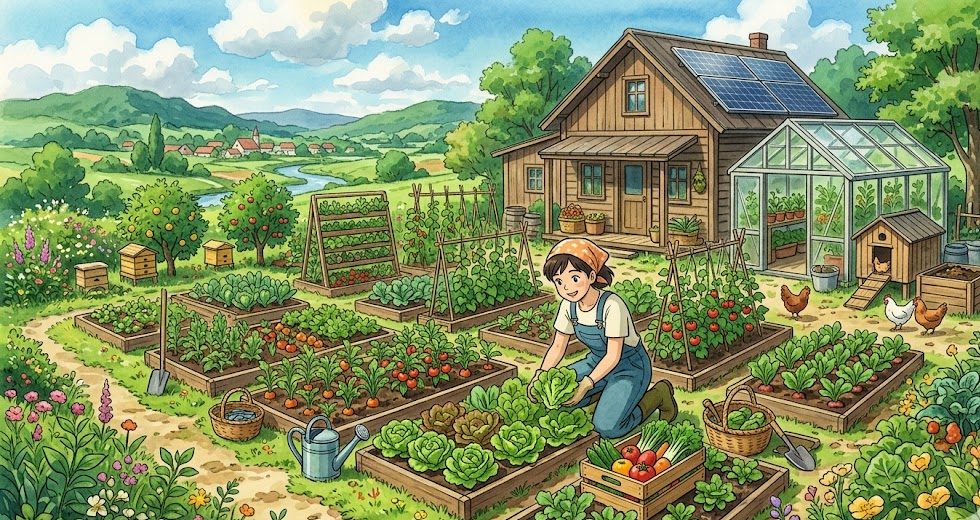
- Niche Aesthetics: Use professional branding, such as Studio Ghibli-inspired watercolor art, to illustrate your farm’s story on social media. This hand-painted anime style resonates with premium buyers who value “Natural Beauty” and “Smart Tech.”
Conclusion: Your Path to Financial Freedom
Micro Farming in 2026 is a strategic path to Financial Freedom. It proves that with the right combination of “Smart Technology,” “Natural Farming,” and “Vertical Innovation,” any space can become a high-yield harvest.
Whether you are starting a “Survival Farm” for self-reliance or building a commercial “Farming Innovation Hub” in your apartment, the goal remains the same: grow more, waste less, and achieve a record-breaking profit per square foot. The future of agriculture isn’t just in the fields; it’s in the small spaces where innovation thrives.