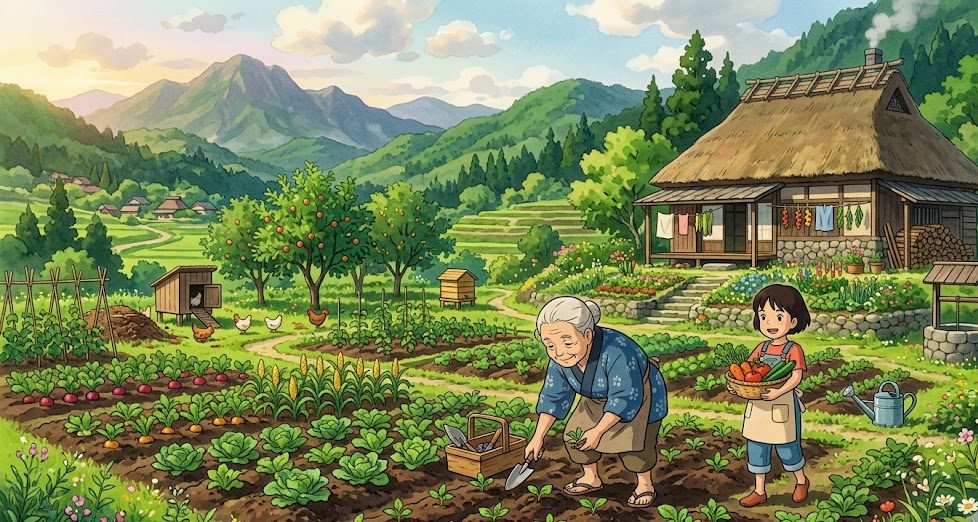
In an era of global supply chain volatility and environmental shifts, the concept of Financial Freedom has expanded to include “Food Sovereignty.” For the modern individual, true independence is found in the ability to produce what you consume. This “Survival Farming” blueprint isn’t just about growing food; it’s about mastering a “Closed-Loop” ecosystem that ensures your “Digital Goldmine” remains secure regardless of external market conditions.
Whether you are managing a “Micro Farming” plot or a larger “Farming Innovation Hub,” these essential skills are the mechanical necessity for a self-sufficient life.
1. Healing the Soil Naturally: The Biological Engine
The foundation of survival is the soil. If your soil is dead, your independence is an illusion. Mastering the art of “healing the soil naturally” ensures that your farm remains a high-yield asset without the need for expensive, synthetic chemical NPK.
- The No-Till Advantage: Plowing destroys the fungal networks (mycorrhizae) that act as a natural nutrient delivery system. Adopting no-till practices preserves soil structure and moisture.
- Composting and Bio-Inputs: Learn to turn organic waste into “Blue Gold.” Utilizing fermented organic matter and bio-inputs “recharges” the soil’s microbial life at zero cost.
- Cover Cropping: Use “green manure” crops to fix nitrogen and prevent erosion, acting as a protective blanket for your land during the off-season.
2. Water-Saving Techniques: Securing “Blue Gold”
In a survival scenario, water is more valuable than currency. You must move beyond simple watering to advanced “water-saving techniques.”
- Rainwater Harvesting: Building small on-farm reservoirs or swales allows you to capture and store every drop of monsoon rain for use during the dry summer months.
- Precision Drip Irrigation: If you have access to a small pump, a gravity-fed drip system delivers hydration directly to the root zone, reducing waste by up to 60%.
- Mulching as a Shield: A thick layer of mulch acts as a low-maintenance barrier, suppressing weeds and drastically reducing evaporation from the soil surface.
3. Smart Crop Selection: Growing for Density and High-Yield
Survival farming requires you to prioritize “High-Value Cash Crops” that offer the most nutrition per square foot.
- Exotic and Hardy Vegetables: Focus on nutrient-dense varieties like broccoli, zucchini, and heirloom cherry tomatoes.
- Ancient Grains: Reviving “Lost Gold” crops like amaranth or millets provides a resilient source of protein and carbohydrates that can thrive in harsh conditions.
- The Vertical Harvest: Use “Vertical Gardening” to maximize space, allowing you to grow a record-breaking amount of food even in a “Micro Farming” setup.
4. Integrated Livestock: The “Closed-Loop” Synergy
Animals are not just a food source; they are the “Smart Tech” that keeps your farm’s “biological engine” running.
- Poultry and Quail: These birds require minimal space and provide high-quality protein through eggs and meat, while their waste serves as the primary raw material for your bio-inputs.
- Sheep and Goats: Small ruminants are excellent for clearing brush and providing dairy, and they fit perfectly into a “low-maintenance” rotational grazing system.
- Aquaponics: Combine fish farming with hydroponics. This “Smart Farming” innovation uses 90% less water and creates a self-cleaning cycle of nutrients and protein.
5. Smart Technology for the Self-Sufficient Farmer
Even a survival farm benefits from “AgriTech.” In 2026, technology is the bridge to a “low-maintenance” high-yield harvest.
- IoT Monitoring: Use simple, solar-powered soil sensors to monitor moisture and pH levels, ensuring you never waste resources.
- AI Predictive Analytics: Artificial Intelligence can act as the “brain” of your farm, analyzing local weather data to provide a precise blueprint for planting and harvesting.
- Off-Grid Power: Mastering small-scale solar or wind energy ensures that your “Smart Technology” remains functional even during power grid failures.
6. Natural Pest Management (NPM)
In a self-sufficient life, you cannot rely on store-bought pesticides. You must master “Natural Pest Management” to protect your crops.
- Biodiversity as a Shield: Planting a variety of crops confuses pests and invites natural predators like birds and frogs into your ecosystem.
- Botanical Repellents: Learn to create your own bio-pesticides using neem, garlic, or fermented organic sprays to boost plant immunity naturally.
Conclusion: Securing Your Future Goldmine
Total food security is a strategic path to Financial Freedom. By combining the precision of Smart Technology with the ancestral wisdom of Natural Farming, you transform your land into a resilient, high-yield environment that requires zero chemical costs.
Whether you are scaling a commercial innovation hub or practicing “Micro Farming” for your family, the goal remains the same: grow more, waste less, and restore the earth. The self-sufficient life is the ultimate “Digital Goldmine,” providing the independence and security that only a well-managed farm can offer.