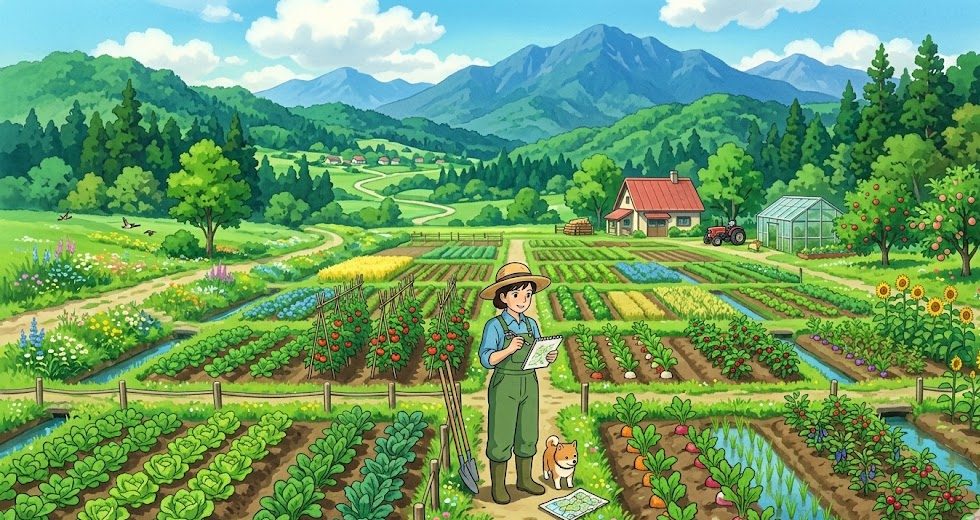
Can a single acre of land really provide a full-time income? While traditional commodity farmers often require thousands of acres to stay afloat, modern micro-farmers are proving that a well-managed single acre can generate between $40,000 and $100,000 in annual revenue. The “Challenge” for many beginners is the misconception that farming is a “get big or get out” game. This “Pain Point” leads to analysis paralysis, where aspiring growers wait years to save for massive plots of land that they don’t actually need to start a successful business.
The “Main Concept” that changes everything is High-Intensity Market Gardening. By focusing on soil health, high-value specialty crops, and direct-to-consumer sales, a one-acre farm can become a high-margin enterprise rather than a low-yield hobby. This article serves as your comprehensive “Thesis Statement” for agricultural entrepreneurship; we will explore the fundamental logic of small-scale farming, the economic benefits of staying small, and a 5-step actionable roadmap to launch your 1-acre business from scratch.
Understanding 1 Acre Farming: Key Concepts and Importance
One-acre farming, often called “Market Gardening,” is a business model that prioritizes output per square foot over total acreage. Historically, this was how cities were fed before the advent of industrial transport. Today, it is more relevant than ever as consumers demand hyper-local, organic produce. In this model, the farm is treated as a high-efficiency production plant where every bed is managed with surgical precision.
Think of 1-acre farming like a high-end boutique bakery compared to a massive industrial bread factory. The factory (large-scale farming) wins on volume but has razor-thin margins and high overhead. The boutique bakery (your 1-acre farm) wins on quality, specialty items, and the ability to charge a premium because customers value the craftsmanship and freshness.
Technically, the success of a 1-acre plan relies on Biointensive methods. This involves permanent raised beds, close plant spacing, and “Succession Planting.” Instead of planting one crop of corn and waiting all summer, a 1-acre farmer might harvest radishes in April, salad greens in June, and carrots in September—all from the exact same square foot of soil. This “stacking” of harvests is what makes the economics of a small plot so incredibly powerful.
Why It Matters: The Top Benefits of 1 Acre Farming
Starting small isn’t just a compromise; it’s a strategic advantage. A 1-acre farm offers several “unfair” benefits over traditional agricultural models.
- Low Capital Requirements: You don’t need a $150,000 tractor or a massive grain silo. Most 1-acre farms can be managed with a walk-behind tractor (like a BCS), high-quality hand tools, and a basic irrigation system. This means you can reach profitability much faster.
- Direct-to-Consumer Margins: Because your volume is manageable, you can sell at farmers’ markets, through a CSA (Community Supported Agriculture), or directly to local chefs. You keep 100% of the retail price instead of the 15% typical of wholesale farming.
- Minimal Waste: It is much easier to monitor and protect one acre from pests and disease than it is 100 acres. This leads to higher-quality produce and significantly less “shrinkage” or crop loss.
- Environmental Stewardship: Small-scale farms are carbon-sequestering engines. By using no-till methods and heavy composting, you are actively rebuilding topsoil and supporting local biodiversity.
Pro Fact: Research from The Market Gardener shows that diversified organic vegetable farms can be ten times more profitable per acre than conventional commodity grain farms.
How to Get Started: A Practical Guide for Beginners
Launching a 1-acre farm requires a shift from “gardening” to “systems management.” Follow this 5-step plan to ensure your land pays for itself.
1. Site Analysis and Infrastructure
Don’t just start digging. Map your acre for Sun Exposure and water access. You will need a “Wash-and-Pack” station, a small nursery (greenhouse or hoop house), and a tool shed. Standardize your bed size—usually 30 inches wide by 50 or 100 feet long—to ensure all your tools work interchangeably across the farm.
2. Selection of “High-Turnover” Crops
For 1-acre success, focus on crops with a high “Value per Bed.”
- Salad Mixes and Arugula: Fast growth, multiple cuts.
- Heirloom Tomatoes: High retail price, vertical growth.
- Microgreens: Can be grown in trays to stack production.
- Gourmet Mushrooms: High-value niche that requires little space.
3. Implement the “Permanent Bed” System
Use a No-Till approach. Instead of plowing the soil every year, which destroys soil structure, you layer compost on top. This suppresses weeds naturally and creates a “biological engine” that feeds your plants without synthetic fertilizers.
4. Set Up Precision Irrigation
In a small space, every drop counts. Use drip irrigation with a timer. This ensures plants are never stressed by drought, which is the #1 cause of stunted growth and poor flavor in vegetables.
5. Build Your “Market Channel”
Before you harvest, you must know where you are selling. Reach out to local restaurants, set up a social media page for your CSA subscriptions, and apply for local farmers’ market stalls. In micro-farming, your “Brand” is as important as your “Broccoli.”
Beginner’s Tip: Avoid the “Variety Trap.” It is tempting to grow 50 different vegetables. In your first year, master 5 to 8 core crops that you know will sell. Efficiency comes from repetition.
Overcoming Challenges and Looking into the Future
The biggest hurdle for the 1-acre farmer is Labor Efficiency. Since you aren’t using big machines, you are the engine. To solve this, you must “lean out” your processes—storing tools exactly where they are used and organizing your harvest workflow to minimize steps. Another challenge is Zoning; ensure your land is legally cleared for commercial agricultural use before investing in infrastructure.
Future Trends: We are seeing a massive rise in Agri-Tech for Smallholders. Innovations like solar-powered weed-zapping robots and smartphone-monitored soil sensors are making it possible to manage a 1-acre plot with 30% less physical labor. Additionally, Agrivoltaics (solar panels over crops) is allowing farmers to generate electricity and food from the same acre, creating a secondary income stream.
Conclusion
A 1-acre farm is more than a plot of land; it is a platform for financial and personal freedom. By focusing on High-Intensity Market Gardening, Soil Health, and Direct Sales, you can build a resilient business that feeds your community and your family.
The core message is simple: You don’t need more land; you need more intention. Start where you are, invest in your soil, and grow your way to a more sustainable and profitable future.
Would you like me to help you create a specific “Crop Rotation Calendar” for your 1-acre plot based on your local climate and hardiness zone?
FAQs
Q1: How much time does a 1-acre farm take to manage? During the peak season, a 1-acre farm is a full-time job (40–50 hours a week). However, by utilizing automated irrigation and “No-Till” weed suppression, many farmers find they can manage the workload effectively with one full-time person and occasional part-time help during harvest.
Q2: Can I make a living on 1 acre without livestock? Yes. In fact, specialty vegetables, mushrooms, and microgreens often have a higher profit margin per square foot than meat or dairy. Livestock can be added later as part of a “closed-loop” system, but they aren’t required for profitability.
Q3: What are the best tools for a 1-acre beginner? The “Big Three” for small-scale success are a Broadfork (for aerating soil), a Tilther (for prepping the top inch of seedbeds), and a Jang Seeder (for precision planting). These tools replace the need for a full-sized tractor.
Q4: Is 1 acre enough to feed a family and still sell at market? Absolutely. A family of four typically needs only 5,000 to 10,000 square feet (about 1/8th to 1/4th of an acre) to meet their vegetable needs. The remaining 30,000+ square feet is your commercial production zone.