Did you know that the average meal on an American dinner plate has traveled over 1,500 miles just to get there? In an era of global supply chain fragility and skyrocketing inflation, many are beginning to ask: What happens if the trucks stop moving? The “Pain Point” for the modern consumer is a total loss of agency over the most basic human need—food. We live in a state of “just-in-time” dependency, where our survival is outsourced to complex logistics and industrial monopolies.
The “Challenge” of escaping this system is that most people believe self-sufficiency requires hundreds of acres and a lifetime of agricultural training. However, the “Main Concept” of a Self-Sufficient Farming Lifestyle is not about land size; it is about a radical shift in mindset from consumption to production. It is the art of building a “closed-loop” system where your land feeds you, and you, in turn, heal the land.
This guide serves as your foundational roadmap. You will learn the core philosophy of self-reliance, the undeniable economic and personal benefits of the lifestyle, and a practical, step-by-step plan to transition from a grocery-store dependent to a sovereign producer.
Understanding Self-Sufficient Farming: Key Concepts and Importance
At its heart, self-sufficient farming is the practice of managing a piece of land—whether a small suburban backyard or a multi-acre homestead—to provide for your own needs. While historically this was the default way of life for 90% of humanity, its modern relevance is fueled by a desire for food security, health, and environmental stewardship. It is the ultimate insurance policy against economic volatility.
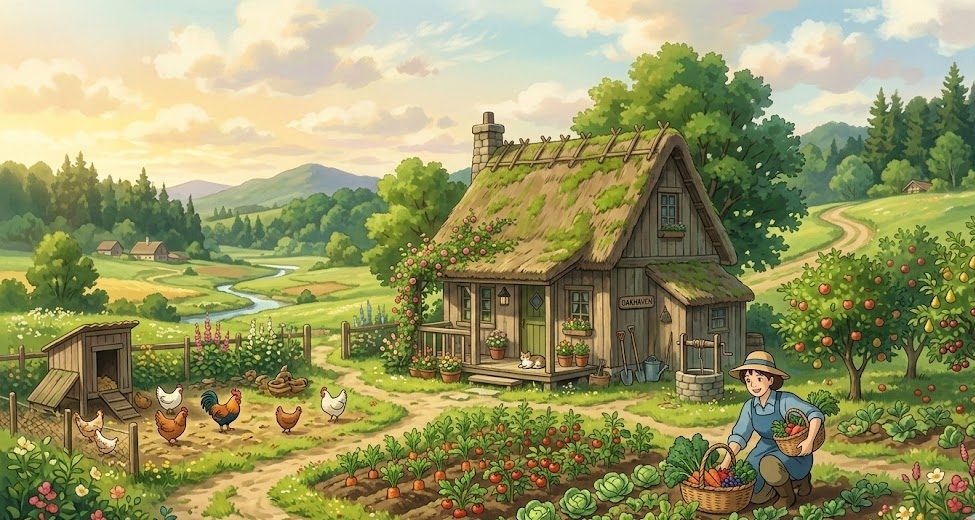
Think of a self-sufficient farm as a perpetual motion machine. In a standard industrial farm, you must constantly “fuel” the machine with external inputs: synthetic fertilizers, pesticides, and store-bought seeds. In a self-sufficient system, the “waste” becomes the “fuel.” Chicken manure becomes the fertilizer for the vegetables; the vegetable scraps feed the chickens; and the chickens provide eggs and pest control for the garden.
This is often referred to as Permaculture. The goal is to mimic a natural forest. In a forest, nobody fertilizes the trees or waters the grass, yet it thrives. By understanding the relationships between plants, animals, and soil, you can create a high-output ecosystem that requires less manual labor and zero chemical intervention over time.
Why It Matters: The Top Benefits of the Lifestyle
Embracing a self-sufficient lifestyle offers a multifaceted return on investment that impacts your bank account, your body, and your peace of mind.
- Financial Sovereignty: By producing your own staples—like potatoes, eggs, and greens—you effectively “opt-out” of food inflation. While prices at the supermarket fluctuate, the “price” of your homegrown food remains tied only to your effort and sunlight.
- Nutritional Integrity: Industrial produce is often bred for “shelf-life” and “transportability” rather than nutrition. When you grow your own, you can choose Heirloom varieties that are significantly higher in vitamins, minerals, and phytonutrients.
- Environmental Restoration: Small-scale self-sufficient farms act as local carbon sinks. By using “no-till” methods and organic composting, you are sequestering carbon and rebuilding topsoil rather than eroding it.
- Mental Well-being: There is a profound, grounded confidence that comes from knowing you can sustain your family. The “dirt under your fingernails” has been scientifically proven to reduce cortisol levels and improve overall mental health.
Pro Fact: According to the Rodale Institute, organic regenerative systems use 45% less energy and can produce yields competitive with conventional systems after a brief transition period.
How to Get Started: A Practical Guide for Beginners
The transition to self-sufficiency is a marathon, not a sprint. To avoid burnout, follow this 5-step implementation plan designed for steady, sustainable success.
1. Start with a “Water and Soil” Audit
Before you plant a single seed, you must secure your inputs. Test your soil’s pH and organic matter levels. If your soil is “dead” (compacted or sandy), start by adding compost and biochar. Additionally, install rain barrels to harvest the water falling for free on your roof.
2. Choose “Life-Raft” Crops First
Don’t get distracted by exotic varieties. Focus on high-calorie, easy-to-store “Survival Staples”:
- Potatoes and Sweet Potatoes (Max calories per square foot).
- Beans and Peas (Essential protein and nitrogen-fixers for soil).
- Winter Squash (Stores for 6+ months without refrigeration).
3. Integrate “Small Livestock”
If local laws allow, start with 3–5 chickens. They are the “gateway animal” of self-sufficiency. They provide daily protein (eggs), produce the best fertilizer on earth, and will happily eat your kitchen scraps and garden pests.
4. Master Food Preservation
Farming is only half the battle; storage is the other half. Invest in high-quality canning supplies, a dehydrator, and a vacuum sealer. A self-sufficient farmer doesn’t just eat what is in season; they eat the summer harvest during the dead of winter.
5. Build an Heirloom Seed Bank
Never rely on buying seeds every year. Learn how to harvest and store Open-Pollinated (OP) seeds. This ensures that your crops become better adapted to your specific micro-climate year after year.
Beginner’s Tip: Start with just three raised beds. It is much better to have a perfectly managed 100-square-foot garden than a neglected quarter-acre field. Scale your land only when you have mastered your current square footage.
Overcoming Challenges and Looking into the Future
The biggest hurdle for beginners is usually Pest Management. Without chemical sprays, you must learn Integrated Pest Management (IPM). This involves planting “trap crops” like marigolds or nasturtiums to lure bugs away from your food. Another challenge is the initial “labor curve”—building the infrastructure takes time, but once the systems (like automatic drip irrigation) are in place, the daily workload drops significantly.
Future Trends: We are seeing a massive resurgence in “Agri-tech for Homesteaders.” New innovations, such as low-cost solar-powered fencing and smartphone-monitored soil sensors, are making it easier for people with full-time jobs to manage self-sufficient plots. Additionally, the rise of Community-Supported Agriculture (CSA) cooperatives allows self-sufficient farmers to trade their surplus with neighbors, creating a local, resilient economy.
Conclusion
The journey toward a self-sufficient farming lifestyle is the ultimate act of independence. It transforms you from a “consumer” who is vulnerable to the whims of the market into a “steward” who is anchored in the reality of the land. By focusing on caloric staples, closed-loop systems, and soil health, you build a fortress of security and health for your family.
The core message is simple: You don’t need to be 100% self-sufficient tomorrow to be 10% more self-sufficient today. Start with one raised bed, one rain barrel, or one chicken coop. Every calorie you grow yourself is a vote for your own freedom and a step toward a more sustainable world.
Would you like me to help you design a specific “Caloric Planting Map” based on the exact dimensions of your available backyard or land?
FAQs
Q1: How much land do I really need to be self-sufficient? While a full diet requires about an acre per person, you can produce a significant supplement (40–60% of your calories) on as little as 2,000 to 5,000 square feet by using intensive vertical gardening and high-calorie crops like potatoes.
Q2: Is self-sufficient farming expensive to start? The initial setup (fencing, soil, tools) has an upfront cost, but a self-sufficient farm is designed to reduce expenses over time. Within 2–3 seasons, the savings on grocery bills and the elimination of fertilizer costs usually offset the initial investment.
Q3: Can I maintain this lifestyle while working a full-time job? Yes. By using automation (like solar-powered timers for irrigation) and “No-Till” gardening methods (which reduce weeding by 90%), you can manage a productive homestead with only 30–60 minutes of daily maintenance.
Q4: What if I have “black thumbs” and kill everything? Most “black thumbs” are actually just people with poor soil. Once you focus on feeding the soil with compost and organic matter, the plants essentially grow themselves. Start with “unkillable” crops like mint, zucchini, and potatoes to build your confidence.