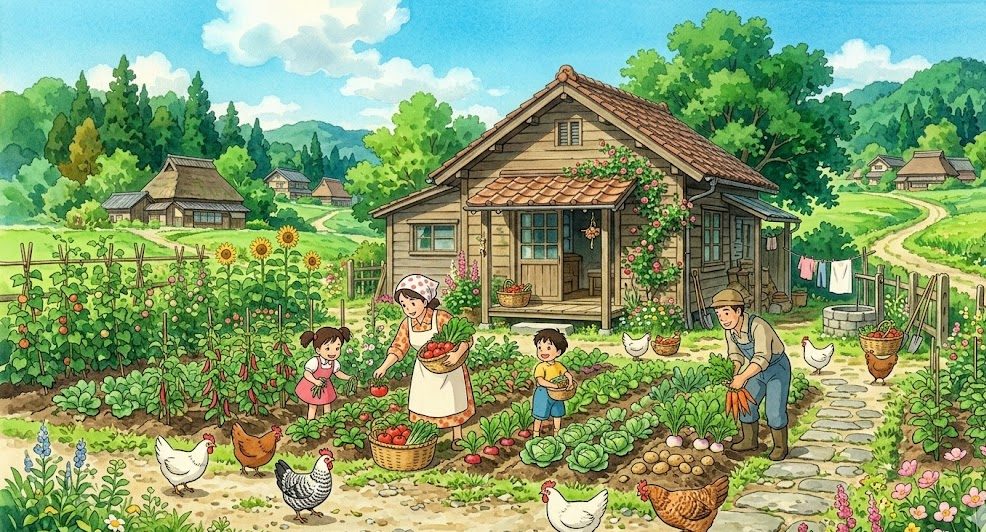
If the global supply chain were to stop tomorrow, how many days could your family survive on the food currently in your pantry? For most households, the answer is less than a week. In an era of increasing climate instability and economic unpredictability, the “Pain Point” is clear: we have become dangerously disconnected from our primary source of life. Relying entirely on a complex, just-in-time delivery system for calories isn’t just a convenience; it’s a vulnerability.
The “Challenge” of traditional gardening is that it often focuses on aesthetics or seasonal hobbies. However, the “Main Concept” of Survival Farming is fundamentally different. It is the strategic cultivation of high-calorie, nutrient-dense crops designed to sustain human life regardless of external market conditions. It is about building a closed-loop system where your land provides your breakfast, lunch, and dinner.
In this comprehensive guide, you will learn the pillars of self-sufficiency. We will cover the biology of soil health, the selection of “life-raft” crops, and a practical, step-by-step roadmap to transform a standard backyard into a high-output survival homestead.
Understanding Survival Farming: Key Concepts and Importance
Survival farming is the modern evolution of the “Victory Garden,” but with a focus on long-term sustainability and caloric density. Unlike recreational gardening, which might prioritize a few heirloom tomatoes, survival farming prioritizes crops that provide the most “bang for your buck” in terms of calories and storage capability. It is the difference between growing a salad and growing a meal.
Think of survival farming like building a battery. During the growing season, you are “charging” your battery by capturing solar energy and storing it in the form of starches (potatoes, corn, grains) and proteins (beans, peas). In the winter or during a crisis, you are “discharging” that energy by eating your stored harvest.
The importance of this practice has surged in 2026. As soil health declines globally and water rights become more contested, the ability to manage a small, highly efficient plot of land is becoming a vital survival skill. We use a Permaculture approach—working with nature rather than against it—to ensure the soil stays fertile for decades without the need for synthetic, store-bought fertilizers.
Why It Matters: The Top Benefits of Survival Farming
Transitioning to a survival-based agricultural model offers profound advantages that extend from your health to your financial independence.
- Absolute Food Security: You are no longer at the mercy of inflation or “out-of-stock” signs. If you grow it, you own it. This provides a psychological peace of mind that no savings account can match.
- Nutritional Superiority: Industrial produce is often bred for transportability, not nutrition. Survival crops, harvested at peak ripeness and grown in mineral-rich soil, contain significantly higher levels of essential vitamins and phytonutrients.
- Economic Resilience: By producing your own staples—like potatoes, beans, and squash—you can reduce your annual grocery bill by thousands of dollars. In a survival scenario, food is the ultimate currency.
- Waste-to-Wealth Cycling: Survival farming teaches you to turn “trash” into “gold.” Kitchen scraps, grass clippings, and animal manure become the fuel for next year’s harvest through advanced composting techniques.
Pro Fact: According to agricultural density studies, an average person can meet their basic caloric needs on as little as 4,000 square feet (about 0.1 acres) of land, provided the crop selection is optimized for starch and protein.
How to Get Started: A Practical Guide for Beginners
Starting a survival farm requires a shift from “planting things I like” to “planting things I need.” Follow this 5-step implementation plan.
1. Secure Your Water and Soil
Before you plant a single seed, you must secure your “Inputs.” Install rain barrels and test your soil’s pH and mineral content. If your soil is “dead” (sandy or heavy clay), start with compost and biochar to create a living sponge that holds moisture and nutrients.
2. Choose “Life-Raft” Crops
Focus on the “Survival Staples”:
- Starches: Potatoes, Sweet Potatoes, and Corn (high calories).
- Proteins: Beans, Peas, and Lentils (soil-fixers).
- Fats: Sunflowers and Nut trees (essential for brain health).
- Storage Veg: Winter Squash and Cabbage (long shelf life).
3. Implement the “Three Sisters” Method
Maximize space by using indigenous intercropping. Plant corn to provide a “pole” for beans, beans to fix nitrogen in the soil, and squash to act as a living mulch that prevents weeds and keeps moisture in the ground.
4. Master the Art of Preservation
Survival farming is only half the battle; the other half is storage. Invest in tools for Canning, Dehydrating, and Fermenting. A root cellar or a cool, dark basement is essential for keeping your starches viable throughout the winter.
5. Establish a Seed Bank
Never rely on buying seeds every year. Learn how to harvest and store “open-pollinated” seeds from your strongest plants. This ensures your crops become better adapted to your specific micro-climate year after year.
Beginner’s Tip: Avoid the “Monoculture Trap.” Don’t plant 50 of the same plant. If a specific pest or disease hits that variety, you lose everything. Diversity is your insurance policy.
Overcoming Challenges and Looking into the Future
The two biggest hurdles for survival farmers are Pest Management and Physical Labor. Without chemical pesticides, you must rely on “Integrated Pest Management” (IPM). This involves planting “trap crops” like marigolds to lure bugs away from your food. Regarding labor, the “No-Till” method—where you layer organic matter on top of the soil instead of digging—can reduce your workload by 70% while improving soil health.
Looking into the future, Low-Tech Automation is the trend to watch. Small-scale solar-powered irrigation and “robot-assisted” weeding are becoming affordable for homesteaders. Additionally, there is a massive resurgence in Ancient Grains like Amaranth and Millet, which are much more resilient to climate-driven droughts than modern wheat.
Conclusion
Survival farming is the ultimate act of self-reliance. It transforms you from a “consumer” into a “producer,” bridging the gap between vulnerability and security. By mastering soil health, selecting high-calorie staples, and learning to preserve your harvest, you create a fortress of health and stability for your family.
The core message is simple: The best time to start a survival farm was ten years ago; the second best time is today. Start with a single raised bed, master one crop, and build your legacy one seed at a time.
Would you like me to create a specific “Caloric Planting Map” based on the exact dimensions of your available backyard space?
FAQs
Q1: Do I need a lot of land to start survival farming? No. Using “vertical gardening” and “square foot gardening” techniques, you can produce a significant amount of food on a standard suburban lot. Even a balcony can produce enough greens and herbs to supplement a survival diet.
Q2: Which crop is the most important for survival? The Potato is often cited as the #1 survival crop. It is easy to grow, requires minimal tools to harvest, produces more calories per square foot than almost any other plant, and contains almost every nutrient a human needs to survive.
Q3: How do I protect my farm from animals? Fencing is your first line of defense. However, “biological fences” like thorny hedges (Blackberry or Hawthorn) can provide both security and an extra food source. Motion-activated lights and sound devices are also effective for nocturnal pests.
Q4: Can survival farming be completely organic? Yes, and it should be. In a true survival scenario, you won’t have access to store-bought chemicals. Learning to make Compost Tea and using Wood Ash for potassium are essential “old-world” skills that keep your farm running indefinitely.