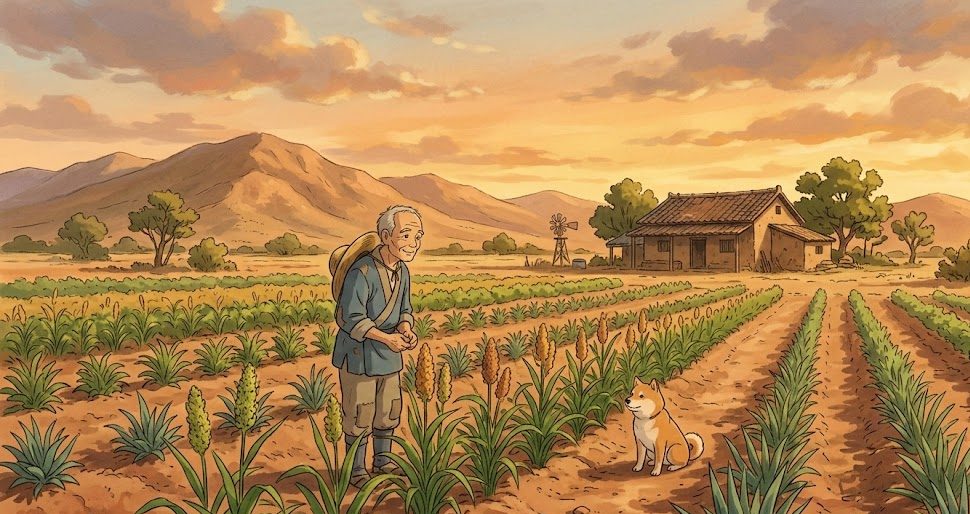
What if you could harvest a bounty even when the sky remains cloudless for months? In 2024 and 2025, global agriculture faced some of the most severe dry spells in recorded history, with nearly 40% of the world’s land now classified as “vulnerable” to drought. For the modern farmer, the “Pain Point” is clear: traditional water-intensive crops like corn and rice are becoming high-risk gambles that can lead to total financial ruin in a single dry season.
The “Challenge” lies in our dependence on a fragile agricultural model that assumes water is an infinite resource. However, the “Main Concept” for a secure future is Climate-Smart Diversification. By integrating drought-resistant crops—species biologically programmed to thrive on minimal moisture—farmers can build a “drought-proof” shield around their livelihoods.
This article serves as a comprehensive guide to these resilient plants. You will learn the biological fundamentals of drought tolerance, the economic advantages of water-sipping varieties, and a step-by-step roadmap for transitioning your acreage into a resilient, high-yield sanctuary.
Understanding Drought Resistance: Key Concepts and Importance
To master Drought Resistant Crops, we must understand the “survival mechanics” of the plant world. These crops aren’t just plants that “don’t die”; they are specialized biological machines designed for moisture conservation. Drought resistance usually falls into two categories: drought avoidance (completing a life cycle before the water runs out) and drought tolerance (surviving and growing during periods of low water).
Think of a standard crop, like modern hybrid corn, as a leaky bucket. To keep it full, you have to keep pouring water in because it loses moisture constantly through its leaves. A drought-resistant crop, like Sorghum or Pearl Millet, is like a well-sealed canteen. It has thick, waxy leaf coatings to stop evaporation and deep taproots that act as “biological drills,” reaching water reserves deep underground that other plants can’t touch.
Historically, these crops sustained civilizations in the Sahara and the Andes for millennia. In the modern era, they are moving from “marginal” status to the mainstream. As irrigation costs skyrocket and aquifers deplete, these “survivor” plants are no longer just an alternative; they are the cornerstone of a sustainable, 21st-century farm.
Why It Matters: The Top Benefits of Drought-Resistant Crops
Switching to water-efficient crops offers a multifaceted return on investment that impacts your wallet, your soil, and the planet.
- Drastic Input Savings: Because these crops require 30% to 50% less irrigation, your utility bills and pumping costs drop significantly. They often require less synthetic fertilizer as they are evolved to scavenge nutrients in lean soils.
- Yield Stability: While a standard wheat crop might fail entirely during a heatwave, drought-resistant varieties like Cowpeas or Amaranth maintain a baseline yield, ensuring you have a product to sell even in the worst years.
- Enhanced Soil Health: Many drought-hardy plants have massive root systems that leave behind significant organic matter when they decompose, effectively “sponging” the soil to hold more water for future seasons.
- Market Growth: Consumer demand for “Ancient Grains” and “Superfoods” is at an all-time high. Crops like Quinoa and Teff fetch premium prices in specialty markets compared to the volatile prices of commodity corn.
Pro Fact: According to the FAO, certain drought-resistant legumes can fix up to 60kg of nitrogen per hectare back into the soil, reducing the need for chemical fertilizers in the following season.
How to Get Started: A Practical Guide for Beginners
Transitioning your farm doesn’t happen overnight. It requires a strategic, phased approach to ensure your equipment and soil are ready for the change.
1. Analyze Your “Water Deficit”
Review your rainfall data from the last five years. Identify the months where your soil moisture drops the lowest. This will help you decide whether you need an “early-maturing” crop (to avoid the heat) or a “hardy-survivor” crop (to grow through it).
2. Select Your “Warrior” Varieties
Start with the most reliable performers.
- Grains: Sorghum, Pearl Millet, and Emmer Wheat.
- Legumes: Cowpeas (Black-eyed peas), Chickpeas, and Bambara Groundnuts.
- Pseudo-cereals: Amaranth and Buckwheat.
3. Retrofit Your Planting Equipment
Drought-resistant seeds are often smaller than standard hybrids. You may need to adjust your seeding depth and planter plates. Because moisture is precious, use no-till or minimum-till methods to keep the soil’s “cap” intact, preventing evaporation.
4. Optimize Soil Organic Matter
A plant can only be as drought-resistant as its soil allows. Incorporate compost or biochar before planting. These materials act like tiny internal reservoirs, holding onto every drop of rain and releasing it slowly to the roots.
5. Establish a Niche Supply Chain
Before you harvest, connect with buyers who value sustainability. Boutique millers, health food brands, and craft brewers are often looking for the unique flavor profiles that drought-resistant ancient grains provide.
Beginner’s Tip: Don’t plant your entire farm in a new crop at once. Use a 10% pilot plot to learn the growth habits and harvesting quirks of the new variety before scaling up.
Overcoming Challenges and Looking into the Future
The biggest hurdle in growing drought-resistant crops is Market Awareness. Many traditional elevators aren’t set up to process grains like Millet or Fonio. Farmers often solve this by forming small cooperatives to share the cost of specialized de-hulling or milling equipment.
Looking ahead, the future of agriculture is Genomic Mapping. We are now identifying the specific “drought-switch” genes in ancient plants. This allows us to breed new varieties that combine the high yields of modern crops with the “iron-clad” resilience of desert plants. We are also seeing the rise of AI-driven moisture sensors that tell a farmer exactly when a drought-resistant plant is entering “stress mode,” allowing for precision micro-irrigation.
Conclusion
The era of “cheap water” is over, but the era of the resilient farmer is just beginning. By embracing drought-resistant crops like Sorghum, Cowpeas, and Amaranth, you are doing more than just planting seeds; you are “climate-proofing” your legacy. These plants are a testament to nature’s ability to survive and thrive under pressure.
The core message is simple: Don’t wait for the next drought to change your strategy. Start diversifying today, and turn your farm into a model of sustainability for the next generation.
Would you like me to help you identify the best drought-resistant crop variety based on your specific soil type and regional hardiness zone?
FAQs
Q1: Do drought-resistant crops produce lower yields? In a perfect year with unlimited water, modern hybrids may yield more. However, in average or dry years, drought-resistant crops often provide a higher net profit because their input costs (water and fertilizer) are significantly lower.
Q2: Can I grow these crops in non-desert areas? Yes! Drought-resistant crops are excellent for “dryland farming” in any region. They are often used as a “catch crop” if a primary crop fails or as a way to utilize the driest parts of a farm.
Q3: Is it hard to find seeds for these rare crops? While your local big-box ag store might not stock them, there are dozens of heritage seed banks and specialized agricultural suppliers online that focus specifically on resilient, non-hybridized seeds.
Q4: Do these crops require different harvesting machinery? Most grains like Sorghum and Millet can be harvested with a standard combine, though you will need to adjust your sieve and fan settings because the seeds are lighter and smaller than corn or traditional wheat.