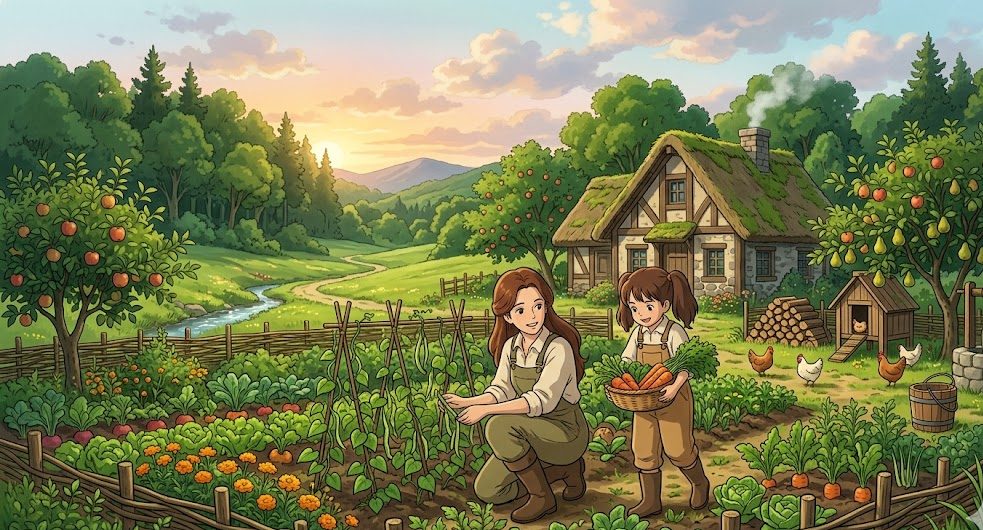
In an era of global supply chain instabilities, rising food costs, and environmental unpredictability, the concept of survival farming has shifted from a “doomsday” niche to a practical strategy for modern resilience. Survival farming isn’t just about gardening; it is the calculated practice of producing enough nutrient-dense food to sustain a household indefinitely, regardless of external market conditions.
True food independence requires a transition from a consumer mindset to a producer mindset. This guide outlines the essential pillars of building a self-contained agricultural ecosystem designed for longevity and security.
1. The Foundation: Calorie-Dense Staple Crops
The biggest mistake novice survival farmers make is growing only “salad crops” like lettuce and radishes. While vitamins are essential, calories provide energy. To survive, you must prioritize crops with high caloric yields and long storage lives.
The “Big Three” of Survival Gardening
- Potatoes: Perhaps the ultimate survival food. They are calorie-dense, easy to grow in various soils, and can be stored for months in a cool, dark place.
- Corn (Grain/Flint): Unlike sweet corn, flint or dent corn can be dried and ground into meal or flour, providing a shelf-stable carbohydrate source.
- Beans/Legumes: These provide essential proteins and, critically, they fix nitrogen back into the soil, acting as a natural fertilizer for your next crop.
The “Three Sisters” Technique
Utilize indigenous wisdom by interplanting corn, beans, and squash. The corn provides a pole for the beans to climb; the beans provide nitrogen; and the large squash leaves act as a “living mulch,” shading the soil to retain moisture and prevent weeds.
2. Soil Management: Your Life Support System
In a long-term survival scenario, you won’t be able to buy bags of synthetic fertilizer. Your soil must be a self-sustaining engine.
- Composting: Every scrap of organic waste—kitchen peels, grass clippings, and livestock manure—must be returned to the earth. This is “black gold.”
- Cover Cropping: Never leave soil bare. In the off-season, plant clover or winter rye to prevent erosion and suppress weeds.
- No-Till Methods: Avoid heavy tilling, which disrupts the delicate fungal networks (mycorrhizae) and soil structure. Instead, layer organic matter on top to build rich, aerated soil over time.
3. Water Independence: Harvesting and Conservation
Food security is impossible without water security. You cannot rely solely on the municipal grid or electric pumps.
- Rainwater Catchment: Install a robust gutter system on every available roof (house, barn, shed) leading into filtered cisterns or rain barrels.
- Greywater Recycling: Develop systems to divert “gentle” wastewater (from showers or laundry) to irrigate non-edible plants or fruit trees.
- Drip Irrigation & Mulching: Use drip lines to deliver water directly to the roots, and cover the soil with 3–4 inches of straw or woodchips to reduce evaporation by up to 70%.
4. Incorporating Livestock for Protein and Power
Plants alone can be difficult to live on exclusively. Small-scale livestock turn “waste” (like grass and bugs) into high-quality protein.
| Animal | Primary Benefit | Space Requirement | Maintenance |
|---|---|---|---|
| Chickens | Eggs, meat, and pest control. | Low | Easy |
| Rabbits | Fastest “meat-to-feed” ratio; cold hardy. | Very Low | Moderate |
| Goats | Milk and brush clearing. | Moderate | High |
| Bees | Pollination and honey (natural sweetener). | Low | Specialized |
Export to Sheets
Pro-Tip: Rabbit manure is “cold” manure, meaning it can be applied directly to plants without composting first, making it an instant fertilizer.
5. Seed Saving: Breaking the Cycle of Dependency
If you rely on buying new seeds every spring, you aren’t self-sufficient.
- Heirloom vs. Hybrid: Only grow Heirloom (Open-Pollinated) seeds. If you save seeds from hybrid plants, the next generation will likely be sterile or revert to a useless wild variety.
- The Drying Process: Learn to properly harvest, dry, and store seeds in airtight containers. A well-maintained “Seed Bank” is more valuable than gold in a crisis.
6. Preservation: Defeating the “Winter Gap”
Growing food is only half the battle; keeping it edible through the winter is the other half. A survival farm must master at least three preservation methods:
- Canning (Pressure & Water Bath): Essential for preserving meats, stews, and low-acid vegetables.
- Dehydration: The most energy-efficient way to store fruits, herbs, and even “leather” soups.
- Fermentation: Using salt and natural bacteria to create probiotics (sauerkraut, kimchi). This requires no electricity and improves gut health.
- Root Cellaring: Using the earth’s natural insulation to keep tubers and apples fresh through the frost.
7. Defensive Landscaping and Perennials
A smart survival farm isn’t just a rectangular plot in the backyard. It uses Permaculture principles.
- Food Forests: Plant perennial fruit and nut trees (Apples, Walnuts, Hazelnuts). These require work to establish but produce food for decades with minimal annual labor.
- Stealth Gardening: If security is a concern, “edible landscaping” blends food into the natural environment. Berry bushes can serve as thorny fences, and Jerusalem Artichokes look like tall wildflowers but hide edible tubers underground.
8. The Mindset of Resilience
Survival farming is a marathon, not a sprint. It requires a deep connection to the cycles of nature and the patience to handle crop failures.
- Diversification: Never rely on a single crop. If a blight hits your potatoes, you must have squash and beans to fall back on.
- Tool Maintenance: Invest in high-quality manual tools (shovels, hoes, scythes, hand-crank grain mills). If the power goes out or fuel becomes scarce, your hands and your steel will be your only assets.
Conclusion
Ultimate self-sufficiency is the ultimate freedom. By building a survival farm, you are not just growing food; you are growing independence. It is a return to a way of life where your survival is dictated by your own sweat, wisdom, and the health of your soil rather than the volatility of a global economy. Start small, save your seeds, and build your sanctuary one harvest at a time.
What specific aspect of survival farming—such as livestock management or seed saving—would you like to dive deeper into first?