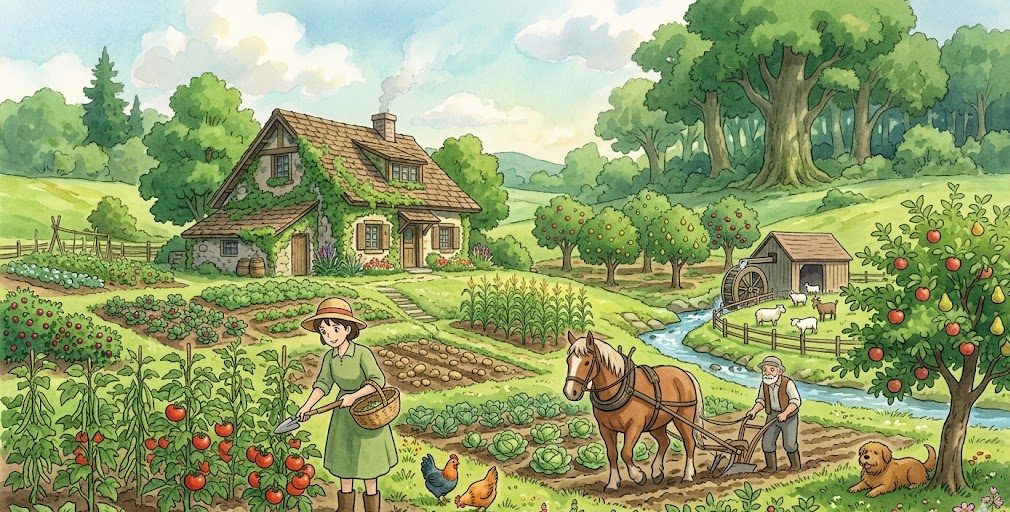
In an era of global supply chain instabilities, rising food costs, and environmental unpredictability, the concept of “Survival Farming” has shifted from a fringe hobby to a mechanical necessity for the resilient household. Survival farming is not merely gardening; it is the strategic design of a closed-loop ecosystem intended to provide 100% of a family’s nutritional needs indefinitely.
To build a truly self-sufficient food source, you must move beyond growing “snacks” and focus on growing calories, nutrients, and soil fertility. This guide provides a technical roadmap for designing, managing, and sustaining a survival farm that can withstand external shocks.
1. The Survival Hierarchy: Calories First, Nutrients Second
The most common mistake in self-sufficiency is focusing on low-calorie vegetables like lettuce or cucumbers. In a survival scenario, calories are the currency of life. Your farm must be designed around “staple” crops.
- The Calorie Kings: Focus on “high-density” crops that store well.
- Potatoes and Sweet Potatoes: These provide massive amounts of carbohydrates per square foot and can be grown in buckets, bags, or traditional trenches.
- Corn, Beans, and Squash (The Three Sisters): This ancient indigenous system is a masterpiece of precision. The corn provides a trellis for beans, the beans fix nitrogen into the soil, and the squash creates a living mulch to prevent evaporation.
- Grains (Millets/Amaranth): These are drought-resistant, nutrient-dense, and can be stored for years without refrigeration.
- The Nutrient Boosters: Supplement your calories with “perennial” vegetables that come back every year without replanting, such as Asparagus, Moringa (The Miracle Tree), and various berry bushes.
2. Soil: The Engine of Self-Sufficiency
In a survival setup, you cannot rely on store-bought chemical fertilizers. If the shops close, your farm must generate its own fertility.
- The Closed-Loop Compost System: Every piece of organic waste—kitchen scraps, weeds, and crop residue—must go into a managed compost pile. This is your “Black Gold.”
- Livestock Integration: Animals are essential for a survival farm, not just for meat, but for their manure. A small flock of chickens or a pair of goats can turn “waste” (weeds and kitchen scraps) into high-nitrogen fertilizer.
- Cover Cropping: Never leave the soil bare. During the off-season, plant Nitrogen-fixers like Clover or Alfalfa. This prevents soil erosion and naturally recharges the ground for the next planting cycle.
3. Water Security and Management
A survival farm is only as resilient as its water source. Relying on city water or a single electric pump is a vulnerability.
- Rainwater Harvesting: Install a network of gutters and tanks (barrels) to catch every drop of rain. In a survival scenario, this is your primary insurance policy.
- Passive Irrigation (Swales): Digging “swales” (trenches on the contour of the land) allows rainwater to soak deeply into the earth rather than running off. This creates a “water bank” in the soil that plants can tap into during dry spells.
- Greywater Recycling: Filter and reuse water from your household (showers/laundry) for your non-edible crops or fruit trees, ensuring nothing is wasted.
4. Defensive Planting and Pest Management
Without commercial pesticides, you must use Ecological Warfare to protect your yield.
- Polyculture vs. Monoculture: Never plant all your potatoes in one spot. Scatter your crops. If a pest finds one patch, the rest of your harvest remains safe.
- Natural Deterrents: Surround your calorie crops with “boundary plants” like Marigolds, Garlic, and Onion. These emit scents that confuse and repel common pests.
- Beneficial Habitats: Build “bug hotels” and birdhouses. Encouraging predatory insects and birds ensures that your “pest control” happens automatically while you sleep.
5. Preservation: The Art of Long-Term Storage
A successful survival farmer doesn’t just grow food; they master the art of stopping time. A harvest is useless if it rots before winter.
- Root Cellaring: Using the earth’s natural cool temperature to store tubers, carrots, and apples.
- Dehydration: Sun-drying fruits and herbs is a zero-energy way to preserve nutrients.
- Fermentation and Pickling: Using salt and natural bacteria (Lactobacillus) to preserve vegetables while adding gut-healthy probiotics to your diet.
- Seed Saving: This is the most critical survival skill. You must learn to harvest, dry, and store seeds from your strongest plants to ensure a harvest for the following year.
6. The Survival Farm Layout: A 1-Acre Blueprint
| Zone | Focus | Key Components |
| Zone 1 (Near House) | Daily Needs | Herbs, salad greens, kitchen compost, and chickens. |
| Zone 2 (Mid-Range) | Staple Crops | Potatoes, corn, beans, and automated drip systems. |
| Zone 3 (Perimeter) | Security & Fruit | Orchard trees, berry bushes, and thorny “security” hedges. |
| Zone 4 (Outer Edge) | Foraging/Fuel | Timber for fuel, wild edible plants, and water catchment. |
7. Energy Independence on the Farm
To make your food source truly “self-sufficient,” the mechanical tools you use must also be independent of the grid.
- Solar Pumps: Invest in solar-powered irrigation pumps to ensure your crops get water even during power outages.
- Hand Tools: While tractors are efficient, a survival farmer must master the use of the scythe, the broadfork, and the hand-hoe. These tools never run out of fuel.
- Biogas: For larger setups, converting livestock manure into biogas provides a free, renewable source of cooking fuel.
8. Conclusion: From Consumer to Producer
Survival farming is a fundamental shift in mindset. It is the transition from being a “consumer” who is dependent on a fragile system to a “producer” who is the master of their own biological destiny.
By focusing on calorie-dense staples, building a closed-loop soil system, and mastering the art of seed saving, you create a fortress of food security. It is hard work, and it requires constant observation, but the reward is the ultimate luxury in the modern world: True Independence.
Whether the “collapse” is a global event or a personal financial crisis, a self-sufficient food source ensures that your family is fed, healthy, and resilient.
Start small, save your seeds, and let the soil provide.