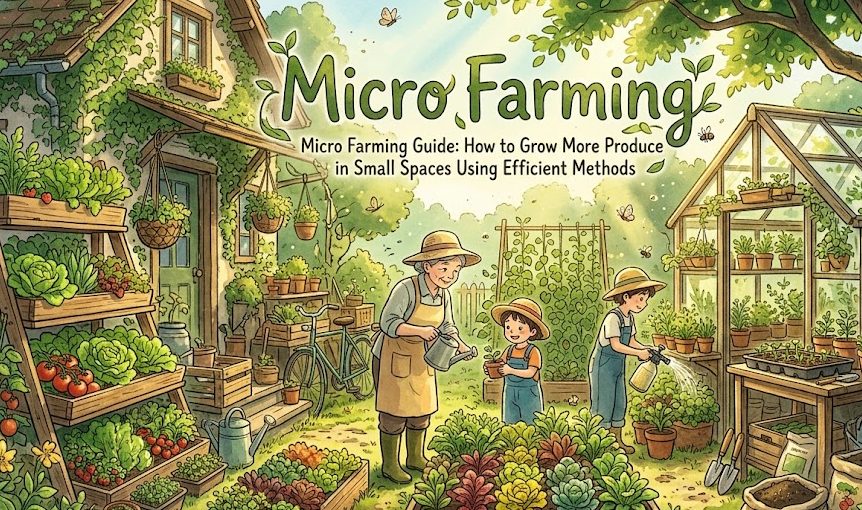
Farming does not always require hundreds of acres of land. A productive growing operation can be built on a small plot when available space, water, sunlight, labor, and growing time are managed carefully.
This approach is often described as micro farming. It focuses on producing useful quantities of vegetables, herbs, fruits, seedlings, flowers, or other agricultural products within a limited area. Instead of expanding outward, micro farmers try to make better use of the space they already have.
Micro farming can take place in a backyard, urban lot, small rural property, greenhouse, high tunnel, community garden, or other suitable growing space. The exact model depends on local conditions and the farmer’s goals.
The central idea is simple: use limited resources efficiently while keeping the production system manageable.
That means choosing crops carefully, reducing wasted space, planning planting schedules, improving soil, managing water precisely, and finding a suitable market for what is grown.
What Makes Micro Farming Different?
Traditional farming often depends on larger fields and specialized equipment. Micro farming works differently.
The emphasis is usually on:
- Intensive use of available land
- High-value or frequently harvested crops
- Direct observation
- Efficient irrigation
- Succession planting
- Multiple harvests
- Manual or lightweight equipment
- Careful crop planning
- Direct or specialty markets
A small farm does not necessarily need to grow everything.
In many cases, a better strategy is to grow a limited selection of crops exceptionally well.
For example, a small operation might specialize in salad greens, herbs, specialty vegetables, seedlings, or other products suited to local demand.
Start by Measuring the Space
The first step is to understand exactly how much usable growing space is available.
Measure the property and identify areas that receive different amounts of sunlight.
A simple map can show:
- Full-sun areas
- Partial-shade areas
- Buildings
- Trees
- Water sources
- Paths
- Storage areas
- Composting areas
- Existing structures
- Drainage patterns
Do not count every square foot as production space.
Plants need access paths, irrigation equipment, working areas, harvest space, and storage. If everything is planted without leaving room to work, routine maintenance becomes difficult.
Efficient design means using space well while maintaining access.
Think in Growing Beds Instead of One Large Field
Small farms can benefit from dividing available land into clearly organized beds.
Raised beds or permanent growing beds can make planting, irrigation, harvesting, and crop rotation easier.
Bed dimensions should be selected according to how the farmer will work.
If most tasks are performed by hand, beds should be narrow enough to reach plants without repeatedly stepping into the growing area.
Permanent paths can also reduce soil compaction because workers know where to walk.
Once the layout is established, the same beds can be reused through multiple growing seasons.
Choose Crops Based on Space and Demand
Crop selection is one of the biggest decisions in micro farming.
A crop should not be selected simply because it grows quickly or has a high retail price.
Consider its:
- Space requirements
- Growing period
- Harvest frequency
- Water needs
- Labor requirements
- Local demand
- Storage life
- Pest pressure
- Selling price
- Harvest method
Leafy greens, herbs, radishes, carrots, green onions, specialty vegetables, and certain compact crops can work well in small-space systems.
Other crops may require much more space per plant and therefore need careful evaluation.
Use Succession Planting
One of the most effective ways to increase production from a small area is succession planting.
Instead of planting an entire bed once and leaving it unused after harvest, farmers can schedule several crops throughout the season.
For example:
Crop A → Harvest → Crop B → Harvest → Crop C
The exact sequence depends on climate, crop maturity, and soil conditions.
Succession planting allows the same physical space to produce multiple harvests over time.
Good records are important because planting dates, maturity periods, and expected harvest windows need to be coordinated.
Use Vertical Space
Small-space farming does not have to remain entirely horizontal.
Vertical growing can increase the amount of usable production area when the crop is suitable.
Trellises, stakes, frames, and other supports can help climbing plants grow upward rather than spreading across the ground.
Crops that naturally climb or benefit from support may include:
- Beans
- Peas
- Cucumbers
- Certain squash varieties
- Tomatoes
- Climbing herbs or specialty plants
Vertical systems require strong support and good planning. Heavy fruit or vines can put significant weight on structures.
The objective is not to grow every crop vertically. It is to use vertical space where it genuinely improves the production system.
Grow Crops in Containers
Containers can turn otherwise unused areas into growing space.
They can be placed on patios, balconies, small yards, rooftops where structurally appropriate, and other locations with sufficient sunlight and water access.
Container farming allows farmers to control:
- Growing medium
- Drainage
- Plant spacing
- Watering
- Crop placement
The major limitation is that containers dry out faster than larger soil beds in many environments.
Container crops therefore require consistent monitoring, especially during hot weather.
Improve the Soil
Small farms benefit enormously from healthy soil because every growing bed may be used intensively.
Before planting, farmers should understand the basic condition of the soil.
A soil test can help identify:
- pH
- Nutrient levels
- Organic matter
- Soil texture
- Potential deficiencies
Compost and other appropriate organic materials can improve soil structure and contribute to long-term soil health.
However, soil amendments should be based on actual needs. Adding large quantities of fertilizer or amendments without testing can create nutrient imbalances.
Healthy soil should be viewed as a long-term production asset.
Make Irrigation More Precise
Efficient irrigation becomes increasingly important as planting density increases.
Hand watering can work for very small operations, but larger micro farms may benefit from drip irrigation, micro-irrigation, or other targeted systems.
Water should reach the root zone without unnecessarily wetting paths and unused soil.
A simple irrigation system can include:
- Main water line
- Filters
- Pressure regulation
- Distribution tubing
- Drip lines or emitters
- Timers where appropriate
Regularly inspect the system for leaks, blocked emitters, and uneven watering.
An inexpensive irrigation system that works reliably can be more useful than a sophisticated system that is difficult to maintain.
Use Mulch to Save Time and Water
Mulching can provide several benefits in small growing systems.
Appropriate mulch can help reduce:
- Evaporation
- Weed growth
- Soil splash
- Temperature fluctuations
- Maintenance work
Organic mulch may also contribute organic matter as it decomposes.
However, mulch should be selected according to the crop and growing environment. Poorly managed mulch can create pest or moisture problems around plant stems.
Plan Sunlight Carefully
Sunlight is one of the most valuable resources in small-space agriculture.
When space is limited, it is important to understand how sunlight moves across the property during the day.
Tall crops can cast shadows over shorter crops.
Structures, fences, buildings, and trees can also reduce available light.
When designing beds, consider placing taller crops where their shadows have the least negative effect on shorter plants.
This can significantly improve the productivity of a small growing area.
Use Companion Planting Carefully
Companion planting can be useful for organizing diverse crops, but it should not become a substitute for good farm management.
Plants with similar water, sunlight, and nutrient requirements can sometimes be grouped together.
The most practical reason to group compatible crops is often easier management.
For example, crops with similar irrigation requirements can share a growing zone.
Rather than following complicated companion-planting charts, micro farmers should prioritize:
Compatible growing requirements → Efficient irrigation → Easy access → Simple maintenance
Use Fast-Growing Crops Strategically
Fast-growing crops can be valuable because they allow a small area to turn over more quickly.
However, speed alone does not determine productivity.
A crop that matures quickly but requires intensive labor may not be as useful as a slightly slower crop that produces repeated harvests.
Farmers should consider the entire cycle:
Planting → Growing → Harvesting → Cleaning → Replanting
The time between crops matters just as much as the time a crop spends growing.
Grow Crops With Multiple Harvests
Some crops can provide repeated harvests rather than one harvest at the end of the season.
This can make them particularly useful for small farms.
Leafy greens, herbs, certain vegetables, and other crops can sometimes be harvested selectively while the plant continues growing.
Repeated harvesting can provide a more consistent supply for customers.
However, harvest frequency should be matched to the plant’s growth rate and the farmer’s available labor.
Consider Protected Growing
A greenhouse, high tunnel, shade structure, or other protected system can increase the usable growing season.
Protected structures can help manage:
- Wind
- Rain
- Temperature
- Cold
- Heat
- Pests
- Crop timing
For a small farm, even a relatively modest protected growing area can become an important part of production.
The key is to use protected space for crops that justify the additional infrastructure.
Explore Hydroponic and Soilless Systems
Micro farming does not have to rely entirely on traditional soil.
Hydroponic systems can grow certain crops using water and nutrient solutions instead of conventional soil.
Common systems include:
- Deep water culture
- Nutrient film technique
- Drip hydroponics
- Ebb-and-flow systems
These systems can be useful where land is extremely limited.
However, hydroponics requires careful management of water quality, nutrients, pH, equipment, electricity, and root health.
It should be treated as a technical production system rather than an automatic shortcut to higher yields.
Make Every Pathway Useful
Space planning goes beyond planting beds.
Storage shelves, vertical trellises, container areas, tool racks, composting areas, and propagation tables can help organize the operation.
Even walls and fences may provide opportunities for vertical structures.
At the same time, do not eliminate all open space.
Workers need room to move, harvest containers need somewhere to go, and equipment needs access.
The most efficient small farm is not necessarily the one with the highest planting density. It is the one where every part of the operation works smoothly.
Start Seedlings Efficiently
Producing seedlings in a dedicated area can save valuable growing-bed space.
Instead of occupying a large bed with plants during their earliest growth stages, seedlings can be started in trays or containers under controlled conditions.
Once plants reach the appropriate stage, they can be transplanted into production beds.
This approach can improve space utilization and allow the farmer to prepare the next crop while another crop is still being harvested.
Seedling production does require attention to light, moisture, temperature, sanitation, and transplant timing.
Reduce Empty Growing Time
One of the biggest opportunities in micro farming is reducing the amount of time beds remain unused.
A simple production calendar can track:
- Current crop
- Expected harvest
- Removal date
- Soil preparation
- Next planting
- Expected next harvest
Even a basic spreadsheet or notebook can make this easier.
The objective is not to keep every bed occupied every day at any cost.
Sometimes a bed needs rest, cover crops, soil improvement, or maintenance. The goal is to make those periods intentional rather than accidental.
Control Weeds Before They Become a Problem
Weeds can quickly consume time on a small farm.
Early control is usually easier than allowing weeds to establish deeply.
Useful practices can include:
- Mulching
- Regular inspection
- Shallow cultivation
- Hand removal
- Crop rotation
- Cover crops
- Maintaining healthy crop growth
Because small farms often use intensive planting, weed control should be integrated into the regular maintenance routine.
A few minutes of weed removal several times a week may prevent a much larger problem later.
Build a Simple Pest Management System
Small farms can benefit from frequent crop observation.
Walk through growing areas regularly and check leaves, stems, flowers, and fruit.
Look for:
- Chewed leaves
- Discoloration
- Wilting
- Insect activity
- Distorted growth
- Signs of disease
Correct identification should come before treatment.
Integrated pest management combines monitoring, prevention, physical controls, cultural practices, beneficial organisms, and appropriate crop-protection products when necessary.
Healthy plants and clean growing areas can make pest management easier.
Keep Production Records
Micro farming creates a large amount of information.
Record:
- Crop variety
- Planting date
- Number of plants
- Harvest dates
- Harvest quantity
- Water use
- Input costs
- Labor time
- Selling price
- Customer feedback
After several growing cycles, the records can show which crops deserve more space and which should be reduced.
This is especially important because a crop can appear productive while actually consuming too much labor.
Think About Labor, Not Just Yield
Small farms often focus heavily on yield per square foot.
Yield matters, but labor efficiency matters too.
Consider how long it takes to:
- Plant
- Weed
- Water
- Prune
- Harvest
- Wash
- Sort
- Package
- Deliver
A crop that produces a large harvest but requires excessive manual work may not be the best choice.
A better measure is often usable output relative to land, water, labor, and operating cost.
Choose a Market Before Expanding
Micro farming is often most successful when production is connected to a specific customer base.
Potential markets include:
- Farmers markets
- Restaurants
- Local grocery stores
- Farm stands
- Community-supported agriculture
- Direct-to-consumer sales
- Specialty food businesses
- Local institutions
Talk to potential buyers before planting large quantities.
Find out what they actually want, how often they buy, what quality they expect, and what quantities they can handle.
Growing a crop first and searching for customers afterward can create unnecessary waste.
A Simple Micro Farm Layout
A small operation could be divided into several functional zones:
Production beds for primary crops.
Propagation area for seedlings.
Protected area for crops requiring additional environmental control.
Compost or soil-management area for organic materials.
Storage area for tools and supplies.
Washing and packing area for harvested products.
Access paths for maintenance and harvest.
This layout keeps production organized and reduces unnecessary movement.
An Efficient Micro Farming Cycle
A practical micro-farming system can follow a repeating cycle:
Plan → Prepare → Plant → Monitor → Harvest → Record → Replant → Improve
Planning determines what should be grown.
Preparation makes the growing area ready.
Planting begins the production cycle.
Monitoring identifies problems early.
Harvesting converts production into usable output.
Recording creates information for future decisions.
Replanting keeps productive areas active.
Improvement makes each cycle more efficient.
Common Mistakes in Micro Farming
One common mistake is trying to grow too many different crops.
Variety can be useful, but too many crops create complicated planting schedules, irrigation requirements, harvesting routines, and marketing tasks.
Another mistake is planting too densely without considering airflow and disease pressure.
Farmers may also underestimate post-harvest work.
Growing vegetables is only one part of the operation. Washing, sorting, packaging, storing, and delivering produce can require significant time.
Overinvesting in equipment is another potential problem.
Micro farms should grow according to proven demand and actual production capacity rather than purchasing expensive infrastructure before the business model is tested.
How to Start a Micro Farm
A beginner can keep the first season relatively simple.
Step 1: Map the available space
Identify sunlight, water access, soil conditions, and usable growing areas.
Step 2: Choose a small crop list
Select a few crops that fit the environment and have realistic demand.
Step 3: Build a small number of beds
Do not develop the entire property immediately.
Step 4: Install efficient irrigation
Create a system that is easy to inspect and maintain.
Step 5: Create a planting calendar
Use succession planting to keep production moving.
Step 6: Track everything
Record inputs, labor, harvests, and sales.
Step 7: Evaluate the season
Identify which crops performed well and which created unnecessary work.
Step 8: Expand selectively
Give more space to successful crops instead of automatically increasing every crop.
Final Thoughts
Micro farming demonstrates that productive agriculture does not always depend on having a large amount of land.
With careful planning, a small growing area can produce a diverse range of crops through intensive beds, succession planting, vertical growing, efficient irrigation, protected production, and thoughtful crop selection.
The most important principle is not simply to grow more plants in less space. It is to make every unit of land, water, labor, and time work efficiently.
A successful micro farm should therefore be designed as a complete system. Crop selection, soil health, irrigation, harvesting, post-harvest handling, marketing, and record keeping all need to work together.
Starting small is often an advantage. A farmer can test crops, understand customer demand, measure labor requirements, improve the growing system, and expand only after the operation has demonstrated what works.
For farmers working with limited land, micro farming can turn a small growing space into a carefully organized agricultural enterprise while maintaining flexibility and room for future improvement.