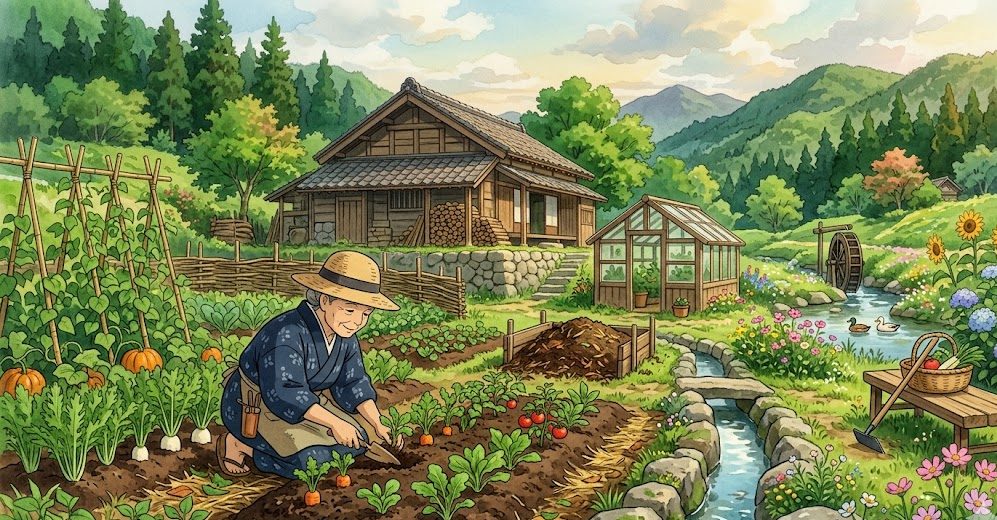
Modern agriculture is incredibly dependent on a delicate, global supply chain. Walk into any farm supply store, and you will see shelves lined with synthetic nitrogen fertilizers, chemical pesticides, imported hybrid seeds, and expensive mechanical tools. While these commercial inputs can drive short-term yields, they create a dangerous vulnerability: if supply chains disrupt, utility costs spike, or inflation hits, your ability to grow food disappears.
Survival farming is the ultimate shift back to self-reliance. It is the practice of treating your land as a closed-loop ecosystem, capable of regenerating itself and producing abundant calories with zero reliance on corporate store-bought inputs.
Whether you are preparing for long-term food security, cutting your homesteading overhead to absolute zero, or managing a remote off-grid plot, this guide delivers a professional blueprint for high-yield, low-cost survival farming.
The Philosophy of Closed-Loop Agriculture
The core law of survival farming is simple: waste is a resource out of place. In nature, nobody fertilizes a forest, yet it grows infinitely. The forest thrives because it recycles its own organic matter.
To farm successfully without commercial inputs, you must stop treating your farm as an extraction zone and start treating it as a loop. Every nutrient that leaves your soil in the form of food must be replaced using natural, hyper-local alternatives generated right on your property.
1. Zero-Cost Fertility: Replacing Commercial Fertilizers
Synthetic N-P-K (Nitrogen, Phosphorus, Potassium) bags are the first things to go out the window in a survival scenario. Fortunately, nature provides powerful, free alternatives to build fertile soil from scratch.
Thermal Hot Composting
A well-managed compost pile is a survival farmer’s goldmine. By layering “Greens” (nitrogen-rich materials like kitchen scraps, animal manure, and green weeds) with “Browns” (carbon-rich materials like dried leaves, straw, and wood shavings) in a 1:2 ratio, you trigger microbial activity.
- Keep the pile damp but not soggy.
- Turn it every 3 to 5 days to introduce oxygen.
- The heat generated ($55^\circ\text{C}$ to $65^\circ\text{C}$) kills weed seeds and harmful pathogens, leaving you with rich, black humus packed with plant-available nutrients in less than a month.
Compost Teas and Liquid Bio-Fertilizers
When you need to give heavy-feeding crops a fast nutrient boost, dry compost takes too long to break down. Instead, make Stinging Nettle or Comfrey Tea.
- Pack a 5-gallon bucket full of wild nettle or comfrey leaves.
- Fill the bucket with rainwater and cover it with a lid.
- Let it ferment for 2 to 3 weeks.
- The resulting liquid will smell terrible, but it is an incredibly potent, nitrogen- and potassium-rich foliar spray that crops absorb instantly through their leaves.
2. Seed Sovereignty: Saving and Adapting Your Own Genetics
If you rely on commercial hybrid ($F_1$) seeds, you are trapped in a cycle of dependency. Hybrid seeds are specifically engineered to produce a great crop in the first generation, but if you save their seeds for the next year, the resulting plants will be weak, unpredictable, and low-yielding.
Focus Exclusively on Heirloom and Open-Pollinated (OP) Varieties
Open-pollinated crops grow “true to type.” This means if you plant an heirloom beefsteak tomato, collect its seeds at harvest, and plant them next spring, you will get the exact same high-quality beefsteak tomato.
Selecting for Survival Genetics
Every year, look closely at your crops. Do not just save seeds from the biggest fruit. Save seeds from the specific plants that survived a dry spell without wilting, the ones that resisted pest attacks naturally, or the ones that yielded earliest. By doing this, you are actively breeding custom, localized genetics that are perfectly adapted to your farm’s unique soil and microclimate.
3. Water Resilience Without Pumps and Electricity
When the power grids fail or fuel prices soar, relying on electric water pumps or high-pressure overhead sprinklers becomes impossible. Survival farming requires moving water passively using gravity and biology.
Swales and Contour Berms
A swale is a ditch dug exactly along the contour line of a slope. Instead of letting rainwater run down a hill, eroding your topsoil, the swale catches the rushing water and forces it to sit still. Over 24 to 48 hours, the water slowly sinks deep into the underground water table, creating a hidden, hydrated “plume” beneath your growing beds. Plants grown directly below a swale can survive long droughts without a single drop of manual irrigation.
Heavy Organic Mulching
Water evaporation is a profit killer. By covering every square inch of exposed dirt with a thick, 4-inch blanket of wood chips, fallen leaves, pine needles, or rotten straw, you keep the soil cool and dark. This simple step cuts your crop’s water requirements by up to 70%, keeping the root zone damp even in intense summer heat.
Low-Cost Input Substitution Matrix
To help you eliminate store-bought supplies completely, use this quick reference table to find free, natural alternatives:
| Commercial Farm Input | Zero-Cost Survival Alternative | Primary Benefit |
| Synthetic Urea (Nitrogen) | Livestock Manure / Legume Cover Crops | Builds organic matter; fixes atmospheric nitrogen |
| Chemical Pesticides | Garlic, Neem Leaf, & Chili Fermented Spray | Repels soft-bodied insects without toxic residues |
| Store-Bought Potash | Clean Hardwood Bio-Ash (from woodstoves) | Boosts Potassium ($K$) and raises acidic soil pH |
| Commercial Seed Starters | Compost mixed with sifted river sand & leaf mold | High drainage, lightweight, and completely sterile |
| Plastic Weed Mats | Thick layers of cardboard topped with autumn leaves | Smothers weeds completely while decomposing into soil |
4. Natural Pest Management: The Eco-Defense Line
In a survival system, chemical pesticides are counterproductive because they kill beneficial predatory insects (like ladybugs and parasitic wasps) along with the pests, leaving your crops completely defenseless against the next wave of invaders.
Companion Planting: The Three Sisters Method
Used for centuries by Native Americans, planting Corn, Beans, and Squash together is the ultimate low-cost guild.
- The Corn acts as a living trellis for the beans to climb.
- The Beans pull nitrogen out of the air and pump it into the soil to feed the corn.
- The Squash grows wide, prickly leaves along the ground, acting as a living mulch that blocks weeds and deters crawling pests.
Botanical Pest Sprays
If a specific pest like aphids or caterpillars breaks through your companion defenses, create a potent botanical spray:
- Mash three heads of raw garlic and five hot chilis into a paste.
- Steep the paste in a gallon of warm rainwater for 24 hours.
- Strain out the solids, add a tablespoon of natural wood-ash lye or eco-soap (as a sticker), and spray it on your crops. Pests hate the volatile oils and sulfur compounds, causing them to abandon your plants immediately.
5. Primitive Tool Upkeep and Localized Sourcing
A true survival farmer minimizes reliance on complex internal combustion engines. Tractors break down, and gasoline is an external dependency.
Invest heavily in high-quality, forged hand tools: a heavy-duty broadfork for aerating soil without flipping it, a sharp scythe for harvesting grains and clearing cover crops, and a versatile hoe.
Learn the art of sharpening your own blades using river stones and lubricating wooden tool handles with raw linseed oil to ensure your equipment lasts a lifetime.
Final Thoughts: The Ultimate Security
Survival farming isn’t a step backward into primitive poverty; it is a step forward into ultimate food security. By shifting your focus away from commercial storefronts and leaning into the natural systems of hot composting, seed saving, gravity-fed water harvesting, and biological pest control, you build an unshakeable, recession-proof asset.
When your farm is a self-sustaining loop, you stop worrying about inflation, market shortages, or supply chain breakdowns. You become entirely sovereign—capable of turning sun, rain, and soil into consistent, nutrient-dense survival wealth.