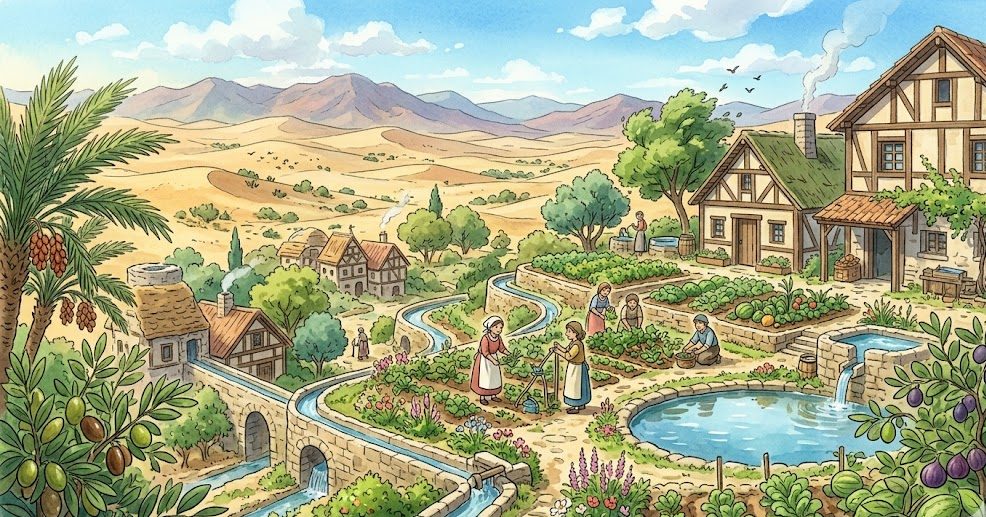
Agriculture has traditionally been bound to regions with fertile soil and abundant rainfall. However, as global populations rise and arable land shrinks, the agricultural frontier is moving into one of the most hostile environments on Earth: the desert.
Once considered entirely barren, hyper-arid regions are becoming hotspots for agricultural productivity. Known as Arid Harvest, this modern phenomenon blends ancient knowledge with cutting-edge technology. By implementing innovative water management and specialized crop selection, desert farming is transforming from a high-risk gamble into a highly profitable, sustainable business model.
1. The Paradox of Desert Farming: Why Arid Regions Hold Potential
At first glance, farming in a desert seems counterintuitive. However, arid environments offer several distinct advantages that traditional agricultural regions lack:
- Abundant Solar Radiation: Deserts receive maximum sunlight hours per year. For plants, this means an endless engine for photosynthesis, leading to rapid growth cycles if water and nutrients are properly managed.
- Lower Pest and Disease Pressure: The naturally low humidity prevents the rapid spread of fungal diseases and specific insect pests that thrive in wet, humid climates.
- Reduced Land Competition: Arid land is often significantly cheaper and more readily available than traditional farmland, allowing agribusinesses to establish large-scale operations with lower initial capital expenditure.
To unlock these benefits, farmers must solve the primary limiting factor: absolute water scarcity.
2. Revolutionary Water Management Technologies
In desert farming, every drop of water must be accounted for, recycled, and utilized to its absolute maximum potential. Traditional flood irrigation has no place here; instead, precision tech rules the field.
Subsurface Drip Irrigation (SDI)
While standard drip irrigation saves water, surface lines lose a massive percentage of water to evaporation under intense desert heat. Subsurface Drip Irrigation (SDI) buries automated drip lines directly in the crop’s root zone. This delivers water and liquid fertilizers (fertigation) directly to where the plant needs it, cutting evaporation rates to near zero and reducing water consumption by up to 50% compared to surface methods.
Hydrogels and Soil Conditioners
To overcome the poor water-retention capabilities of sandy desert soils, modern farmers utilize biodegradable superabsorbent polymers (hydrogels). Mixed into the soil, these crystals act like mini-reservoirs, absorbing water during irrigation and releasing it slowly to the roots over days. This stabilizes the soil moisture profile and prevents nutrients from leaching into deep, unreachable ground layers.
Atmospheric Water Generation and Desalination
For regions lacking freshwater aquifers, innovation steps in:
- Brackish Water Desalination: Utilizing solar-powered desalination units to convert salty, underground water into pure, crop-ready water.
- Atmospheric Water Generators (AWG): Extracting moisture directly from desert air. While still scaling, integration with solar grids makes this a highly promising localized solution.
3. Crop Strategies: Choosing the Right Plants for Arid Success
High-profit desert farming relies on shifting away from water-intensive crops (like alfalfa or traditional rice) and focusing on high-value, drought-tolerant, or salt-tolerant alternatives.
Halophytes: Embracing Salinity
Halophytes are plants that naturally thrive in salty environments. Crops like Salicornia (sea asparagus) can be irrigated using pure seawater. Salicornia is highly prized as a gourmet vegetable in upscale culinary markets, and its seeds can be crushed to produce high-quality cooking oil and biofuel.
High-Value Xerophytes and Resilient Cash Crops
- Date Palms: The classic desert crop remains incredibly profitable. Modern farms utilize tissue culture to mass-produce elite, high-yield varieties like Medjool dates, which command premium prices globally.
- Jojoba and Guayule: Jojoba thrives in intense heat and requires minimal water. Its seeds produce a high-value liquid wax used extensively in the multi-billion-dollar global cosmetics industry.
- Quinoa and Amaranth: These climate-resilient pseudo-grains are naturally adapted to harsh conditions and boast high protein profiles, catering perfectly to the exploding global health-food market.
4. Controlled Environment Agriculture (CEA) in the Desert
To truly master the desert, many enterprises are removing the outdoor climate variables altogether through Controlled Environment Agriculture (CEA), specifically tailored for arid landscapes.
[Solar Array] ──> Powers ──> [Cooling Fans & Desalination]
                                    │
                                    ▼
[Recycled Water] ─────────> [Hydroponic Greenhouse] ──> High-Yield Crops
Seawater Greenhouses
An ingenious architectural innovation, seawater greenhouses use the ambient hot desert air and seawater to cool and humidify the growing structure. The air entering the greenhouse is humidified by trickling seawater over a honeycomb structure, cooling the interior by up to 15°C below the outside temperature. As the humid air leaves, it hits a solar-cooled condenser, creating fresh water for the crops.
High-Tech Hydroponics and Aeroponics
By growing crops in nutrient-rich water solutions (hydroponics) or misting roots in the air (aeroponics) within closed-loop greenhouses, farmers completely bypass the challenges of poor desert soil. These systems recycle up to 95% of the water used, producing massive yields of leafy greens, tomatoes, and berries in the middle of barren dunes.
Summary Matrix: Desert Farming Optimization
| Technology / Strategy | Primary Benefit | ROI Potential | Ideal Crop Types |
| Subsurface Drip (SDI) | Eliminates surface evaporation | High (Immediate water savings) | Orchard crops, Row crops |
| Seawater Greenhouses | Creates microclimates with saltwater | Very High (Long-term) | Tomatoes, Peppers, Berries |
| Halophyte Cultivation | Eliminates need for freshwater | Medium – High | Salicornia, Sea Aster |
| Soil Hydrogels | Increases sand water retention | Fast (Low upfront cost) | Root vegetables, Leafy greens |
5. The Economic Viability and Future of Arid Agriculture
Is desert farming genuinely profitable? The answer lies in the shift toward premium markets. Because desert crops are grown under controlled, precise nutrient applications, they often feature superior quality, uniform size, and higher nutrient concentrations. Furthermore, being geographically closer to emerging markets in the Middle East and North Africa reduces shipping logistics and cold-chain costs.
Moreover, carbon credit initiatives are now incentivizing desert greening. Converting barren desert into carbon-sequestering agro-forestry setups (such as massive jojoba or date plantations) allows farming corporations to generate dual revenue streams: selling agricultural products and trading carbon credits on the global market.
Conclusion: The New Green Horizon
The “Arid Harvest” is redefining the boundaries of global food security. Desert farming is no longer about fighting nature; it is about using precise technology to harness the unique benefits that arid environments offer.
Through the smart application of subsurface irrigation, soil-conditioning hydrogels, seawater greenhouses, and high-value resilient crops, the desert is fast becoming the next great agrarian frontier. For forward-thinking investors and agronomists, the sands are not an obstacle—they are a blank canvas for sustainable, highly profitable innovation.