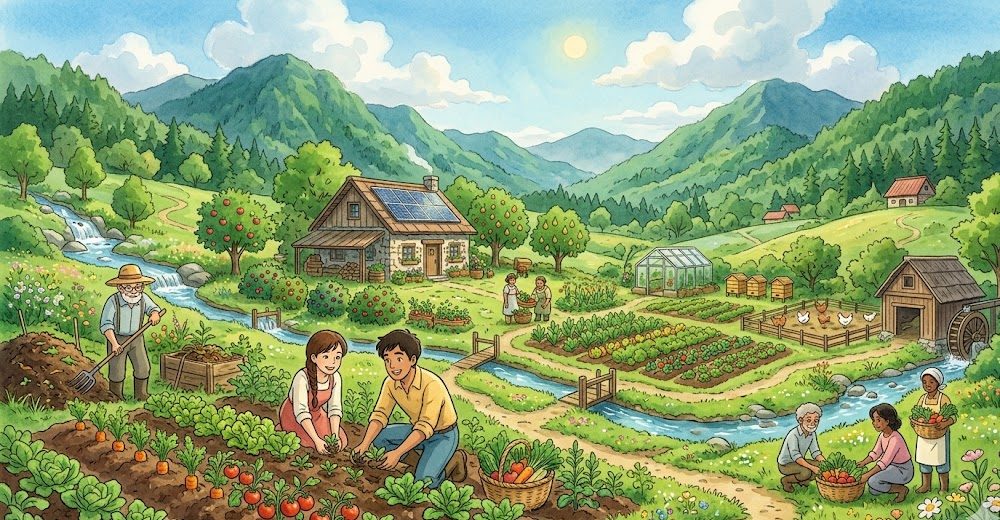
In an era of global uncertainty—ranging from supply chain disruptions and climate volatility to economic shifts—the concept of “food security” has moved from a government buzzword to a personal priority. A Resilient Food System is one that can withstand shocks, continue to produce under stress, and provide nutrient-dense food with minimal external inputs.
Survival Farming is the practical application of this resilience. It isn’t just about growing vegetables; it’s about designing a self-sustaining ecosystem that functions like a closed loop. Whether you are working with a backyard plot or a multi-acre farm, this guide outlines the strategies to build a food system that ensures survival and health regardless of external circumstances.
1. The Foundation: Soil Health as Life Insurance
In a survival scenario, you cannot rely on store-bought chemical fertilizers. Your soil must be a living, breathing engine of fertility.
- Closed-Loop Composting: Every scrap of organic matter—crop residue, kitchen waste, and livestock manure—must be returned to the soil. This creates a “Bank of Nutrients” that feeds your plants year after year.
- No-Till Practices: Digging deep into the earth disrupts the fungal networks (mycorrhizae) that help plants absorb water and resist disease. By using “no-dig” methods, you preserve the soil structure and keep moisture locked underground.
- Cover Cropping: Never leave the soil bare. Planting nitrogen-fixing crops like clover or beans ensures that even when you aren’t growing “food,” you are growing “fertility.”
2. Crop Selection: Calories, Nutrition, and Hardiness
A resilient farm focuses on “survival crops”—plants that are calorie-dense, easy to store, and difficult to kill.
The “Big Three” of Survival Calories:
- Potatoes/Tubers: Highest calorie yield per square foot. They are easy to grow, can be hidden underground from pests (and people), and store for months in a cool, dark place.
- Corn/Maize: Provides essential carbohydrates and can be dried and ground into flour for long-term storage.
- Beans/Legumes: The “meat” of the vegetable garden. They provide vital protein and replenish the soil’s nitrogen simultaneously.
The “Medicine Cabinet” Crops:
Include nutrient-dense “superfoods” like Kale, Garlic, and Onions. These provide essential vitamins and natural antimicrobial properties that keep the immune system strong when traditional medicine may be hard to access.
3. Water Security: Gravity and Harvesting
A farm without water is just a desert. Resilience means having multiple ways to hydrate your crops without relying on electric pumps or city infrastructure.
- Rainwater Harvesting: Utilize every roof surface to collect water into barrels or cisterns. A 1,000-square-foot roof can collect over 600 gallons of water from just one inch of rain.
- Swales and Berms: Shape your land to catch water. By digging shallow trenches (swales) along the contours of your land, you force rainwater to soak into the ground slowly rather than running off, effectively “charging” your soil like a battery.
- Greywater Systems: Reusing water from laundry or dishes (using biodegradable soaps) can provide a consistent source of irrigation for fruit trees and non-edible windbreaks during droughts.
4. Livestock Integration: The Protein Multiplier
Animals are essential for a resilient system because they convert things humans can’t eat (grass, bugs, weeds) into things we can (eggs, meat, milk).
- Chickens: The ultimate survival animal. They provide daily protein (eggs), pest control (they eat beetles and ticks), and high-quality fertilizer.
- Rabbits: They are quiet, require very little space, and breed rapidly. Their manure is “cold,” meaning it can be applied directly to plants without composting first.
- Goats: If space allows, goats can act as living lawnmowers, clearing brush and providing milk that can be turned into cheese or yogurt for long-term storage.
5. Seed Saving: Breaking the Chain of Dependency
If you have to buy new seeds every year, you are not resilient. True survival farming requires mastering the art of Seed Saving.
- Open-Pollinated Varieties: Only grow “Heirloom” or open-pollinated seeds. Unlike “Hybrid” seeds, which may be sterile or produce unpredictable offspring, heirlooms will grow “true to type” year after year.
- Selection for Resilience: By saving seeds from the plants that survived the hottest drought or the coldest frost on your land, you are essentially “programming” your crops to thrive in your specific microclimate over generations.
6. Passive Preservation: Living Without the Fridge
A resilient food system includes a plan for the “Hungry Gap”—the months between harvests.
- Root Cellars: Use the earth’s natural insulation. A simple underground cellar maintains a constant cool temperature, allowing you to store potatoes, carrots, and apples for 6–8 months without any electricity.
- Fermentation and Pickling: This isn’t just for flavor; it’s a biological preservation method. Fermenting cabbage into sauerkraut or milk into kefir creates probiotics that improve gut health while extending the food’s life.
- Solar Dehydration: Using the sun to dry fruits, herbs, and even meat (jerky) is a zero-cost way to create lightweight, shelf-stable nutrition.
7. Perennial Food Forests
Annual crops (like tomatoes) require work every year. Perennials—fruit trees, nut trees, and berry bushes—are the “set and forget” assets of survival farming. Once established, a food forest provides a massive amount of food for decades with almost zero labor. Chestnuts and walnuts, in particular, provide fats and proteins that are vital for long-term survival.
Conclusion
Building a resilient food system is a journey from dependency to sovereignty. It is about moving away from a “just-in-time” food model toward a “just-in-case” philosophy. By focusing on soil health, water harvesting, and seed saving, you transform your land into a fortress of biology. Survival farming isn’t just a backup plan for a crisis; it is a way of living in harmony with the earth, ensuring that no matter what happens in the outside world, your table remains full.