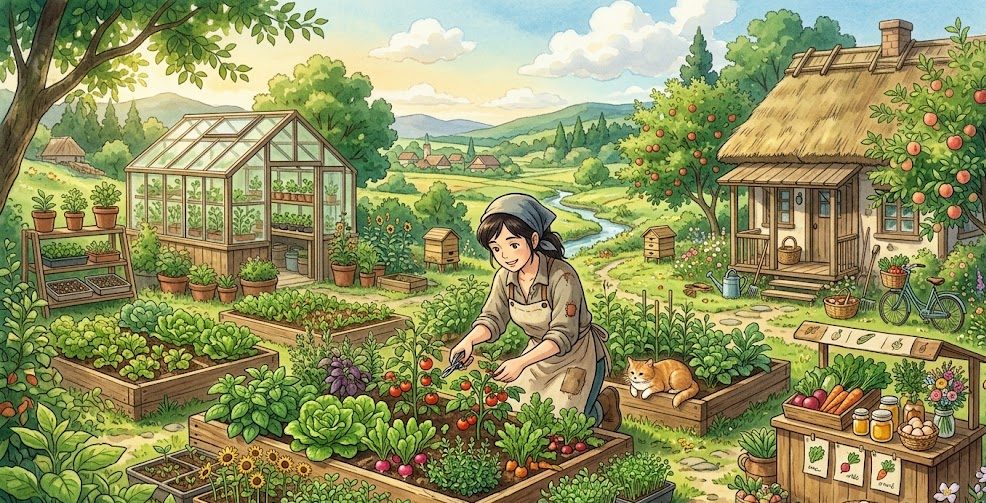
For decades, the agricultural dream was synonymous with owning hundreds of acres of rolling hills. But in 2026, the script has flipped. As land prices soar and urban populations crave ultra-fresh, local produce, the most profitable farmers aren’t the ones with the most land—they are the ones with the most efficient land.
Micro Farming is the art of generating high-income yields from plots as small as a backyard, a shipping container, or even a spare room. By focusing on high-value crops and precision techniques, “Agri-preneurs” are now earning professional-level incomes from spaces that were once considered “hobby gardens.”
This guide reveals the secrets to turning minimal square footage into a maximum-profit enterprise.
1. The Strategy: Value Over Volume
In large-scale farming, profit comes from volume (selling thousands of tons of wheat at a low margin). In micro farming, profit comes from value. You must choose crops that are:
- High-Density: Plants that can be grown close together.
- Fast-Rotating: Crops that go from seed to harvest in under 40 days.
- Perishable & Premium: Items that lose quality quickly in transit, giving you (the local grower) a “freshness” advantage over big industrial farms.
2. Top Profitable Crops for Small Spaces
According to 2026 market trends, these are the “heavy hitters” for micro-scale profitability:
Microgreens (The 14-Day Goldmine)
Microgreens are young vegetable greens that are approximately 1-3 inches tall. They are packed with flavor and nutrients.
- Growth Cycle: 10–14 days.
- Why they pay: High-end restaurants and health food stores pay a premium for fresh, vibrant microgreens to use as garnishes and salad bases. You can grow these on vertical racks, stacking your profit layers high.
Gourmet Mushrooms (The Vertical Advantage)
Mushrooms like Oyster, Lion’s Mane, and Shiitake don’t need sunlight or soil—they grow on bags of straw or sawdust.
- Growth Cycle: 3–5 weeks.
- Why they pay: Exotic mushrooms fetch 3–5 times the price of common button mushrooms. Because they grow vertically in climate-controlled sheds or basements, you can produce hundreds of pounds in a tiny footprint.
Saffron (The World’s Most Expensive Spice)
If you have the right climate (or a controlled indoor environment), saffron is the ultimate micro-crop.
- The Secret: It takes roughly 150 flowers to produce 1 gram of saffron. While labor-intensive, the retail price—often reaching $2,000 to $5,000 per pound—makes it a viable luxury crop for small, dedicated spaces.
Cherry Tomatoes & Specialty Peppers
Standard tomatoes are commodities. However, heirloom cherry tomatoes and “snacking” peppers (like Shishito or Habanada) are high-value specialty items that produce continuously for months.
3. Precision Systems: The Micro-Farmer’s Toolkit
To earn “big” from “small,” you must replace soil with systems that accelerate growth.
Vertical Racking & LED Lighting
By growing “up” instead of “out,” you multiply your acreage without buying more land. Modern 2026 LED technology allows you to mimic the sun’s spectrum with 40% less energy than previous models, making indoor farming economically viable.
Hydroponics and Aeroponics
- Hydroponics: Growing in nutrient-rich water. It uses 90% less water than traditional farming and allows for 30% faster growth.
- Aeroponics: Mist-based growth. By suspending roots in the air and misting them with nutrients, plants get maximum oxygen, leading to explosive growth rates.
4. Marketing Secrets: Sell the Story, Not Just the Veggie
In 2026, transparency is a currency. Consumers want to know who grew their food and how.
- The “Hyper-Local” Brand: Use platforms like Instagram, TikTok, and local farm-to-table apps to show behind-the-scenes footage of your harvest.
- Subscription Boxes (CSA): Secure your income by selling “shares” of your harvest. 50 loyal neighbors paying $30 a week for a fresh greens box creates a stable, predictable $1,500/week revenue stream.
- QR Code Traceability: Place a QR code on your packaging that links to a video of your micro-farm. This builds trust and justifies your premium price point.
5. Profitability Potential (Small-Space Estimates)
| Crop | Space Required | Cycle Time | Est. Monthly Profit |
| Microgreens | 100 sq. ft. (racks) | 14 Days | $1,500 – $3,000 |
| Oyster Mushrooms | 200 sq. ft. (shed) | 30 Days | $2,000 – $4,500 |
| Hydroponic Lettuce | 500 sq. ft. | 35 Days | $1,000 – $2,500 |
| Cherry Tomatoes | 500 sq. ft. | Continuous | $800 – $1,800 |
6. Common Mistakes to Avoid
- Over-Automating Too Early: Don’t spend $20,000 on robots before you’ve sold your first tray of greens. Master the biology manually first.
- Ignoring the “Cold Chain”: Your advantage is freshness. If you don’t have a way to keep produce cold from harvest to delivery, you lose your premium edge.
- Growing What You Like, Not the Market: You might love spicy radishes, but if your local chefs want mild sunflower shoots, follow the money.
7. Conclusion: The Rise of the Nanofarm
Micro farming is the ultimate “side hustle” that can scale into a full-time empire. It democratizes agriculture, allowing urban dwellers and small landowners to participate in the most essential industry on Earth.
The “secret” isn’t in the seeds or the tech—it’s in the unit economics. When every square inch of your farm is producing a high-value, high-demand product, the size of your land no longer limits the size of your bank account.
Start small, optimize every inch, and watch your small space yield big returns.