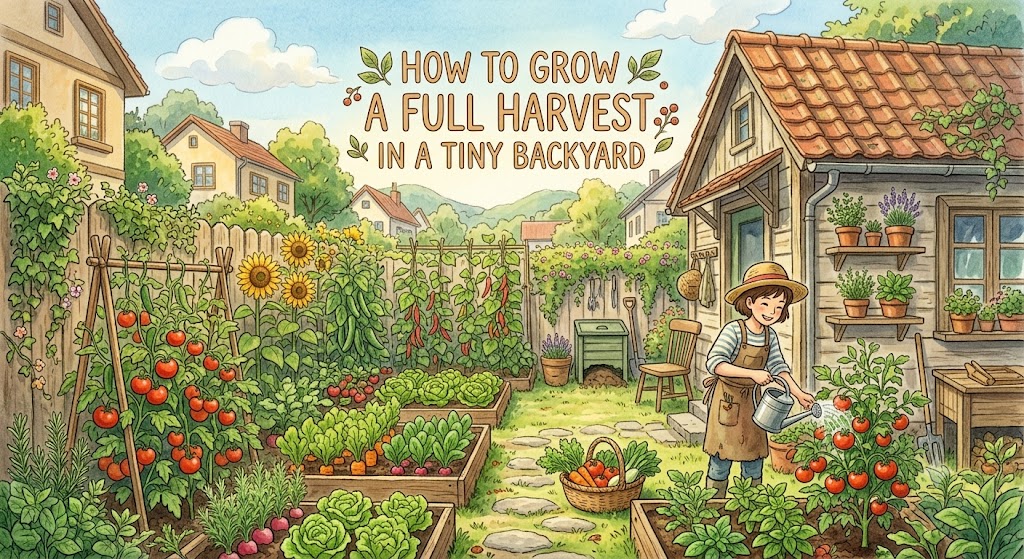
You don’t need hundreds of acres to grow a meaningful amount of food.
A small backyard, side yard, patio, balcony, or even a few carefully organized containers can become a surprisingly productive growing space when every square foot is planned properly.
That is the basic idea behind micro farming.
Instead of measuring success by the size of the land, micro farmers focus on how efficiently they use the space available. They combine compact crops, vertical growing, succession planting, containers, raised beds, smart irrigation, and careful crop selection to produce a steady harvest from a surprisingly small area.
For homeowners across the United States, this approach can be especially practical. Urban and suburban properties often have limited outdoor space, but they may still have access to sunlight, water, and a little unused ground.
The goal isn’t to turn a backyard into a commercial farm.
It’s to create a small, productive food system that makes the most of limited space.
What Is Micro Farming?
Micro farming is essentially small-scale intensive food production.
A micro farm might use:
- A backyard
- A small garden
- Raised beds
- Containers
- A greenhouse
- A patio
- A rooftop
- Vertical growing structures
The exact definition can vary, but the basic principle is simple:
Grow more useful crops from less space.
Instead of planting one large row of a single crop, a micro farmer might combine several crops and use the space vertically as well as horizontally.
Start With the Sun
Before buying seeds or building raised beds, observe your backyard.
Sunlight is one of the most important resources in small-space farming.
Most vegetables perform best when they receive several hours of direct sunlight, although requirements vary considerably between crops.
Spend a few days observing:
- Morning sunlight
- Afternoon sunlight
- Areas shaded by buildings
- Tree shadows
- Fence shadows
- Seasonal changes
A sunny location can be reserved for crops that need stronger light.
Shadier areas may be better suited to crops that tolerate lower light.
Good planning starts with the space you already have.
Think in Square Feet, Not Acres
Traditional farming often focuses on acreage.
Micro farming requires a different mindset.
Imagine a backyard with only 100 square feet available.
Instead of seeing it as a tiny piece of land, think about how many productive growing surfaces it contains.
You might have:
- Ground-level beds
- Vertical trellises
- Containers
- Hanging planters
- Wall-mounted growing systems
The same footprint can potentially support multiple layers of production.
Choose Crops That Give You a Good Return on Space
Not every crop makes sense for a tiny garden.
A large pumpkin plant can spread across a surprising amount of ground.
A small bed of salad greens may produce harvestable food repeatedly.
For limited spaces, consider crops such as:
- Lettuce
- Spinach
- Radishes
- Green onions
- Herbs
- Bush beans
- Peppers
- Cherry tomatoes
- Carrots
- Beets
- Cucumbers
- Strawberries
The best crops depend on your climate, sunlight, available space, and what your household actually eats.
There is little value in growing something simply because it is easy if nobody wants to eat it.
Grow Vertically
Vertical growing is one of the most powerful techniques in micro farming.
Instead of allowing plants to occupy only the ground, give climbing crops a structure to use.
Trellises can support:
- Cucumbers
- Pole beans
- Peas
- Certain tomatoes
- Small melons
- Climbing flowers
A vertical structure can turn an otherwise unused area above the soil into productive growing space.
This is particularly useful in narrow backyards.
Use Raised Beds Strategically
Raised beds can make a small garden easier to organize.
They can provide clear boundaries for crops and may make soil management more straightforward.
A small backyard might use several narrow beds rather than one large bed.
For example:
Bed 1: Salad greens
Bed 2: Root vegetables
Bed 3: Peppers and herbs
Bed 4: Beans and climbing crops
This makes planting, harvesting, and crop rotation easier to manage.
Containers Can Turn Empty Areas Into Growing Space
Containers are extremely useful when traditional garden beds aren’t possible.
You can grow plants in:
- Pots
- Grow bags
- Large containers
- Window boxes
- Raised planters
Containers can be placed on patios, balconies, driveways, or other suitable areas.
But container gardening requires more attention to watering because containers can dry out faster than larger soil beds.
Drainage is also important.
A container without adequate drainage can create root problems.
Use Succession Planting
Here’s where micro farming becomes much more interesting.
You don’t have to use the same piece of soil for only one crop during an entire season.
With succession planting, you can plant another crop after harvesting the first.
For example:
Early spring: Radishes
Late spring: Beans
Summer: Greens suited to the local climate
Fall: Cool-season vegetables
The exact schedule depends on your growing zone.
The goal is to keep productive space working throughout as much of the growing season as practical.
Don’t Plant Everything at Once
A common beginner mistake is planting an entire packet of seeds on one day.
Then everything becomes ready at approximately the same time.
Suddenly you have more lettuce, radishes, or greens than you can realistically eat.
Instead, plant smaller amounts at intervals.
For example:
Week 1 → Small row
Week 3 → Another row
Week 5 → Another row
This can create a more continuous harvest.
Harvest Young Greens
Many leafy vegetables can be harvested gradually.
Instead of removing the entire plant immediately, certain greens can be harvested selectively depending on the variety and growing conditions.
This allows a small garden to provide food over a longer period.
Examples include:
- Lettuce
- Kale
- Mustard greens
- Arugula
- Swiss chard
The goal is not always maximum individual plant size.
It can be maximum useful harvest over time.
Grow Herbs in Small Spaces
Herbs can be excellent micro-farming crops because they don’t always require much space.
Consider:
- Basil
- Parsley
- Cilantro
- Chives
- Thyme
- Oregano
- Mint
Some herbs can be grown in containers.
Be careful with aggressive spreaders such as mint; keeping them contained can prevent them from taking over nearby growing areas.
Use Companion Planting Carefully
Companion planting is often discussed in small gardens.
The idea is to grow certain plants near one another because they may have compatible growth habits or attract beneficial insects.
For example, a gardener might combine:
Tomatoes + Basil + Flowers
The most useful benefit is often practical space planning and biodiversity rather than expecting a magical pest-control effect.
Good spacing, healthy plants, sanitation, and appropriate pest monitoring remain important.
Make Your Soil Work Harder
Healthy soil is the foundation of productive micro farming.
Before planting, understand your soil.
A soil test can help identify important characteristics such as:
- pH
- Nutrient levels
- Organic matter
- Other conditions relevant to plant growth
Compost and appropriate organic amendments can improve soil structure and fertility when used correctly.
Avoid assuming that more fertilizer automatically means more food.
Excess nutrients can create problems.
Compost Your Garden Waste
A backyard micro farm can generate useful organic material.
Leaves, certain plant residues, and other suitable organic materials can potentially be composted.
Finished compost can be incorporated into garden systems where appropriate.
This creates a simple cycle:
Garden waste → Compost → Soil amendment → New crops
Always follow local guidance for what can be composted.
Use Efficient Watering
Water management becomes especially important when growing many plants in a small area.
Hand watering works for small gardens, but drip systems or soaker systems can make watering more consistent.
A basic irrigation setup can include:
- Water source
- Tubing
- Emitters
- Timer
- Simple filters where needed
The goal is to provide appropriate moisture without constantly wetting leaves or wasting water.
Mulch the Soil
Mulch can help protect soil and reduce evaporation.
Suitable mulch materials may include:
- Straw
- Shredded leaves
- Wood-based mulch
- Other appropriate organic materials
Mulch can also help suppress weeds.
Leave appropriate space around plant stems to reduce moisture-related problems.
Use Small Greenhouses or Season Extenders
If your climate has a short growing season, a small greenhouse or protected structure can increase the amount of time you can grow.
Other options include:
- Row covers
- Cold frames
- Mini tunnels
These structures can protect plants from certain weather conditions.
But ventilation matters.
A small enclosed structure can become extremely hot surprisingly quickly.
Use Weather Data
Modern micro farmers have access to information that previous generations could only estimate.
Weather apps and local forecasts can help with:
- Planting decisions
- Frost preparation
- Irrigation planning
- Heat protection
- Harvest timing
Even a simple local weather station can provide useful information.
Try Simple Soil Sensors
Technology doesn’t have to be complicated.
Affordable soil-moisture sensors can help you understand whether the root zone is actually dry.
This is better than watering simply because the soil surface looks dry.
Different crops have different moisture requirements, so use sensor readings as one input rather than treating a single number as a universal rule.
AI Can Help Plan a Tiny Garden
Artificial intelligence can also become a useful planning assistant.
You can provide information such as:
- Garden dimensions
- Growing zone
- Sunlight hours
- Crops you like
- Available containers
An AI tool can help brainstorm:
- Planting layouts
- Succession schedules
- Crop combinations
- Garden task lists
But local agricultural guidance and actual garden conditions should remain the final authority.
AI can help organize ideas.
It cannot physically inspect your soil or predict every weather event.
A 100-Square-Foot Example
Let’s imagine a small backyard area measuring approximately 10 × 10 feet.
Instead of filling it with one crop, you could divide the space into several sections.
Area 1
Leafy greens.
Area 2
Carrots and radishes.
Area 3
Peppers and herbs.
Area 4
Beans using a vertical trellis.
Boundary
Containers for additional herbs and strawberries.
The exact layout should depend on sunlight and local growing conditions.
The key idea is multiple crop types and multiple growing layers.
Don’t Forget Pollinators
A productive backyard can also support pollinators.
Consider adding suitable flowering plants near vegetable areas.
Depending on your region, these may attract:
- Bees
- Butterflies
- Other beneficial insects
Avoid unnecessary pesticide use and choose plants appropriate for local conditions.
A diverse backyard can support more than food production.
It can become a small ecosystem.
Manage Pests Early
A tiny garden can suffer serious damage surprisingly quickly.
Inspect plants regularly for:
- Chewed leaves
- Discoloration
- Wilting
- Insects
- Eggs
- Fungal symptoms
Early detection is much easier to manage than waiting until an entire crop is damaged.
Physical barriers, hand removal, sanitation, crop diversity, and other integrated pest-management approaches can all be useful depending on the problem.
Don’t Overcrowd Plants
When space is limited, it can be tempting to plant everything as close together as possible.
That can backfire.
Overcrowded plants may experience:
- Poor airflow
- Increased disease pressure
- Competition for resources
- Difficult harvesting
Efficient farming doesn’t mean ignoring plant spacing.
It means using space intelligently while giving plants what they need.
Track What Actually Works
Keep a simple garden notebook.
Record:
- Planting dates
- Varieties
- Harvest amounts
- Weather
- Pest problems
- Watering
- Fertilization
- What tasted best
After one season, you’ll know much more about your backyard.
After several seasons, you can build a customized growing system based on your actual conditions.
That information can be more valuable than generic gardening advice.
Focus on Food You Actually Use
This may be the most important micro-farming rule.
Don’t grow something just because it produces a lot.
Grow what your household actually eats.
If your family uses tomatoes every week, dedicate space to tomatoes.
If you cook with herbs constantly, grow herbs.
If nobody likes zucchini, don’t dedicate half the garden to it just because zucchini grows quickly.
The most productive garden is the one that produces food you actually use.
Can a Tiny Backyard Really Produce a Full Harvest?
Yes—but expectations need to be realistic.
A small backyard cannot replace a commercial farm or necessarily provide every food your household needs.
However, it can produce a meaningful amount of fresh food.
With careful planning, a small space can provide:
- Fresh herbs
- Salad greens
- Vegetables
- Root crops
- Tomatoes
- Peppers
- Beans
- Berries
The exact harvest will depend on climate, sunlight, soil, skill, weather, and crop selection.
The goal is not to create a miniature version of a 500-acre farm.
It’s to make a small piece of land unusually productive.
A Smart Micro-Farming Plan
If you’re starting from scratch, keep the first season simple.
Step 1: Measure the Space
Record length, width, sunlight, and water access.
Step 2: Pick 5–8 Crops
Choose crops your household actually enjoys.
Step 3: Test the Soil
Understand what you’re working with.
Step 4: Build the Basic Growing Area
Use beds, containers, or both.
Step 5: Add Vertical Support
Use trellises for suitable climbing plants.
Step 6: Install Efficient Watering
Make watering simple and consistent.
Step 7: Plant in Stages
Use succession planting instead of planting everything simultaneously.
Step 8: Record Results
Track harvests and problems.
Step 9: Improve Next Season
Keep the crops that performed well and replace those that didn’t.
Final Thoughts
Micro farming proves that productive agriculture doesn’t always require a huge amount of land.
A small backyard can become surprisingly efficient when you combine smart crop selection, vertical growing, succession planting, containers, healthy soil, efficient irrigation, and careful planning.
Modern tools can make the process even easier.
Weather apps can help with timing.
Sensors can help monitor soil moisture.
Simple irrigation systems can reduce repetitive work.
AI can help organize planting ideas.
But technology isn’t the heart of micro farming.
The real advantage comes from understanding your space and using every useful part of it wisely.
A tiny garden won’t produce everything a household needs, but it can provide a meaningful supply of fresh food while making productive use of land that might otherwise sit unused.
And that’s what makes micro farming so interesting.
You don’t necessarily need more land to grow more—you need a smarter system for the land you already have.