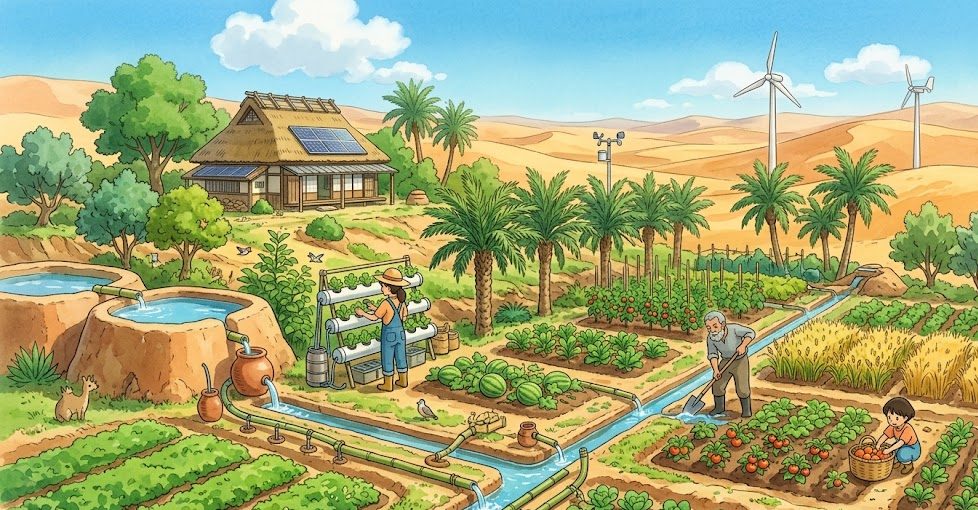
For thousands of years, hyper-arid regions and vast desert landscapes were considered completely unusable for traditional agriculture. The combination of intense, baking heat waves, a near-total absence of predictable rainfall, and coarse, shifting sand that cannot hold moisture or vital crop nutrients made open-field cultivation an impossible dream.
Historically, human settlements were forced to crowd tightly around permanent river valleys or natural oases to sustain basic crops.
Today, global climate shifts, declining arable land reserves, and rapid population growth are forcing a massive rethink of these geographic limitations. Progressive agricultural operations and agritech entrepreneurs are no longer viewing empty arid zones as barren wastelands. Instead, they see them as major development opportunities.
By transforming these sun-drenched regions into a modern desert farming innovation hub, growers can unlock unique production advantages.
Deserts offer an almost endless supply of clean, uninterrupted solar energy and vast expanses of affordable space. By implementing advanced water-conservation engineering, targeted soil remediation, and responsive climate-control tools, you can establish a highly resilient, commercial farming operation. This approach allows you to secure stable, high-yield harvests year-round, turning harsh desert conditions into consistent business profits.
The Economics of Arid Agriculture: Turning Challenges Into Assets
Operating a commercial farm in a hyper-arid climate requires shifting from a model of abundance to one of strict resource optimization. While conventional open-field farms in temperate regions frequently deal with unexpected cloud cover, seasonal frost shocks, or uncontrollable pest swarms carried by regional winds, desert environments offer a uniquely predictable baseline.
Unmanaged Arid Agriculture:
[High Evaporation] ──> [Rapid Soil Salinization] ──> [Crop Desiccation] ──> [System Failure & Heavy Loss]

Innovative Desert Farming Hub:
[Closed-Loop Water] ──> [Subsurface Nutrient Delivery] ──> [Root-Zone Shielding] ──> [Continuous Premium Yields]
The primary economic advantage of a desert farming hub lies in its unshaded, continuous solar footprint. Because sunlight is never a limiting factor, crops can synthesize energy at maximum biological rates every single day.
By utilizing precise, enclosed delivery infrastructure that protects water and nutrients from surface evaporation, you can achieve individual crop growth cycles that are up to 30% faster than traditional soil-bound setups. This efficiency enables predictable harvest schedules and allows you to supply high-value markets when neighboring regions are hit by off-season weather disruptions.
1. Soil Transformation: Sand-Clay Engineering and Liquid Nanoclay
The foundational hurdle of desert farming is the nature of desert sand itself. Standard sand particles are large, coarse, and completely uncharged, meaning any irrigation water or applied fertilizer drains straight down through the root zone like a sieve, leaving crops parched and starved.
The Mechanism of Liquid Nanoclay (LNC)
One of the most significant breakthroughs in modern arid land remediation is the deployment of Liquid Nanoclay technology. This process involves blending natural, fine clay particles with water until they dissociate into individual, microscopic flakes carrying a negative electrical charge.
When this liquid compound is sprayed directly onto standard desert fields, the microscopic clay flakes wrap around individual coarse sand particles. This structural change alters the physical makeup of the sand, creating a stable, interconnected matrix that behaves exactly like high-quality, fertile agricultural loam.
- Moisture Retention: Implementing sand-clay engineering reduces on-farm water demands by 50% to 60%, holding vital moisture precisely within the upper 12 to 18 inches of the soil profile where crop roots feed.
- Nutrient Stabilization: The natural electrical charges on the clay particles chemically bind to essential plant nutrients like nitrogen, potassium, and phosphorus. This prevents expensive fertilizer inputs from leaching deep into underlying aquifers during irrigation cycles.
2. Seawater Farming and Advanced Biosaline Agriculture
Because fresh groundwater reserves are incredibly limited in arid zones, sustainable desert operations are shifting toward utilization of alternative water sources, specifically brackish groundwater and coastal seawater.
Cultivating Halophytic Crop Varieties
Biosaline farming bypasses the need for intensive, energy-expensive desalinization plants by focusing on halophytes—specialized plants that have evolved to grow and thrive in highly saline environments.
- Salicornia (Sea Asparagus): This high-value succulent crop is irrigated directly with raw, unfiltered seawater. The crisp, salt-tolerant vegetable commands premium prices in high-end culinary markets, while its oil-rich seeds can be harvested for sustainable biofuel and protein-dense animal forage.
- Salt-Tolerant Date Palms and Olives: Utilizing brackish groundwater allows desert farms to operate large-scale orchards of specialized date palm and olive cultivars. These crops handle high mineral concentrations safely by sequestering salt particles within non-fruiting plant tissues or expelling excess minerals through specialized leaf glands.
Balancing System Architecture to Maximize Desert ROI
Building a profitable desert farming venture requires matching your specific structural choices with the environmental realities of your regional footprint.
| Arid Farming System | Initial Capital Setup | Daily Water footprint | Primary Economic Output | Environmental Protection Focus |
| Sand-Clay Engineering Fields | Moderate | Moderate (Subsurface targeted delivery) | High-volume grain, field fodder, and deep-rooting pulse crops. | Prevents dust storms and stabilizes shifting dunes permanently. |
| Seawater Irrigation Channels | Low to Moderate | High (Utilizes zero fresh water assets) | Premium culinary halophytes, specialty biofuels, and marine biomass. | Requires managed drainage layouts to prevent inland salt pooling. |
| Evaporative Cooling Greenhouses | High | Low (Highly optimized, closed-loop recycling) | High-value vine tomatoes, bell peppers, strawberries, and leafy greens. | Shields delicate crop leaves from intense UV radiation burns. |
3. High-Efficiency Subsurface Drip and Roots-Zone Micro-Climates
In an environment where afternoon surface temperatures can easily exceed 115°F (46°C), standard overhead sprinklers or surface irrigation canals are highly inefficient. Nearly 70% of the discharged water volume can flash evaporate into the air before ever touching a leaf, leaving behind heavy crusts of destructive salt minerals on the soil surface.
The Precision Subsurface Strategy: Commercial desert production hubs rely entirely on Subsurface Drip Irrigation (SDI) lines buried 8 to 20 inches deep. These computer-guided delivery networks pulse tiny, measured volumes of an optimized water-nutrient mix directly onto the active root tips. Because the soil surface remains completely dry, evaporation is minimized, surface weed growth is suppressed, and the vulnerable crop roots stay cool and functional during the hottest part of the day.
To further protect these root zones, farms install permanent windbreaks using deep-rooted, drought-hardy trees like Casuarina or Prosopis cineraria along the outer borders of the property. These living barriers slow down hot desert winds, reduce crop transpiration stress, and stop moving sand dunes from burying active planting beds.
A Step-by-Step Implementation Blueprint for Desert Farming Success
Transitioning a raw, arid plot of land into a highly efficient, income-generating agricultural production center requires a clear, technically sound roadmap.
1.Step 1: Auditing Water Mineral Profiles and Topography:Focus: Site Diagnostics.
Begin by conducting detailed laboratory assays of your available water assets, measuring exact salinity, sodium adsorption ratios (SAR), and trace mineral loads. Map the natural contours of your desert plot to identify areas susceptible to fast sand drifts or low spots where cold air might pool during winter desert nights.
2.Step 2: Implementing Windbreaks and Applying Nanoclay:Focus: Land Engineering.
Plant multi-layered rows of deep-rooted, drought-tolerant windbreak trees along your windward borders to stabilize the local micro-climate. Apply liquid nanoclay formulations or well-processed organic amendments across your primary planting lanes, incorporating the material thoroughly to transform raw sand into a high-capacity soil sponge.
3.Step 3: Laying Buried Subsurface Irrigation Networks:Focus: System Installation.
Install high-durability, pressure-compensating subsurface drip lines precisely beneath your designated crop rows. Connect these lines to a central automated filtration unit equipped with automatic back-flushing valves to ensure fine desert sand particles or mineral scales never clog the internal drip emitters.
4.Step 4: Seeding Resilient Cultivars and Scheduling Cycles:Focus: Commercial Scaling.
Sow your selected salt-tolerant or heat-hardy crop varieties directly into the treated zones. Program your automated irrigation computers to deliver small, frequent water pulses during cool night and early morning hours, maximizing water use efficiency and securing top-tier commercial crop yields.
Frequently Asked Questions (FAQs)
How do desert farmers prevent harmful salt build-up in the soil over time?
When irrigating in arid climates, salt accumulation is a natural challenge as water leaves the field through plant use and evaporation. Desert farmers manage this by applying a precisely calculated “leaching fraction.” This involves occasionally applying a controlled volume of water specifically designed to push accumulated salts down past the root zone into deeper, inactive soil layers, keeping the active root area safe and productive.
Can standard organic compost be used effectively in raw desert sand?
Yes, compost is highly valuable for desert cultivation, but it must be managed carefully. Because desert soils are hot and sandy, oxygen moves through them quickly, causing raw organic matter to break down and disappear rapidly. To get long-lasting results, combine your compost with stable carbon materials like biochar, or apply it using thin, regular applications rather than one large treatment.
What are the best high-value fruit crops to grow commercially in desert climates?
Specialized fruit crops like high-quality date palms, pomegranates, figs, and certain seedless grape varieties thrive in desert conditions. These plants actually benefit from the intense, unshaded sunlight and dry summer air, which lowers the risk of surface fungal diseases and concentrates natural sugars within the fruit, resulting in a premium-quality harvest.
Does desert agriculture require high-tech greenhouses to be profitable?
Not necessarily. While high-tech greenhouses provide exceptional control for delicate, premium crops like leafy greens and berries, large-scale field operations can be highly profitable using open-field setups. Success in open fields relies on utilizing subsurface drip systems, applying sand-clay engineering, and choosing hardy, climate-appropriate crops like pulses, fodder, and specialized oilseeds.
Conclusion
Transforming arid deserts into highly productive farming operations is an excellent way to secure high, predictable crop yields while expanding global food production. Continuing to rely entirely on shrinking temperate land and traditional, water-heavy farming methods leaves the agricultural sector vulnerable to shifting climates and rising input costs.
By upgrading your operation with innovative strategies like sand-clay engineering, subsurface irrigation, biosaline cultivation, and living windbreaks, you can eliminate resource waste. These proven, practical techniques do more than just make farming possible in difficult climates—they turn intense desert sunlight and space into powerful production assets, ensuring a resilient, highly profitable future for modern agribusiness.