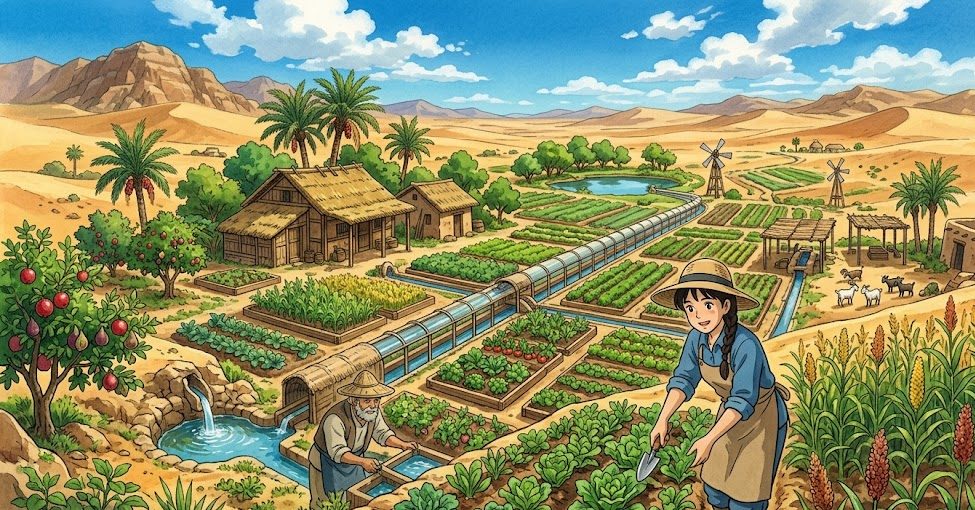
When most people think of a desert, they picture endless waves of dry sand, blazing heat, and a complete absence of life. It looks like the absolute last place on Earth where you could successfully grow food. For decades, traditional agriculture avoided these arid regions, leaving them to wild brush and cacti.
But as global fresh water supplies shrink and fertile land becomes scarce, we are being forced to look at the map differently.
Thanks to an incredible wave of sustainable desert farming innovation, the world’s driest spaces are transforming into highly productive green fields. Farmers are no longer fighting the heat; they are learning to partner with it. By combining cutting-edge modern technology with ancient water-harvesting secrets, arid land agriculture is becoming a highly profitable and resilient reality.
Whether you are looking to farm in a challenging dry climate or you are fascinated by the future of food security, these five hidden desert growth methods are proving that life can thrive in the sand.
1. Deep-Root Irrigation and Clay Pot Agriculture
Watering a plant in the desert using a standard sprinkler is a major mistake. The scorching sun and dry winds will evaporate the moisture into the air before a single drop reaches the roots. Sustainable desert farming requires keeping the water entirely hidden underground.
The Modern Subsurface Approach
Advanced arid farms use deep-root drip irrigation systems. Flexible tubes are buried deep beneath the sand, placing exact, tiny droplets of water directly against the roots. Because the surface of the sand stays bone dry, weed seeds cannot germinate, and not a single drop is lost to the sky.
The Ancient Secret: Olla Pots
If you are working on a smaller homestead level or looking for a low-cost, zero-electricity solution, you can use an ancient technique called Olla irrigation.
How it Works: Unglazed, porous clay pots (Ollas) are buried up to their necks in the sand and filled with water. Crops are planted closely around the pot. Because the clay is porous, water slowly seeps out through the walls only when the surrounding soil becomes dry. The plant roots grow tightly around the clay pot, drinking directly from the source with zero waste.
2. Sand Hydroponics: The “Non-Soil” Revolution
Traditional dirt farming relies on rich organic matter. Desert sand lacks these nutrients, meaning traditional crops will starve if planted directly into a dune without help. To bypass this, innovative growers are turning to sand hydroponics.
Using Sand as a Sterile Anchor
Unlike water-only hydroponic setups that require expensive plastic channels, sand hydroponics utilizes the natural desert landscape. The sand is treated purely as a physical anchor to hold the plant roots upright.
Precision Nutrient Feeding
A highly filtered water solution packed with liquid volcanic minerals, nitrogen, and potassium is pumped through the sand bed at scheduled intervals.
- The Recycling Advantage: The sand naturally filters the water as it drains downward.
- Closed-Loop Pumping: A plastic liner buried beneath the sand capturing bed catches the draining water, pumping it right back into storage tanks to be used again. This uses up to 90% less water than traditional dirt farming.
3. Desert Agroforestry and the Power of Nitrogen-Fixing Trees
If you plant a delicate vegetable out in the open desert, the intense sun will sunburn the leaves and dry out the ground. To grow food sustainably in arid land, you must build a natural shield using desert agroforestry.
Creating a Multi-Tier Canopy
Agroforestry involves intentionally planting specific trees alongside your cash crops. In desert regions, farmers plant rows of deep-rooted, drought-tolerant trees like Mesquite, Acacia, or Date Palms.
[Sunlight] ➔ [Top Layer: Date Palms Block Extreme Heat] ➔ [Mid Layer: Fruit Trees] ➔ [Ground Layer: Delicate Vegetables Thrive in Gentle Shade]
These taller trees act as a natural windbreak, slowing down hot desert winds that dry out crops. They also create a dappled shade canopy that reduces the ground temperature by several degrees, allowing delicate vegetables to survive underneath.
Mining for Nitrogen
Many native desert trees are “nitrogen-fixers.” Their roots draw nitrogen gas out of the air and store it in the soil, naturally fertilizing the ground for the smaller crops growing nearby.
4. Dew and Fog Harvesting Networks
In many coastal deserts, it almost never rains, yet the early morning air is thick with heavy fog and humidity. One of the most fascinating hidden growth methods in arid land agriculture involves catching this invisible airborne moisture.
Giant Mesh Nets
Farmers set up large, vertical mesh nets along hillsides where desert winds blow the morning fog inland. As the fog passes through the fine plastic mesh, tiny water droplets cling to the material.
Gravity-Fed Irrigation
Over several hours, these tiny droplets join together to form heavy drops that slide down the netting into a collection trough at the bottom. This gravity-fed system can collect thousands of liters of pure, soft water every single morning without using a single watt of electricity. This free water is piped directly to the roots of the crops.
5. Saline Agriculture: Growing Crops with Saltwater
Fresh water is incredibly rare in the desert, but brackish underground water or ocean water is often highly abundant. Traditional crops die instantly if watered with salty water because the salt extracts moisture out of the plant cells. The final frontier of desert farming is saline agriculture.
Breeding Halophytes
Scientists and farmers are domesticating “halophytes”—specialized plants that naturally love salt. Crops like Samphire (sea asparagus), certain varieties of quinoa, and specialized wild rices thrive when watered with pure seawater.
Desalination Waste Loops
For traditional crops, smart farms utilize solar-powered desalination units to strip salt from underground water. The clean water goes to vegetables, while the leftover concentrated salty brine is redirected into inland aquaculture ponds to raise shrimp and saltwater fish. The nutrient-rich waste from the fish is then used as an organic liquid fertilizer for desert-hardy trees.
Conclusion: The Desert is Ready to Bloom
Sustainable desert farming proves that human ingenuity can overcome the harshest environmental limitations. By moving away from wasteful flood tactics and adopting smart underground watering, exploiting sand hydroponics, building protective agroforestry shields, and harvesting moisture from the air, we can turn barren spaces into thriving food hubs. Arid land agriculture is no longer an experiment; it is a vital blueprint for a food-secure world.
Frequently Asked Questions (FAQs)
1. Does sand hydroponics require special types of sand?
Standard desert sand can be used, but it must be washed thoroughly first to remove excessive salts or fine silt that can clog irrigation lines. Coarser sand is preferred because it allows water to drain evenly while keeping plenty of oxygen pockets open for the roots to breathe.
2. Can you grow traditional vegetables like tomatoes in the desert?
Yes! When grown inside simple shade houses or under the canopy of agroforestry trees, tomatoes, cucumbers, peppers, and leafy greens thrive in the desert. The abundant sunlight actually speeds up their growth cycles, provided their root zones stay cool and properly hydrated.
3. How much water can a fog harvester realistically collect?
A single well-positioned, medium-sized fog harvesting net (about 40 square meters) can collect between 150 to 400 liters of fresh water per day, depending on the local humidity levels. In coastal desert regions like Peru and Morocco, entire villages use these networks for both drinking water and agriculture.
4. Is solar energy important for desert farming?
Solar energy is the perfect partner for desert farming. Because arid regions receive intense, uninterrupted sunlight, installing solar panels provides free, clean electricity to run automated drip pumps, water filters, and automated greenhouse fans all day long.
5. Can desert farming help stop climate change?
Yes, dramatically. When you establish sustainable agroforestry and sand hydroponics systems across barren land, you are creating a “green lung.” The millions of new plants absorb carbon dioxide out of the atmosphere and trap it in the ground, helping cool the local micro-climate over time.