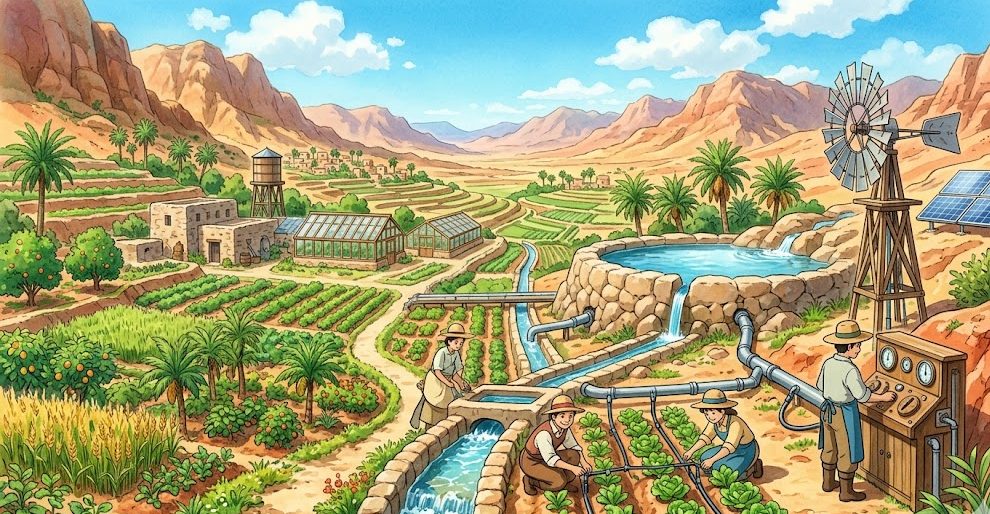
Global agriculture is facing a critical bottleneck. As climate patterns shift, drylands and hyper-arid regions now encompass over 41% of the Earth’s land surface, playing home to more than 2.5 billion people who rely directly on these ecosystems for food security (Lal, 2025). With traditional arable land shrinking and groundwater tables depleting at alarming rates, conventional farming methods are proving completely unsustainable in these fragile environments.
To cultivate crops where water is scarce and solar radiation is intense, agriculturalists can no longer rely on traditional inputs. Transforming hyper-arid soils into high-yielding zones requires a systematic shift toward Arid Zone Agriculture. By deploying cutting-edge desert farming technologies, precision water recycling setups, and advanced soil matrix modifications, growers can successfully optimize crop yields while conserving every precious drop of water.
1. Navigating the Realities of Arid Soil Chemistry
Farming in desert or arid environments presents a unique set of harsh agronomic challenges that go far beyond a simple lack of rainfall. Understanding these underlying soil dynamics is critical before deploying structural or technological solutions:
[ High Evaporation Rates ] ──► Upward Capillary Water Movement ──► Surface Salt Accumulation
                                                                            │
[ Sub-Surface Necrosis ]  ◄── Root Osmotic Stress & Dehydration ◄───────────┘
High Salinity and Electrical Conductivity (EC)
Because evaporation rates in desert zones drastically exceed annual rainfall, water moves upward through the soil profile via capillary action. As this water evaporates at the surface, it leaves behind high concentrations of dissolved mineral salts (such as sodium chloride and calcium sulfate). This process elevates the soil’s Electrical Conductivity (EC), creating high osmotic pressure that makes it incredibly difficult for standard crop roots to pull moisture from the ground, eventually causing plant dehydration.
Extreme Structural Instability
Arid lands are predominantly sandy soils characterized by minimal clay fractions and virtually non-existent Soil Organic Matter (SOM)—frequently dropping below 0.5% (Lal, 2025). Lacking stable structural aggregates, these soils feature very low nutrient retention capacities (Low Cation Exchange Capacity) and exceptionally high water infiltration rates, causing applied fertilizers and water to leach deep below the root zone within minutes.
2. Advanced Desert Irrigation Frameworks
In desert cultivation, traditional flood or overhead sprinkler systems are highly inefficient, losing up to 60% of applied water directly to evaporation before it can touch a plant leaf. Maximizing hydro-efficiency requires precise root-zone delivery systems.
Subsurface Drip Irrigation (SDI) with Intelligent Fertigation
Subsurface drip irrigation represents the absolute gold standard for water-saving cultivation in hyper-arid zones. By burying specialized drip lines 20 to 50 cm beneath the surface, water is delivered directly to the root matrix. This keeps the desert surface dry, completely eliminating evaporation losses caused by high wind and solar radiation.
When coupled with automated fertigation systems, water-soluble macro and micronutrients are injected directly into the water stream in micro-doses, matching the crop’s precise daily growth stage and eliminating chemical runoff.
Automated Pulse Irrigation Systems
Rather than applying water in a single, prolonged irrigation cycle—which forces moisture past loose, sandy root zones—desert operators utilize pulse irrigation. This technique applies water in short, high-frequency bursts (e.g., 5 minutes of watering every hour). This creates a stable, consistent bulb of moisture right around the root zone, maximizing horizontal water movement while preventing deep vertical leaching.
3. High-Tech Structural Solutions for Hyper-Arid Climates
When outdoor environmental stress becomes too severe for crops to survive, modern desert farming relies on advanced controlled-environment agriculture (CEA) setups to manipulate the microclimate.
| Technology | Operational Mechanism | Arid Farming Benefit |
|---|---|---|
| Seawater Greenhouses | Uses abundant solar energy to evaporate pumped seawater along the front structure of the greenhouse. | Cools and humidifies the interior air to match optimal tropical growth zones, while condensing the remaining vapor into pure freshwater for crop irrigation. |
| Liquid Nanoclay (LNC) Treatment | Nanometer-thin layers of natural liquid clay are sprayed directly onto sandy soil particles. | Binds individual sand grains into a stable structure that retains water and nutrients like rich agricultural loam, reducing irrigation requirements by up to 50%. |
| Multi-Spectral Shading Nets | Specialized photo-selective covers that filter out destructive ultraviolet and infrared rays while allowing light waves optimized for photosynthesis to pass through. | Significantly reduces crop transpiration stress and lowers ambient leaf temperatures by up to 5°C to 8°C during peak desert heat. |
Export to Sheets
4. Upgrading Soil Hydro-Efficiency and Carbon Sequestration
Reengineering the physical composition of desert sand is crucial for creating a self-sustaining agricultural ecosystem. This is achieved by introducing stable amendments that permanently alter the soil matrix.
Biochar Integration
Biochar—a highly porous, carbon-rich charcoal created through the oxygen-deprived pyrolysis of agricultural waste—serves as a permanent structural upgrade for sandy desert soils. Its highly porous structure acts like a microscopic sponge, holding up to ten times its weight in water and providing a safe, permanent habitat for beneficial soil microbes to thrive. Because biochar is highly stable, it safely locks carbon away in the soil for centuries, building long-term soil organic carbon (SOC) levels (Lal, 2025).
Superabsorbent Hydrogels (SAPs)
When incorporated into the root zone during planting, eco-friendly potassium-based superabsorbent polymers expand dramatically upon contact with irrigation water. They capture and lock in moisture during the watering cycle and slowly release it back to the plant as the surrounding sand dries out, significantly extending the required window between irrigation events.
5. Tailoring the Crop Strategy: Selection and Agronomic Care
Technology alone cannot guarantee success in arid zone farming; you must select crop varieties naturally adapted to thrive under intense environmental stress.
The Halophyte and Xerophyte Framework: High-yield desert operations increasingly look toward cultivating valuable halophytes (salt-tolerant plants like Samphire or Quinoa) and xerophytes (drought-resistant species like Date Palms, Olives, Jojoba, and Aloe Vera). These species possess natural genetic mechanisms—such as deep taproots or specialized cellular vacuoles—that allow them to withstand high-salinity irrigation water and prolonged dry spells without sacrificing profitability.
Simultaneously, practitioners apply organic mulches (like date palm fronds or recycled crop residues) across any exposed sand surfaces. This practice lowers surface temperatures, halts capillary salt buildup, and provides a steady source of decaying organic matter to nourish the underlying biological ecosystem.
Conclusion
Arid zone agriculture is no longer an experimental niche; it is a vital frontier for global food production. By bridging the gap between advanced controlled-environment infrastructure, liquid nanoclay soil upgrades, and smart subsurface pulse irrigation, desert entrepreneurs can turn barren sand into highly productive, green agricultural assets. Investing in hydro-efficient desert tech maximizes water conservation, protects fragile ecosystems, and secures highly profitable crop yields in the face of escalating global warming.