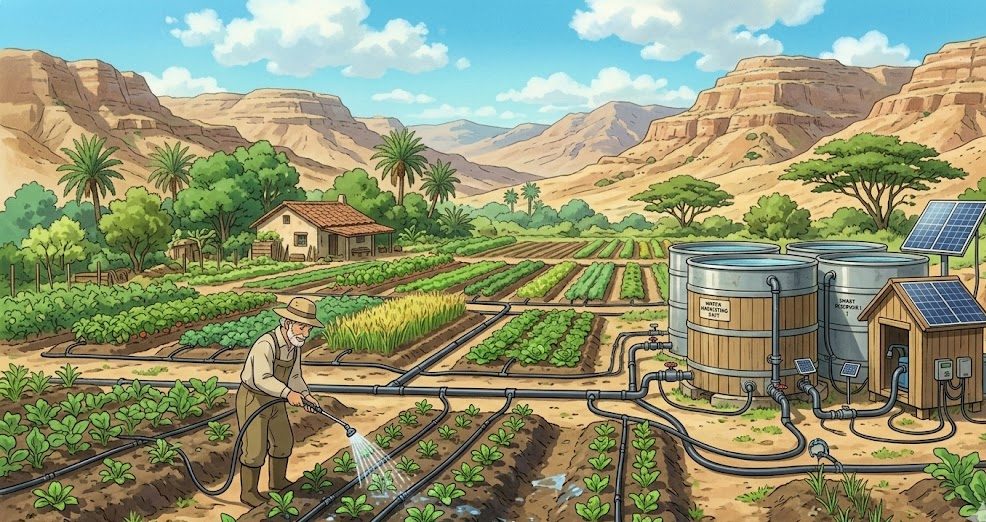
Did you know that agriculture is responsible for nearly 70% of all freshwater withdrawals worldwide? In arid regions, this figure often climbs even higher, yet as much as 50% of that water is lost to evaporation or runoff before it ever reaches a plant’s roots. For farmers operating in sun-drenched, water-scarce environments, the “Pain Point” is no longer just about high utility bills—it is about the literal survival of their land as aquifers deplete and droughts become the “new normal.”
The “Challenge” lies in outdated flood or overhead irrigation systems that treat water as an infinite resource. However, the “Main Concept” for a prosperous future is Smart Irrigation. By leveraging precision technology and ancient hydrological wisdom, farmers can produce higher yields using a fraction of the water.
This article serves as a comprehensive guide to mastering the art and science of water efficiency. You will learn the core mechanics of smart delivery systems, the economic impact of precision watering, and a step-by-step roadmap to upgrading your infrastructure for maximum resilience.
Understanding Smart Irrigation: Key Concepts and Importance
At its core, Smart Irrigation is the practice of delivering the right amount of water, at the exact right time, directly to the plant’s root zone. Unlike traditional methods that hydrate the entire field—including the weeds and the air—smart systems are targeted. This field has evolved from simple drip lines to sophisticated Internet of Things (IoT) networks that “talk” to the soil.
Think of smart irrigation like a modern IV drip in a hospital versus a bucket of water. A bucket splash is wasteful and provides a “shock” of resources that mostly runs off. An IV drip, however, provides a steady, measured flow of nutrients directly into the “veins” (roots) of the crop, keeping it at peak health without a single drop of waste.
Modern systems rely on Evapotranspiration (ET) controllers and soil moisture sensors. These devices monitor local weather data and ground conditions to pause watering when it’s windy or when the soil is already saturated. In arid regions, this prevents salinization—a common problem where over-watering causes salts to rise to the surface, eventually poisoning the soil. By keeping the surface dry and the roots hydrated, smart irrigation maintains the delicate chemical balance of desert earth.
Why It Matters: The Top Benefits of Smart Irrigation
Transitioning to smart water management isn’t just an environmental duty; it is a calculated business upgrade that impacts every facet of a farm’s performance.
- Drastic Reduction in Water Consumption: Switching from flood to Subsurface Drip Irrigation (SDI) can reduce water usage by 30% to 70%. This is vital for farmers facing strict water quotas or rising pumping costs.
- Significant Yield Increases: Precision watering prevents “plant stress.” When a plant doesn’t have to cycle between being “drowned” and “thirsty,” it can focus all its energy on growth and fruit production, leading to more uniform and higher-quality harvests.
- Suppression of Weeds and Disease: Most weeds require surface moisture to germinate. By delivering water underground or directly at the base of the crop, you “starve” the weeds in between rows. Additionally, keeping foliage dry prevents many fungal blights common in humid environments.
- Labor Efficiency: Automated smart systems eliminate the need for manual gate-opening or hose-moving. Farmers can monitor their entire irrigation network from a smartphone app, allowing them to focus on other high-value tasks.
Pro Fact: According to the USDA, precision irrigation can increase water-use efficiency to over 95%, compared to just 60% for traditional furrow irrigation.
How to Get Started: A Practical Guide for Beginners
Upgrading to a smart system may seem daunting, but it can be achieved through a modular, step-by-step transition.
1. Conduct a “Pressure and Flow” Audit
Before buying tech, you must understand your water source. Measure the pressure and flow rate of your well or reservoir. Smart systems, especially drip lines, require specific pressure regulators to prevent “blowouts” or uneven watering.
2. Install Subsurface Drip Irrigation (SDI)
In arid regions, surface drip lines can degrade under intense UV rays. Subsurface lines are buried 6 to 12 inches deep, protecting the plastic and delivering water exactly where the roots are. This almost entirely eliminates evaporation.
3. Deploy Soil Moisture Sensors
Place sensors at different depths (e.g., 6, 12, and 24 inches) throughout your field. This provides a “3D map” of how water moves through your specific soil type, telling you exactly when the root zone is actually dry.
4. Integrate a Smart Controller
Connect your valves to a controller that uses Real-Time Weather Data. If the forecast predicts a rain event or high winds (which increase evaporation), the controller will automatically adjust or skip the watering cycle.
5. Establish a “Fertigation” Program
Since you now have a direct line to the roots, you can use your irrigation system to deliver liquid nutrients. This “Fertigation” ensures that fertilizer is never wasted on non-crop areas, further reducing your input costs.
Beginner’s Tip: Always install a High-Quality Filtration System. In arid areas, water often contains fine sand or minerals that can clog precision emitters. A good filter is the best insurance policy for your smart hardware.
Overcoming Challenges and Looking into the Future
The primary hurdle for smart irrigation is the Initial Capital Investment. High-tech sensors and buried lines cost more upfront than a simple pump. However, most farmers see a “break-even” point within 2 to 3 seasons through savings in water, fertilizer, and labor. Another challenge is Rodent Damage to buried lines; this can be solved by using specific repellent-treated piping or deeper burial depths.
Future Trends: We are entering the era of AI-Driven Predictive Irrigation. In the near future, satellites will monitor crop “transpiration” from space, sending signals to farm computers to adjust watering before the plant even shows signs of thirst. We are also seeing a rise in Solar-Powered Desalination, allowing farmers to use brackish groundwater for irrigation without the high energy costs usually associated with salt removal.
Conclusion
Smart irrigation is the bridge between the “dust bowls” of the past and the sustainable oases of the future. By shifting from a mindset of “more is better” to “precise is profitable,” farmers in arid regions can secure their livelihoods against a changing climate.
The core message is simple: Value every drop. Whether you start with a single moisture sensor or a fully automated IoT network, the move toward precision is the most important investment you can make for your land’s legacy.
Would you like me to help you calculate the estimated “Return on Investment” (ROI) for a drip irrigation system based on your current water costs and crop type?
FAQs
Q1: Will smart irrigation work with salty (brackish) water? Yes, but it requires careful management. Smart drip systems can actually help manage salinity by keeping the root zone consistently moist, which prevents salts from concentrating. However, you must use specialized “self-flushing” emitters to prevent mineral buildup.
Q2: How do I power these sensors in remote desert areas? Most modern smart irrigation sensors and controllers are solar-powered and use long-range radio (LoRaWAN) or cellular data to transmit info, making them perfect for remote locations without electrical grids.
Q3: Is smart irrigation only for large-scale industrial farms? Not at all. There are many affordable, “plug-and-play” smart kits designed for small-scale organic farms and even home gardens that offer the same water-saving benefits.
Q4: How long do subsurface drip lines last? When buried and maintained with proper filtration and occasional flushing, subsurface drip lines can last 12 to 20 years, as they are protected from the sun’s UV rays and mechanical damage from farm equipment.