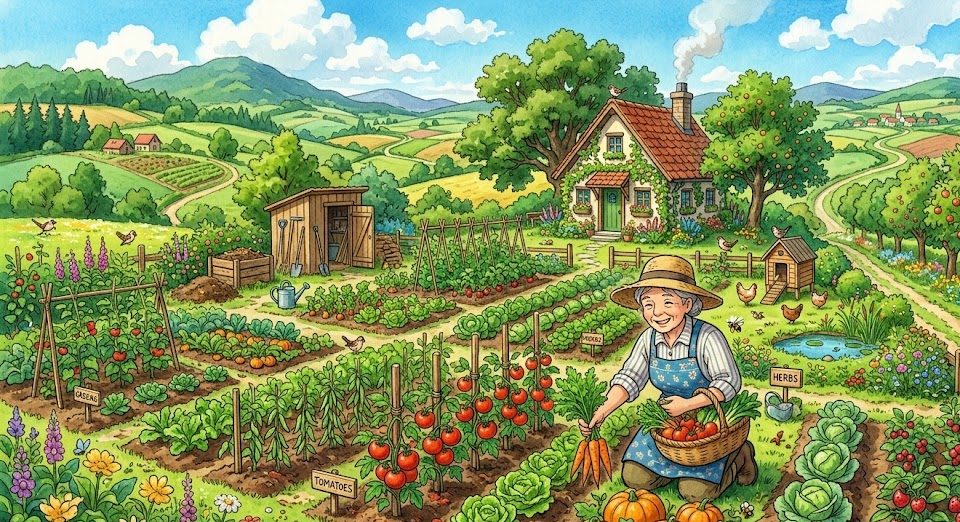
Can you believe that a quarter-acre of land—roughly the size of two basketball courts—can generate over $40,000 in annual revenue? While traditional industrial farmers often struggle to break even on thousands of acres, a new wave of “agricultural entrepreneurs” is proving that bigger isn’t always better. For many aspiring growers, the “Pain Point” is the astronomical cost of land and heavy machinery, which creates a barrier to entry that feels impossible to climb.
The “Challenge” lies in our outdated perception that farming requires vast plains and multi-million dollar tractors. However, the “Main Concept” for modern success is Micro Farming. This high-intensity, small-scale approach focuses on “value per square foot” rather than “yield per acre.” By growing high-demand, niche crops and selling directly to the consumer, you can transform a backyard or a small rural plot into a high-margin business.
In this guide, you will learn the fundamental mechanics of high-density production, the economic strategies that make small plots profitable, and a practical, step-by-step roadmap to launch your own micro-farm. Whether you have a suburban lot or a small family patch, this thesis will show you how to turn dirt into a dependable income stream.
Understanding Micro Farming: Key Concepts and Importance
Micro farming is the practice of intensive cultivation on small plots of land, typically ranging from a tenth of an acre to five acres. Unlike industrial agriculture, which relies on “economies of scale” (selling massive amounts of low-value crops like corn or soy), micro farming thrives on “economies of intensity.” It is a return to localized, high-quality food systems that prioritize soil health and biological efficiency over chemical inputs.
To understand the technical side, think of a micro-farm like a high-end boutique rather than a massive warehouse. A warehouse moves thousands of cheap items with very low profit margins. A boutique, however, sells a few specialized, high-quality items at a premium price. In micro farming, we don’t grow “commodity” crops; we grow “specialty” crops like microgreens, gourmet mushrooms, or heirloom cherry tomatoes.
The importance of micro farming has surged in 2026 as consumers increasingly demand transparency, freshness, and local sourcing. By utilizing techniques like Vertical Layering (growing up, not just out) and Succession Planting (planting a new crop the moment one is harvested), micro-farmers can achieve 10 to 15 harvest cycles per year on the same patch of dirt. This “stacking” of yields is what allows a tiny plot of land to outperform a massive conventional farm in terms of net profit.
Why It Matters: The Top Benefits of Micro Farming
Micro farming isn’t just about the money; it’s a lifestyle shift that offers significant economic, environmental, and personal rewards.
- Low Capital Entry: You don’t need a half-million-dollar combine. Most micro-farms can be started with simple hand tools, a walk-behind tractor (like a BCS), and a basic irrigation setup, making it accessible to almost anyone with a backyard.
- Direct-to-Consumer Margins: By cutting out the “middleman” (wholesalers and grocery chains), micro-farmers keep 100% of the retail price. Selling at farmers’ markets or through a CSA (Community Supported Agriculture) model doubles or triples your profit per pound.
- High Water and Space Efficiency: Because you are managing a smaller area, you can use precision drip irrigation and intensive mulching. Micro-farms often use 80% less water than conventional farms while producing more food per square inch.
- Environmental Regeneration: Micro-farms are almost always organic or “regenerative” by necessity. By building Soil Organic Matter (SOM) through composting, you are sequestering carbon and providing a sanctuary for local pollinators.
Pro Fact: According to the Market Gardener institute, well-managed micro-farms can generate a profit margin of 40-60%, whereas large-scale industrial farms often operate on margins as slim as 3-5%.
How to Get Started: A Practical Guide for Beginners
Launching a profitable micro-farm requires a shift from “hobbyist gardener” to “business operator.” Follow this 5-step plan to ensure your land pays for itself.
1. Market Research: Find the “Gap”
Don’t grow what you like to eat; grow what the market wants to buy. Visit local restaurants and farmers’ markets. Are they missing high-quality salad mixes? Gourmet radishes? Edible flowers? Identify a high-value niche that is currently underserved in your area.
3. Focus on “High-Turnover” Crops
For a small plot to be profitable, the “Days to Maturity” (DTM) must be low. Focus on crops like:
- Microgreens: 7–14 days (Can be grown indoors or in racks).
- Salad Greens/Arugula: 30–40 days.
- Radishes/Baby Carrots: 25–50 days.
- Gourmet Mushrooms: 2–4 weeks.
3. Master the “Bio-Intensive” Bed System
Create permanent raised beds (usually 30 inches wide). This allows you to manage the soil without ever stepping on it, preventing compaction. Use thick compost mulching to suppress weeds and provide a constant slow-release fertilizer.
4. Invest in “Small-Scale” Infrastructure
You need three core tools to start:
- A High-Quality Nursery: A small greenhouse or “hoop house” to start seeds early.
- Precision Seeder: A tool like the Jang Seeder to ensure perfect spacing and zero wasted seed.
- Cold Storage: A simple “CoolBot” setup to keep your harvest crisp until market day.
5. Build Your “Brand” and Sales Channel
In micro farming, you are the face of the business. Start a CSA program where neighbors pay upfront for a weekly box of produce. This provides you with working capital at the beginning of the season when you need it most.
Beginner’s Tip: Avoid “Crop Complexity.” In your first year, master just 3 to 5 crops. It is better to be the “Radish King” of your town than to have 20 failing varieties of exotic vegetables you don’t know how to harvest.
Overcoming Challenges and Looking into the Future
The biggest hurdle for micro-farmers is Labor Efficiency. Since you aren’t using big tractors, you are doing the work by hand. To solve this, you must “lean out” your processes—organizing your wash-and-pack station so that every movement is minimized. Another challenge is Zoning and Regulations; always check local bylaws before converting a residential backyard into a commercial farm.
Future Trends: We are seeing a massive rise in Agri-Tech for Smallholders. Innovations like solar-powered weed-zapping robots and smartphone-monitored soil sensors are making micro-farms more productive than ever. Additionally, the “Farm-to-Table” movement is evolving into “Farm-to-Doorstep,” where micro-farmers use apps to deliver ultra-fresh produce directly to local subscribers within hours of harvest.
Conclusion
Micro farming proves that you don’t need a massive inheritance or a huge land grab to be a successful farmer. By focusing on high-value crops, intensive soil management, and direct marketing, you can turn even a small backyard into a profitable engine of growth.
The core message is simple: Small is powerful. Every square foot of land is an opportunity for income and independence. Start where you are, use what you have, and grow your business one bed at a time.
Would you like me to create a “Sample Crop Rotation Calendar” for a 1,000-square-foot plot based on your local climate?
FAQs
Q1: How much land do I actually need to make a living? While it depends on the crop, many professional micro-farmers earn a full-time income on half an acre to one acre. If you specialize in ultra-high-value crops like microgreens or mushrooms, you can even do it in a converted garage or basement.
Q2: Is micro farming physically demanding? Yes, but it is “smart” work rather than “brute” work. Because the scale is small, you aren’t lifting massive weights; you are doing repetitive tasks like seeding, weeding, and harvesting. Proper ergonomic tools can significantly reduce physical strain.
Q3: Can I micro-farm while keeping my 9-to-5 job? Absolutely. Many people start as “Side-Hustle Farmers,” spending 10–15 hours a week on their plot. As the revenue grows and the systems become automated, they eventually transition to full-time.
Q4: What is the most profitable micro-farm crop? Currently, Microgreens often hold the title for highest ROI because of their 10-day growth cycle and high price per pound ($20–$40). However, Gourmet Mushrooms and Quick-Rotation Salad Mixes are also top contenders for small-space profitability.