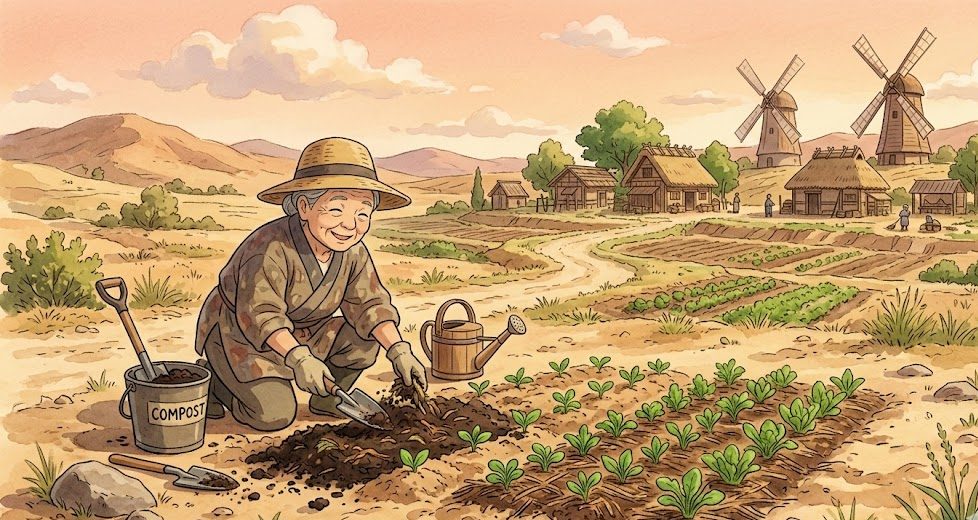
Did you know that it takes nature approximately 500 years to build just one inch of topsoil, yet we are currently losing it at a rate nearly 10 times faster than it can be replaced? In arid and desert regions, this crisis is even more pronounced. For farmers and landowners in these zones, the “Pain Point” is a heartbreaking cycle: the soil is so sandy and depleted that it cannot hold water, and without water, life cannot return to the soil to build fertility. It feels like trying to grow a garden in a pile of crushed glass.
The “Challenge” is that traditional chemical-heavy farming often backfires in the desert, leading to toxic salt buildup and further sterilization of the land. However, the “Main Concept” for a breakthrough is Biological Soil Regeneration. Instead of treating soil as a lifeless substrate, we must treat it as a living organism that needs to be “fed” and “sheltered” from the sun.
In this article, we will explore the fundamental science of arid-land fertility. You will learn the specific techniques to turn “dirt” into “living soil,” the economic benefits of low-input restoration, and a practical, 5-step roadmap to revitalize your land even in the harshest dry climates.
Understanding Soil Fertility in Arid Zones: Key Concepts and Importance
To improve fertility in dry areas, we must understand the “Soil Food Web.” In temperate forests, soil stays fertile because falling leaves create a natural mulch that feeds microbes. In the desert, that cycle is broken. High UV radiation and heat literally “bake” the organic matter out of the ground, leaving behind nothing but mineral sand.
Think of desert soil like a sieve. No matter how much water or liquid fertilizer you pour in, it runs straight through because there is no “glue” to hold it. That glue is Organic Matter (OM). In technical terms, we are trying to increase the Cation Exchange Capacity (CEC)—the soil’s ability to hold onto nutrients so they aren’t washed away.
Shutterstock
Modern soil restoration in drylands focuses on “Bio-Priming.” We use specialized amendments like Biochar and Mycorrhizal Fungi to create a microscopic infrastructure. The fungi act as an extension of plant roots, reaching into tiny crevices for water, while the biochar acts as a permanent “reef” for microbes to live in. By shifting our focus from chemical NPK (Nitrogen, Phosphorus, Potassium) to biological life, we create a self-sustaining system that resists the heat.
Why It Matters: The Top Benefits of Soil Regeneration
Investing in soil fertility in dry areas yields returns that go far beyond just “greener plants.” It is a fundamental shift in the resilience of your agricultural operation.
- Massive Water Retention: Every 1% increase in soil organic matter allows the soil to hold an additional 20,000 gallons of water per acre. This reduces your irrigation costs and protects crops during heatwaves.
- Salt Mitigation: Healthy, fertile soil with high carbon content helps “buffer” against salinity. It allows salts to be leached deeper into the ground rather than rising to the surface and “burning” your crops.
- Carbon Sequestration: Desert soils are massive potential carbon sinks. By building soil fertility, you are actively pulling CO2 out of the atmosphere, which may soon allow farmers to earn carbon credits.
- Lower Input Costs: Once the biological “engine” of your soil is running, you no longer need to spend thousands on synthetic fertilizers. The microbes and fungi do the work of unlocking nutrients for you.
Pro Fact: According to the UN Convention to Combat Desertification, restoring degraded land can generate an estimated $1.4 trillion in economic returns annually through increased food security and ecosystem services.
How to Get Started: A Practical Guide for Beginners
Transforming desert soil requires a strategic, layered approach. Follow this 5-step plan to start your fertility journey.
1. Apply “Biochar” as a Permanent Base
Biochar is charcoal made from agricultural waste. Unlike compost, which eventually disappears, biochar stays in the soil for hundreds of years. It acts like a microscopic sponge, holding water and providing a home for beneficial bacteria.
2. Introduce “Green Manure” Cover Crops
Never leave your soil bare. Plant drought-tolerant nitrogen-fixers like Cowpeas, Sunn Hemp, or Clover. These plants pull nitrogen from the air and “pump” it into the soil through their roots. When they die, they leave behind precious organic matter.
3. Use the “Mulch-and-Drop” Method
In dry areas, your soil needs a “skin.” Cover the ground with at least 4-6 inches of organic mulch (straw, wood chips, or dried grass). This keeps soil temperatures up to 10°C cooler, allowing soil life to survive during the peak of summer.
4. Inoculate with Mycorrhizal Fungi
You can buy powdered fungi spores to “coat” your seeds before planting. These fungi create a symbiotic network with the roots, essentially “trading” minerals for plant sugars. This is the secret to plants surviving in “poor” desert soil.
5. Transition to “No-Till” Management
Every time you plow desert soil, you break the fungal networks and release moisture into the air. Switch to No-Till or “Minimum-Till” methods. This keeps the “soil architecture” intact and allows organic matter to build up in layers.
Beginner’s Tip: Avoid using high-salt chemical fertilizers like Urea or Potassium Chloride in dry areas. These can kill the very soil microbes you are trying to cultivate and lead to “soil crusting” that prevents water from soaking in.
Overcoming Challenges and Looking into the Future
The biggest hurdle in dryland restoration is Initial Moisture. It takes a small amount of water to start the biological engine. Many farmers solve this by using Zai Pits (small basins that catch runoff) or Olla irrigation (clay pots) to establish the first generation of cover crops.
Looking into the future, Precision Soil Monitoring is a game-changer. New sensors can now measure soil microbial activity in real-time, allowing farmers to apply “bio-stimulants” exactly where they are needed. We are also seeing the rise of Agrivoltaics, where solar panels are placed above crops. The shade from the panels reduces soil evaporation by 20-30%, creating a perfect microclimate for building soil fertility.
Conclusion
Improving soil fertility in the desert is not a quick fix; it is a long-term investment in the “biological capital” of your land. By focusing on Organic Matter, Fungal Networks, and Soil Sheltering, you can transform a barren landscape into a productive ecosystem.
The core message is simple: Don’t just feed the plant; feed the soil. When you build the soil, the soil will take care of the plants, the water, and your future.
Would you like me to help you create a custom compost recipe using the specific organic waste materials available in your local region?
FAQs
Q1: How long does it take to see results in desert soil? While building deep topsoil takes centuries, you can see a massive improvement in water retention and plant health in as little as 1 to 2 growing seasons by using biochar and thick mulching.
Q2: Can I use greywater (waste water from sinks/showers) to build fertility? Yes, but be careful! Ensure you use “biocompatible” soaps that are low in boron and salts. Greywater is an excellent resource for establishing “fertility islands” (clusters of trees and shrubs) in dry areas.
Q3: Is biochar expensive to make? Biochar can be made for almost zero cost using a simple “Top-Lit Up-Draft” (TLUD) kiln and any dry agricultural waste like corn stalks, coconut shells, or wood trimmings.
Q4: Why is chemical fertilizer bad for dry soil? In wet areas, rain washes away excess salts. In dry areas, the salts from chemical fertilizers stay in the topsoil, eventually reaching levels that are toxic to plants and beneficial soil microbes. Biological fertilizers (compost, manure, bio-slurry) are much safer.