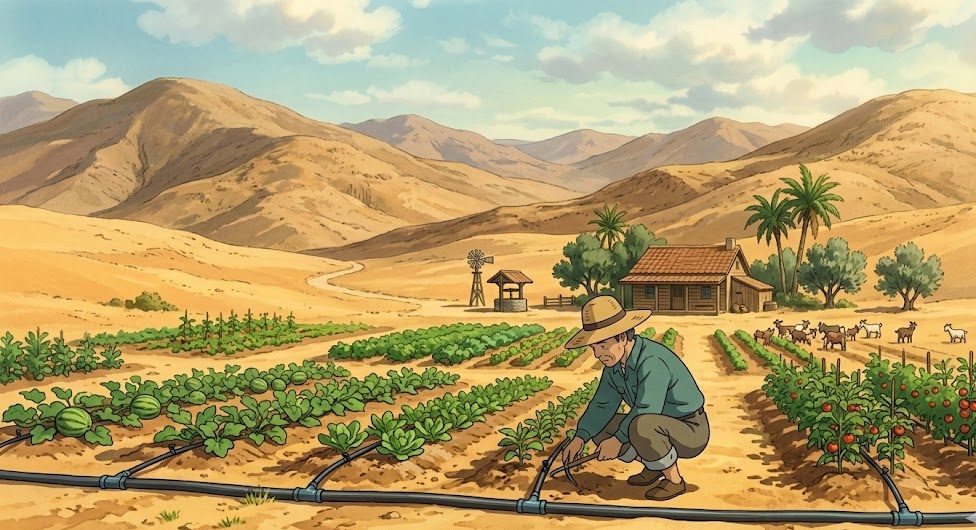
What if you could grow a thriving garden in a place where it only rains a few inches a year? It sounds impossible, but civilizations have been doing exactly that for millennia. Today, with water scarcity affecting nearly one-third of the global population, the techniques used to green the desert are no longer just “survival skills”—they are the future of global food security.
The “Challenge” we face is a warming planet where traditional irrigation is becoming prohibitively expensive and environmentally destructive. The “Pain Point” for many farmers in arid regions is the heartbreaking sight of crops withering under a relentless sun, despite pouring thousands of gallons of water into the sand.
The “Main Concept” that solves this is Desert Farming Efficiency—a blend of ancient wisdom and modern technology designed to trap every drop of moisture and protect plants from thermal stress. In this article, you will discover the foundational methods of arid-land agriculture, the economic benefits of water-smart farming, and a practical roadmap to help you transform dry earth into a high-yielding asset.
Understanding Desert Farming: Key Concepts and Importance
Desert farming isn’t about fighting the sun; it’s about mastering the water cycle at a hyper-local level. In a temperate climate, you can afford to be somewhat wasteful with water because the atmosphere is humid. In the desert, the air is a “thirsty” sponge that pulls moisture out of the soil and plants through a process called evapotranspiration.
Think of desert farming like a financial budget. In a high-income area (temperate), you might not notice a few extra expenses. In a low-income area (the desert), every penny—or in this case, every drop of water—must be tracked and “invested” directly where it provides the most return.
Historically, techniques like the Nabataean terraces or Qanat systems (underground tunnels) allowed ancient people to move water miles across the desert without losing a drop to evaporation. Today, we use “Precision Agriculture” to achieve the same result. By focusing on the root zone rather than the whole field, we can grow more food with 80% less water than traditional flood irrigation.
Why It Matters: The Top Benefits of Desert Farming Techniques
Adopting specialized desert techniques does more than just save water; it changes the entire economic and ecological profile of a farm.
- Drastic Water Savings: Utilizing Sub-Surface Drip Irrigation (SDI) or Olla irrigation (clay pots) delivers water directly to the roots. This prevents up to 90% of the water loss associated with evaporation.
- Superior Yield Quality: Desert regions offer intense, consistent sunlight. When water is managed correctly, this high solar radiation leads to faster photosynthesis and higher sugar content in fruits, creating premium-quality produce that commands higher market prices.
- Reduced Weed and Pest Pressure: Most weeds need surface moisture to germinate. By keeping the surface of the desert soil dry and only watering underground, you “starve” the weeds while the crop thrives. Additionally, dry air naturally prevents many fungal diseases.
- Climate Change Mitigation: Techniques like Biochar application and Agrivoltaics (solar panels over crops) help sequester carbon in the soil and produce renewable energy, making the farm a net-positive for the environment.
Pro Fact: According to recent agricultural data, switching from overhead sprinklers to sub-surface drip irrigation in arid zones can increase water-use efficiency by over 40% while simultaneously increasing crop yields.
How to Get Started: A Practical Guide for Beginners
If you are ready to start growing in a dry climate, follow this 5-step implementation plan designed to minimize risk and maximize water retention.
1. Build a “Windbreak” First
The wind is the desert’s greatest thief. Hot, dry winds significantly increase the rate at which plants lose moisture. Plant a perimeter of drought-tolerant trees or install fencing to create a microclimate that keeps the air still and slightly more humid.
2. Implement Deep Mulching
Never leave desert soil naked. Cover your growing area with 4-6 inches of organic mulch (straw, wood chips, or dried leaves). This acts as an insulation blanket, keeping the soil temperatures up to 10°C cooler and preventing the sun from baking the moisture out of the ground.
3. Install Olla or Drip Systems
Avoid sprinklers at all costs. For small plots, use Ollas (unglazed clay pots buried in the ground). For larger scales, install a Sub-Surface Drip system. These tools ensure that water goes to the roots, not the sky.
4. Optimize Soil “Sponge-iness”
Desert sand drains too fast. Mix in Biochar or high-quality compost. These materials act like tiny internal reservoirs that hold onto water, giving the plant a “buffer” during the hottest part of the day.
5. Selection of “Heat-Seeker” Varieties
Start with crops that love the desert. Focus on Date Palms, Pomegranates, Figs, Millet, or Tepary Beans. These species have “genetic memory” that allows them to thrive in heat that would kill a standard tomato plant.
Beginner’s Tip: Always water at dusk or night. This gives the plant a full 8-10 hours to absorb moisture into its cells before the sun comes up to start the evaporation process again.
Overcoming Challenges and Looking into the Future
The primary hurdle in desert farming is Soil Salinity. When water evaporates from the surface, it leaves behind salts. Over time, this can make the land toxic to plants. The solution is “Deep Watering”—occasionally applying enough water to flush the salts down below the root zone—and using salt-tolerant crops like Quinoa or Barley.
Looking forward, the trend of Agrivoltaics is the most exciting innovation. By placing solar panels 10 feet above the crops, farmers provide much-needed shade to the plants (reducing water needs by 20%) while the plants’ transpiration cools the solar panels, making them more efficient. It is a win-win for energy and food.
Conclusion
Desert farming is a masterclass in efficiency. By shifting from a mindset of “unlimited resources” to one of “precise investment,” we can grow bountiful harvests in the most unlikely places. Whether you are using ancient clay pot irrigation or modern AI-driven drip systems, the goal is the same: to value every drop.
The future of agriculture isn’t in finding more water; it’s in learning how to use the water we have with wisdom and grace.
Would you like me to create a specific list of the best “salt-tolerant” crops for your specific desert region?
FAQs
Q1: Is desert farming more expensive than traditional farming? Initially, the infrastructure (drip lines, solar pumps, or windbreaks) can be more expensive. However, because you save so much on water costs and experience fewer pest/disease issues, the long-term ROI is often higher than in temperate regions.
Q2: Can I grow leafy greens in the desert? Yes, but they require “Climate Modification.” You will need 30-50% shade cloth and a reliable sub-surface watering system to keep them from bolting (going to seed) too quickly in the heat.
Q3: What is “Olla” irrigation? It is an ancient technique using unglazed terracotta pots. You bury the pot, fill it with water, and the porous clay slowly “sweats” water into the soil based on the plant’s needs. It is nearly 100% efficient.
Q4: Does the high heat kill the soil microbes? Extreme heat can sterilize the top inch of soil. This is why mulching is mandatory. A thick layer of mulch keeps the soil cool enough for the beneficial bacteria and fungi to stay alive and support your plants.