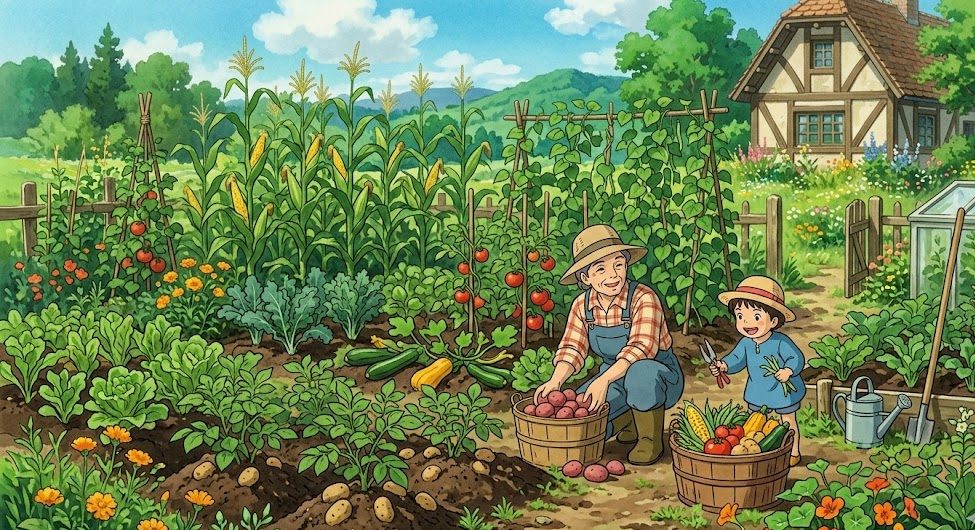
If the global food supply chain were disrupted tomorrow, how long could your family thrive on what you grow in your own backyard? For most, the answer is startling: less than a week. In an era of rising inflation and unpredictable environmental shifts, the “Pain Point” for many is a total dependency on a fragile, industrial food system. We have traded our food security for convenience, leaving us vulnerable to price hikes and empty supermarket shelves.
The “Challenge” of self-sufficient farming is not just growing food, but growing the right food—crops that provide enough calories, protein, and nutrients to sustain a human life year-round. The “Main Concept” for success is Caloric Density and Storage Capability. True self-sufficiency isn’t found in a salad bowl; it is found in the starches and proteins that can be harvested and kept for the winter.
In this comprehensive guide, you will learn the pillars of self-reliant agriculture. We will explore the “Life-Raft” crops every farmer needs, the biological fundamentals of high-yield small-scale plots, and a practical, step-by-step roadmap to transform your land into a productive, closed-loop ecosystem.
Understanding Self-Sufficient Farming: Key Concepts and Importance
Self-sufficient farming is the strategic cultivation of land to meet the majority of one’s nutritional needs without external inputs. Unlike recreational gardening, which often prioritizes variety and aesthetics, self-sufficient farming focuses on biomass and caloric output. It is the difference between a “hobby” and a “homestead.”
Think of your self-sufficient farm like a biological battery. During the peak of summer, you are capturing solar energy and storing it in the form of complex carbohydrates and fats. When winter arrives or the market fails, you “discharge” that battery by consuming your stored harvest.
Historically, this was the standard way of life for 90% of humanity. Today, it has regained modern relevance through the Permaculture movement. Permaculture teaches us to view the farm as a cycle: crop waste feeds the compost, compost feeds the soil, and the soil feeds the plants. By mastering this cycle, you eliminate the need for expensive synthetic fertilizers, making your food production truly independent of the global economy.
Why It Matters: The Top Benefits of Self-Sufficient Farming
Transitioning toward self-reliance offers a profound return on investment that impacts your health, your finances, and your peace of mind.
- Financial Sovereignty: By producing your own staples—potatoes, beans, and grains—you effectively “opt-out” of food inflation. In a world where grocery prices can jump 10% in a month, your backyard remains a stable source of wealth.
- Nutritional Integrity: Industrial crops are often bred for “shelf-life” and “transportability,” not nutrition. When you grow your own, you can choose Heirloom varieties that are significantly higher in vitamins, minerals, and antioxidants.
- Environmental Restoration: Small-scale self-sufficient farms act as carbon sinks. By using “no-till” methods and organic mulching, you are pulling carbon out of the atmosphere and locking it into the soil, creating a localized cooling effect.
- Psychological Resilience: There is a unique “security” in knowing that regardless of what happens in the news, you have 500 pounds of potatoes and 200 pounds of beans stored in your cellar. It builds a grounded confidence that no supermarket can provide.
Pro Fact: According to agricultural density studies, an average person can meet their basic caloric needs on as little as 4,000 to 5,000 square feet of land, provided the crop selection is optimized for starch and protein rather than water-heavy vegetables.
How to Get Started: A Practical Guide for Beginners
Starting your journey toward self-sufficiency requires a shift in mindset. You must stop thinking in “servings” and start thinking in “calories.” Follow this 5-step implementation plan.
1. Secure Your “Life-Raft” Staples
Focus your space on the Survival Core:
- Starches: Potatoes, Sweet Potatoes, and Corn (High calories per square foot).
- Proteins: Dry Beans, Peas, and Lentils (Soil-fixing and easy to store).
- Fats: Sunflowers or Nut trees (Essential for brain health).
- Vitamins: Winter Squash, Cabbage, and Carrots (Long shelf-life).
2. Implement the “Three Sisters” Method
Don’t waste space on monocultures. Use the traditional Three Sisters technique: plant corn to provide a pole for beans, beans to fix nitrogen in the soil, and squash to act as a living mulch that prevents weeds and retains moisture.
3. Master Soil “Bio-Priming”
Before you plant, you must build the “sponge.” Use Biochar and Compost to create a soil structure that holds water. In a self-sufficient model, you shouldn’t buy fertilizer. Instead, use “compost tea” and “green manure” (cover crops) to feed the earth.
4. Invest in Preservation Infrastructure
Farming is only half the battle. You must be able to store what you grow. Invest in Canning supplies, a Dehydrator, and a Cool Root Cellar. If you can’t store a crop for at least six months, it isn’t a true self-sufficiency crop.
5. Establish an “Open-Pollinated” Seed Bank
Never rely on buying seeds every year. Grow Open-Pollinated (OP) varieties, which allow you to save seeds that will grow “true to type” the following year. This ensures your farm is a permanent, self-renewing resource.
Beginner’s Tip: Avoid the “Variety Trap.” It is tempting to grow 20 types of exotic peppers, but a self-sufficient farmer focuses on mastering the top 5 high-calorie crops first. Once your staples are secure, then you can add the “flavor” crops.
Overcoming Challenges and Looking into the Future
The biggest hurdle for the self-sufficient farmer is Labor and Pest Management. Without chemical sprays, you must rely on Integrated Pest Management (IPM)—using predatory insects and trap crops to protect your food. Regarding labor, the trend toward “No-Till” gardening is a game-changer. By layering organic matter rather than digging, you preserve soil life and reduce your workload by nearly 70%.
Looking into the future, Agri-Tech for Smallholders is booming. We are seeing the rise of low-cost, solar-powered automated irrigation and “Smart Seed” databases that help farmers find the best heirloom varieties for their specific micro-climate. The future of farming is “High-Tech/Low-Input,” where data helps us mimic nature more effectively.
Conclusion
Self-sufficient farming is the ultimate act of independence. It transforms you from a “consumer” into a “steward,” bridging the gap between vulnerability and security. By focusing on caloric staples, soil health, and seed saving, you build a legacy of resilience that can sustain your family for generations.
The core message is simple: Don’t wait for a crisis to build your ark. Start with one raised bed of potatoes or a small plot of beans today. Every calorie you grow yourself is a vote for your own freedom and a step toward a more sustainable world.
Would you like me to help you design a specific “Caloric Planting Map” based on the exact dimensions of your available land?
FAQs
Q1: Can I be self-sufficient on just one acre? Absolutely. One acre is more than enough to feed a family of four if you use intensive gardening techniques like Vertical Gardening and Succession Planting. Most families can meet their needs on even less.
Q2: Which crop provides the most calories for the least work? The Potato is the undisputed king of self-sufficiency. It is easy to grow, requires minimal tools to harvest, and provides a nearly complete nutritional profile when eaten with a small amount of fat or dairy.
Q3: How do I handle a lack of water during a drought? The secret is in the soil. By increasing your Soil Organic Matter (SOM) through heavy mulching and composting, your soil acts like a giant sponge, allowing you to grow crops with up to 50% less water than traditional methods.
Q4: Is it possible to grow all my own protein? Yes. A combination of Dry Beans, Peas, and high-protein grains like Quinoa or Amaranth can provide all the essential amino acids a human needs. If you have the space, adding chickens for eggs provides a highly efficient “protein loop” for the farm.