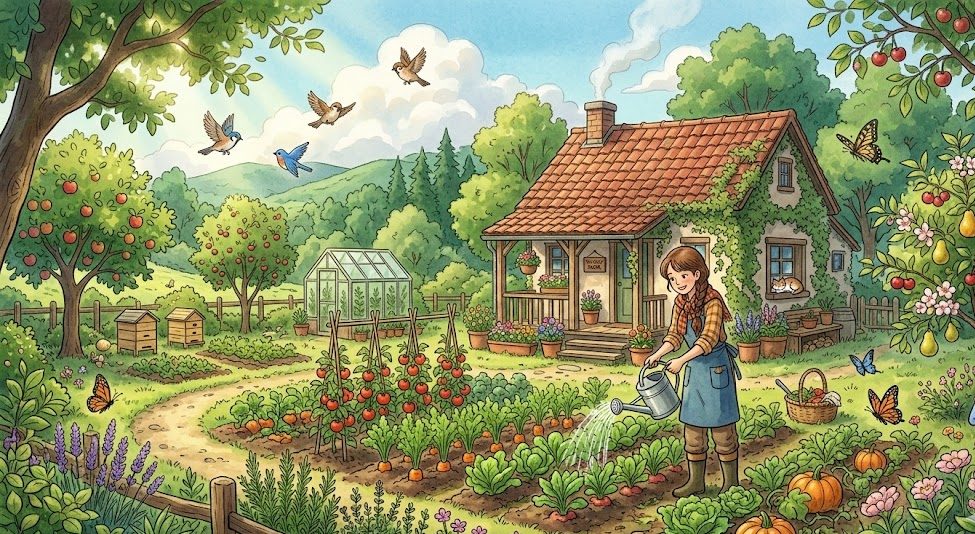
Did you know that the average global food supply chain requires nearly 10 units of fossil fuel energy to deliver just 1 unit of food energy to your plate? In an era defined by economic volatility and rising grocery costs, the “Pain Point” for most families is a total loss of control over their nutritional security. We have traded our self-reliance for a fragile “just-in-time” delivery system that prioritizes shelf-life over health and profit over planet.
The “Challenge” is that most people believe they need hundreds of rural acres and a massive tractor to grow their own food or earn an income. However, the “Main Concept” that is revolutionizing 2026 is Backyard Micro Farming. This high-intensity, small-scale approach focuses on “verticality” and “biological density” rather than vast acreage. It turns a standard lawn into a high-output production engine.
In this guide, you will learn the fundamental pillars of micro-scale agriculture. We will explore the mechanics of “closed-loop” systems, the undeniable economic benefits of urban production, and a practical 5-step roadmap to transform your backyard into a source of food, profit, and resilience.
Understanding Backyard Micro Farming: Key Concepts and Importance
Backyard micro farming is the practice of intensive cultivation on small residential plots, typically ranging from a tenth of an acre down to a few hundred square feet. Unlike traditional “hobby gardening,” micro farming is a disciplined system aimed at maximum output. Historically, this concept mirrors the “Victory Gardens” of the 1940s, but today it is enhanced by modern Agri-tech and Permaculture principles.
To understand the technical side, think of a micro-farm like a high-efficiency processor in a computer. A standard garden is like an old hard drive—it takes up space and moves slowly. A micro-farm, however, uses “multi-threading” (also known as Succession Planting) to run multiple operations at once. As soon as one crop is harvested, another is already in the ground.
By using Permanent Raised Beds, the micro-farmer never steps on the soil, preserving the “Soil Architecture” and the delicate fungal networks that feed the plants. This method allows you to grow up to 10 times the amount of produce per square foot compared to traditional row farming. It is a transition from “managing land” to “managing a living ecosystem.”
Why It Matters: The Top Benefits of Micro Farming
The move from consumer to micro-producer offers a radical return on investment that impacts your health, your wallet, and your community.
- Massive Financial Savings: By producing your own high-value staples (like organic greens, tomatoes, and berries), you can reduce your annual grocery expenses by $2,000 to $5,000 depending on the size of your plot.
- Hyper-Localized Nutrition: Industrial produce loses up to 50% of its vitamins within days of being harvested and shipped. Micro farming allows you to harvest and eat within minutes, ensuring peak nutritional density.
- Carbon Sequestration: Micro-farms are active carbon sinks. By using “no-till” methods and heavy composting, you are pulling CO2 from the air and locking it into the soil, creating a cooler micro-climate in your neighborhood.
- Secondary Income Stream: Even a tiny backyard can produce a surplus. Selling “boutique” items like gourmet mushrooms or microgreens to local restaurants can turn your backyard into a revenue-generating asset.
Pro Fact: According to recent urban agriculture studies, well-managed micro-farms can generate an average of $2.00 to $5.00 of gross revenue per square foot, making them more profitable per inch than most industrial corn fields.
How to Get Started: A Practical Guide for Beginners
Transforming your lawn into a farm requires a shift from “planting things” to “building a system.” Follow this 5-step implementation plan.
1. Sunlight and Water Mapping
Identify the “Micro-Climates” in your yard. Most caloric crops (like potatoes or corn) need 6-8 hours of direct sun, while greens can handle partial shade. Install a basic Drip Irrigation system early; consistency in moisture is the secret to high-density growth.
2. Standardize Your Bed Sizes
Don’t just dig holes. Build beds that are 30 inches wide. This is the professional micro-farming standard because it allows you to reach the center from either side without stepping on the soil. Keep pathways narrow to maximize your growing area.
3. The “Compost First” Rule
In micro farming, you don’t feed the plant; you feed the soil. Start a hot compost bin using a 3:1 ratio of “browns” (leaves/straw) to “greens” (kitchen scraps). Applying a 2-inch layer of compost annually eliminates the need for expensive, synthetic fertilizers.
4. Choose “Value-Dense” Crops
For small spaces, skip the low-value crops like field corn. Focus on High-Value/Low-Space items:
- Microgreens: (Harvested in 10 days, high price).
- Indeterminate Tomatoes: (Grown vertically on strings).
- Pole Beans: (Uses vertical space).
- Salad Mixes: (Multiple harvests from one planting).
5. Transition to “No-Till” Management
Never use a rototiller in a micro-farm. Tilling destroys the soil structure and releases moisture. Instead, use a Broadfork to aerate the ground and layer organic matter on top. This builds a “living sponge” that requires less water over time.
Beginner’s Tip: Start with just three raised beds. Many beginners fail because they over-plant and cannot keep up with the weeding. Master your first 100 square feet before expanding to the rest of the yard.
Overcoming Challenges and Looking into the Future
The primary hurdle for backyard farmers is Pest Pressure. Without chemical sprays, you must rely on Companion Planting—the art of planting flowers like Marigolds and Calendula to lure “beneficial insects” (like ladybugs) that eat the pests for you. Another challenge is Zoning; always check your local “Homeowners Association” (HOA) rules regarding vegetable gardens in front yards.
Future Trends: We are seeing a surge in “Smart Micro-Farming.” In 2026, low-cost sensors can now monitor soil moisture and nitrogen levels via your smartphone. Additionally, the rise of Agrivoltaics (placing solar panels over shade-tolerant crops) is allowing backyard farmers to harvest both food and electricity from the same 500 square feet.
Conclusion
Backyard micro farming is the ultimate act of modern rebellion. It replaces dependency with sovereignty and transforms a high-maintenance lawn into a low-input source of life. By focusing on Soil Architecture, Vertical Growth, and Succession Planting, you can provide your family with the highest quality food on earth while building a more resilient future.
The core message is simple: You do not need to leave the city to find the farm. Start with one bed, focus on your soil, and watch your backyard become the most productive part of your life.
Would you like me to create a “Planting Calendar” based on your specific hardiness zone to help you time your first harvest perfectly?
FAQs
Q1: How much time does a micro-farm take to maintain? Once the beds are established and the mulch is down, a standard backyard micro-farm (approx. 500-1000 sq ft) requires only 30–45 minutes of work per day. Most of this time is spent on harvesting and light weeding.
Q2: Can I grow enough to actually feed my family? While 100% self-sufficiency is difficult on a small lot, you can easily grow 100% of your fresh vegetables and a significant portion of your caloric staples (like potatoes and squash) on as little as 1,000 square feet.
Q3: What if I have bad soil (clay or sand)? This is the beauty of micro farming! Since you are building Raised Beds, you aren’t limited by your native soil. You can import high-quality organic soil and compost to start, and then build your own fertility over time through composting.
Q4: Is micro farming expensive to start? The initial cost for wood (for beds), soil, and seeds for a small backyard setup usually ranges between $300 and $800. However, the “payback period” is often less than one year when you factor in the savings on organic grocery bills.